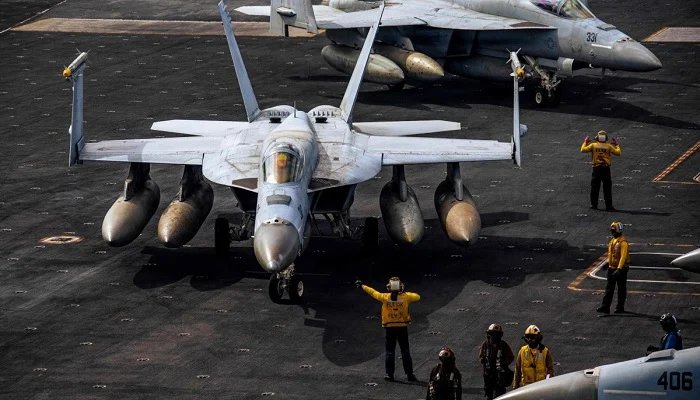
A photo shows F/A-18E Super Hornets on the flight deck of the USS Gerald R. Ford, dated March 15, 2026. — AFP
– President Trump states, “There will be a response” following an Iranian attack.
– Iran claims it launched missiles at U.S. bases in Jordan.
– Three individuals were killed during a U.S. strike on Larak Island.
Tensions flared Monday as President Donald Trump vowed to retaliate against Iran after a month of rising hostilities, shifting from economic sanctions to direct military exchanges. Iran responded by firing missiles at two U.S. military installations in Jordan, retaliating for a U.S. attack on its Larak Island, where Washington claimed to have hit Iranian missile launchers involved in mine-laying operations in the Strait of Hormuz.
This confrontation underscores how swiftly a conflict rooted in sanctions and economic pressure can escalate into military action. Although neither side appears intent on full-scale war, both have indicated readiness to respond to future assaults.
A Fox News reporter quoted Trump saying, “We’re going to hit them hard. There will be a response.” In the Oval Office, Trump added that the recent strikes don’t mean a return to all-out war, describing Iran as a “failed nation” with a severely weakened economy and military. He stated, “That doesn’t mean we won’t smack them. We’ll see what happens.”
When asked if nuclear weapons were off the table, Trump responded that there was “no reason” to consider using nukes, since Iran is already “totally defeated militarily.”
A senior Iranian official told Reuters that the missile exchanges, the first since late July, were a “limited and contained confrontation,” but warned Iran would retaliate harshly if attacked again.
Trump asserted that U.S. defenses intercepted all Iranian missiles capable of causing damage and claimed that new U.S. sanctions are significantly impacting Iran’s economy, according to Fox News. Earlier, Trump shared AI-generated videos of explosions at Iran’s main oil export terminal with the caption, “Kharg Island being blown to smithereens!!!” However, Iran dismissed the videos as “laughable,” clarifying that no such attack occurred. Vice President JD Vance commented that Trump was “sending a message” with his social media posts and noted his tendency to “switch it up.”
So far, the U.S. has avoided striking Iran’s major oil and gas infrastructure, fearing Iran’s retaliation against Gulf neighbors in response.
### Increasing Economic Pressure
Instead, the U.S. has intensified efforts to pressure Tehran and its trading partners through secondary sanctions targeting nations that buy Iranian oil. Treasury Secretary Scott Bessent said Iran is “lashing out” because these sanctions are hurting its economy. “They’re in shock over their economic decline,” he told reporters at the G20 finance ministers’ meeting. Bessent mentioned plans to introduce weekly secondary sanctions focusing initially on Iranian banks to accelerate pressure.
### U.S. Strikes on Iranian Targets
U.S. forces targeted two Iranian missile launchers on Larak Island Sunday after observing Islamic Revolutionary Guard Corps forces preparing to launch rockets and mines into the Strait of Hormuz. The attack resulted in three fatalities, including two Revolutionary Guards Navy members, according to Iran’s Tasnim news agency. Larak Island, close to the strategic port of Bandar Abbas, lies in the narrow strait that typically handles 20% of global oil and gas shipments but has been effectively closed since hostilities escalated.
The U.S. Central Command described the strike as a “limited, precise” operation targeting imminent threats, without providing further details. Iran’s state TV claimed a supertanker caught fire after being hit by mines; the U.S. military later denied that.
### Iran’s Position and Ongoing Conflict
President Trump paused his “Operation Epic Fury” bombing campaign in April with a ceasefire, and in June, both sides agreed to informal talks. However, the peace quickly unraveled, leading to renewed exchanges of fire in July.
In recent weeks, the U.S. has tried to cripple Iran economically through a blockade of ports, aiming to pressure Tehran into capitulating on its demands. Iran maintains that the Strait of Hormuz remains closed unless reopened under its own terms.
Iranian President Masoud Pezeshkian expressed willingness to negotiate, advising that continuing the war serves no one’s interests. “We believe that ongoing conflict benefits no one—neither us nor the region or humanity at large,” he told Indian Prime Minister Narendra Modi during a regional security meeting in Kyrgyzstan.
Despite setbacks, Trump’s objectives—dismantling Iran’s nuclear program, limiting its regional aggression, and enabling regime change—remain unmet.