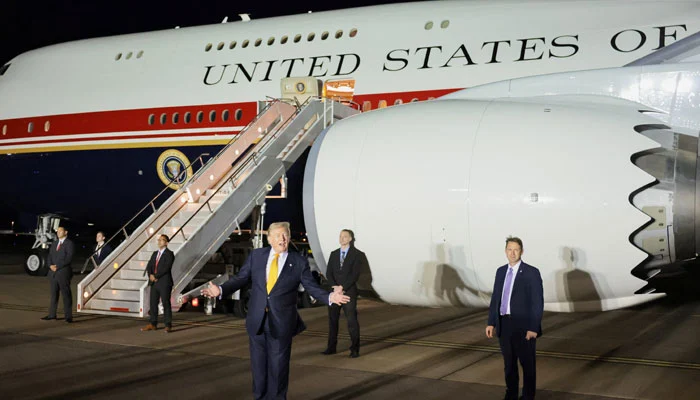
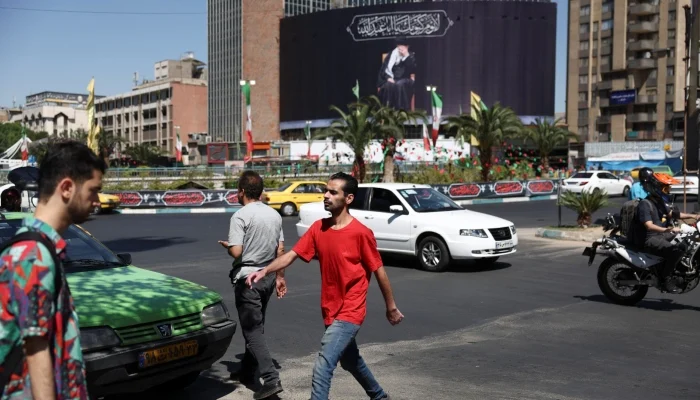
US President Donald Trump announced that talks with Iran will start on Monday after he decided to postpone any new “disastrous” strikes against the Islamic republic in favor of pursuing a diplomatic solution.
“Obviously, they don’t want to be attacked. They saw the buildup and understood the looming threat,” Trump told journalists Sunday from aboard Air Force One.
“Our current approach is to engage in negotiations. The discussions kick off tomorrow afternoon,” he added, though he didn’t specify where the talks would take place or who would be involved.
On Saturday, Trump backed away from threats of a massive military strike against Iran, which he claimed would be the largest since World War II, stating that “a deal’s perimeter” was established.
He explained on Sunday that Iran, along with U.S. allies Saudi Arabia, the UAE, and Qatar, had asked for a delay on the strikes.
“When our allies requested to hold off, I had to consider it. Their requests suggest a potential deal,” Trump said.
He added that there were agreements on the Strait of Hormuz and possibly on Iran’s nuclear program, which could lead to its denuclearization.
Reiterating that the scale of the planned attack would have been “the biggest since WWII,” Trump noted it would have taken years to recover if possible at all, emphasizing the destruction it would cause.
Saudi Crown Prince Mohammed bin Salman also urged against launching the strikes, warning of unforeseen consequences.
“Could flooding and chaos spill into their country? Many bad outcomes could arise,” Trump warned.
The conflict started on February 28 when the U.S. and Israel launched surprise strikes against Iran, but intermittent diplomacy has resulted in periods of reduced tensions. A previous ceasefire agreement involving the reopening of the Strait of Hormuz—an essential route for global energy supplies—collapsed, and Iran has since reinforced its control over the waterway amid escalating attacks from both sides in recent weeks.
Iran’s Foreign Minister Abbas Araqchi has held phone conversations with Saudi Arabia’s Prince Faisal bin Farhan and Pakistan’s army chief, Asim Munir, to discuss diplomatic strategies, according to Iranian state media.
Earlier, Iranian media reported that negotiations with Oman over the Strait of Hormuz were nearing completion, citing Araqchi.
The Iranian Foreign Ministry stated that talks are centered on establishing a new route through the strait, clarifying that this does not affect whether the strait remains open or closed. Last month, Iran rejected an Omani proposal—supported by Gulf states—that involved collecting voluntary fees for using the strait.
Israel’s Energy Minister Eli Cohen, who also serves on Prime Minister Benjamin Netanyahu’s security cabinet, confirmed close security and intelligence collaboration with the U.S. on regional developments. However, he emphasized that regardless of agreements or external commitments, Israel remains prepared to act against Iran if it attempts to restart its nuclear program or expand its missile industries.
Trump and Netanyahu met earlier this week in Washington, during which they discussed various options—diplomacy, economic measures, and military action—to prevent Iran’s nuclear ambitions, which Tehran denies pursuing.