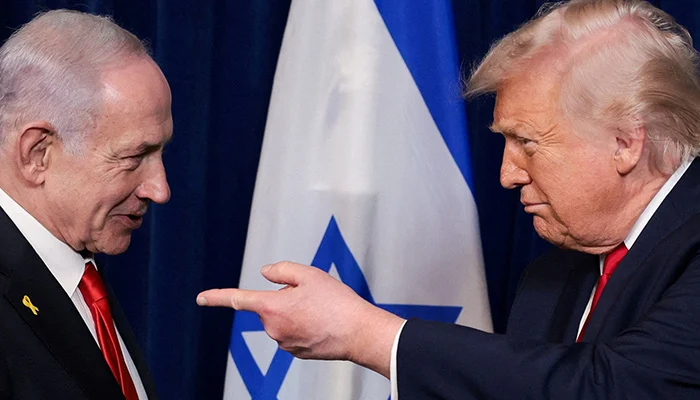
During a press conference at Trump’s Mar-a-Lago club in Palm Beach, Florida, on December 29, 2025, US President Donald Trump pointed at Israeli Prime Minister Benjamin Netanyahu, signaling a tense moment between the two leaders.
– Trump and Netanyahu’s meeting comes amid ongoing tensions concerning Iran’s strategies.
– Netanyahu is actively seeking Trump’s support as Israel prepares for upcoming elections.
– Trump is under scrutiny over calls for increased US involvement in the Iran conflict.
Prior to their scheduled White House meeting on Tuesday, Trump expressed frustration with Netanyahu, indicating displeasure over leaked details of the Israeli leader’s talking points on Iran. When asked about reports that Netanyahu planned to discuss Iran’s underground facility near one of its nuclear sites—known as Pickaxe Mountain—Trump dismissed the importance, suggesting Netanyahu only brought it up to keep him engaged. He stated, “I don’t need Bibi to tell me that. Bibi’s telling me that because he wants me to stay involved,” and questioned why Netanyahu would publicly announce such information instead of sharing it privately during their meeting.
The New York Post reported that Netanyahu was prepared to provide intelligence indicating Iran is expanding its nuclear infrastructure at Pickaxe Mountain while falsely claiming to pursue peace. Netanyahu’s office has yet to respond to comments about Trump’s remarks.
Photographs shared by Netanyahu’s office showed the two leaders smiling broadly during their meet in the Oval Office, joined by Vice President JD Vance, Secretary of State Marco Rubio, and Defense Secretary Pete Hegseth. Trump had first briefed with Ukrainian President Volodymyr Zelenskyy in private before joining Netanyahu. Both meetings were described as “positive and productive,” with relations between the U.S. and Ukraine warming as Kyiv has made advances against Russian forces. Netanyahu faces increased frustration from the White House over the stalled progress in broader efforts to resolve Iran’s nuclear ambitions and is also under pressure from Trump supporters skeptical of deeper American involvement in the Middle East.
The Israeli and Ukrainian leaders attended a memorial service in Washington honoring Senator Lindsey Graham, a staunch supporter of both Israel and Ukraine. Meanwhile, the conflicts in Ukraine and the Middle East are at pivotal stages. Trump announced a pause in US airstrikes, hoping to give diplomacy more room, while Zelenskyy emphasized the importance of advancing peace talks to end Russia’s invasion of Ukraine.
Netanyahu’s relationship with Trump has been inconsistent, at times needing to be restrained from provocative military actions against Hezbollah in Lebanon. Netanyahu is reportedly seeking Trump’s endorsement for his reelection bid on October 27, aiming to bolster his standing at home, where polls remain unfavorable. Their upcoming discussion is expected to cover the Abraham Accords—agreements brokered during Trump’s administration to normalize relations between Israel and the UAE, Bahrain, Morocco, and Sudan. Trump has also expressed interest in including Saudi Arabia in these accords and recent efforts to negotiate a nuclear deal with Riyadh, which has so far rejected joining without a pathway to Palestinian statehood.
Relations have improved between Trump and Zelenskyy since early tensions, especially as Kyiv has achieved some success in its fight against Russia, including targeted attacks on Moscow’s oil infrastructure. Zelenskyy post-meeting emphasized the need to intensify diplomatic efforts to end Russia’s invasion. They also discussed cooperation on missile defense and drone production, with Zelenskyy mentioning talks about licensing production of interceptors for Patriot systems and joint drone initiatives. Following their discussions, Zelenskyy was scheduled to meet with US senators at the Capitol.