Tag: Netanyahu

  • Trump’s Frustration with Netanyahu Over Iran Sparks Tensions at Leaders’ Meeting

    Trump’s Frustration with Netanyahu Over Iran Sparks Tensions at Leaders’ Meeting

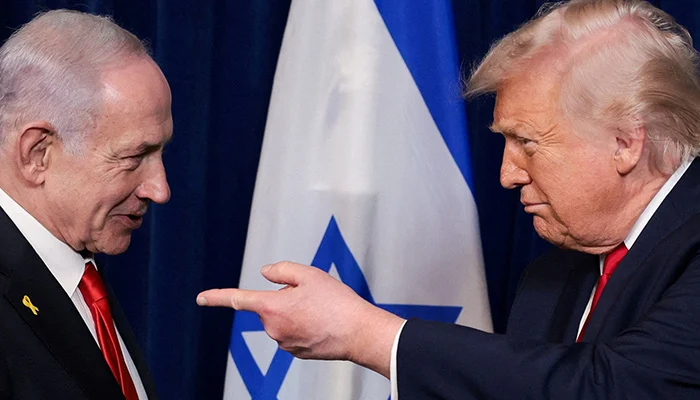
    During a press conference at Trump’s Mar-a-Lago club in Palm Beach, Florida, on December 29, 2025, US President Donald Trump pointed at Israeli Prime Minister Benjamin Netanyahu, signaling a tense moment between the two leaders.

    – Trump and Netanyahu’s meeting comes amid ongoing tensions concerning Iran’s strategies.
    – Netanyahu is actively seeking Trump’s support as Israel prepares for upcoming elections.
    – Trump is under scrutiny over calls for increased US involvement in the Iran conflict.

    Prior to their scheduled White House meeting on Tuesday, Trump expressed frustration with Netanyahu, indicating displeasure over leaked details of the Israeli leader’s talking points on Iran. When asked about reports that Netanyahu planned to discuss Iran’s underground facility near one of its nuclear sites—known as Pickaxe Mountain—Trump dismissed the importance, suggesting Netanyahu only brought it up to keep him engaged. He stated, “I don’t need Bibi to tell me that. Bibi’s telling me that because he wants me to stay involved,” and questioned why Netanyahu would publicly announce such information instead of sharing it privately during their meeting.

    The New York Post reported that Netanyahu was prepared to provide intelligence indicating Iran is expanding its nuclear infrastructure at Pickaxe Mountain while falsely claiming to pursue peace. Netanyahu’s office has yet to respond to comments about Trump’s remarks.

    Photographs shared by Netanyahu’s office showed the two leaders smiling broadly during their meet in the Oval Office, joined by Vice President JD Vance, Secretary of State Marco Rubio, and Defense Secretary Pete Hegseth. Trump had first briefed with Ukrainian President Volodymyr Zelenskyy in private before joining Netanyahu. Both meetings were described as “positive and productive,” with relations between the U.S. and Ukraine warming as Kyiv has made advances against Russian forces. Netanyahu faces increased frustration from the White House over the stalled progress in broader efforts to resolve Iran’s nuclear ambitions and is also under pressure from Trump supporters skeptical of deeper American involvement in the Middle East.

    The Israeli and Ukrainian leaders attended a memorial service in Washington honoring Senator Lindsey Graham, a staunch supporter of both Israel and Ukraine. Meanwhile, the conflicts in Ukraine and the Middle East are at pivotal stages. Trump announced a pause in US airstrikes, hoping to give diplomacy more room, while Zelenskyy emphasized the importance of advancing peace talks to end Russia’s invasion of Ukraine.

    Netanyahu’s relationship with Trump has been inconsistent, at times needing to be restrained from provocative military actions against Hezbollah in Lebanon. Netanyahu is reportedly seeking Trump’s endorsement for his reelection bid on October 27, aiming to bolster his standing at home, where polls remain unfavorable. Their upcoming discussion is expected to cover the Abraham Accords—agreements brokered during Trump’s administration to normalize relations between Israel and the UAE, Bahrain, Morocco, and Sudan. Trump has also expressed interest in including Saudi Arabia in these accords and recent efforts to negotiate a nuclear deal with Riyadh, which has so far rejected joining without a pathway to Palestinian statehood.

    Relations have improved between Trump and Zelenskyy since early tensions, especially as Kyiv has achieved some success in its fight against Russia, including targeted attacks on Moscow’s oil infrastructure. Zelenskyy post-meeting emphasized the need to intensify diplomatic efforts to end Russia’s invasion. They also discussed cooperation on missile defense and drone production, with Zelenskyy mentioning talks about licensing production of interceptors for Patriot systems and joint drone initiatives. Following their discussions, Zelenskyy was scheduled to meet with US senators at the Capitol.

  • Looksmaxxer Clavicular in Israel: Gym with Netanyahu & Date with IDF Social Media Manager

    Looksmaxxer Clavicular in Israel: Gym with Netanyahu & Date with IDF Social Media Manager

    Controversial “looksmaxxer” Clavicular recently ignited discussions on social media following his trip to Tel Aviv, Israel. During his visit, he reportedly went on a date with an IDF social media manager and dined with advisors to Israeli Prime Minister Benjamin Netanyahu.

    Later, Clavicular went live on Kick, revealing that Netanyahu’s advisors had asked him for advice on looksmaxing and whether he could do a gym livestream with the Israeli leader to connect with younger audiences.

    During the stream, he shared, “They mentioned Bibi has been struggling to connect with the younger generation; they think he looks old and out of shape. Would you be interested in doing a gym stream with him?”

    ‘Looksmaxxer’ Clavicular in Israel: Gym session with Netanyahu and dinner with IDF social media manager?

    Clavicular stated he had dinner with Netanyahu’s advisors to teach them about looksmaxing. He also said they asked him to organize a gym livestream with the Prime Minister, which drew reactions from the media and the public.

    He tweeted, “Clavicular says he had dinner with Benjamin Netanyahu’s advisors to teach them about looksmaxing and claims they asked him to do a gym stream with Netanyahu 😳👀. They mentioned Bibi’s difficulty in connecting with the younger generation; they think he’s old and out of shape.”

    The influencer later noted that Israel’s more liberal media outlets criticized his visit due to their opposition to Netanyahu. In relation to his meeting with Netanyahu, some media labeled Clavicular an anti-Semite, referencing a video where he was seen singing along to Kanye West’s song “Heil Hitler” with a group of controversial influencers, including Sneako and Nick Fuentes.

    According to Al Jazeera, Shira Braun—an IDF soldier responsible for managing the Israeli military’s TikTok account—also faced backlash after streaming and socializing with Clavicular.

    One critic remarked, “Risking professional reputation and military career just for a fleeting moment of digital fame demonstrates terribly poor judgment.”

    Another asserted that claims of disciplinary action are false, stating, “She was assigned there, and now they’re just managing the situation.”

    Al Jazeera reported, “The soldier managing the Israeli military’s TikTok account, Shira Braun, is under scrutiny after appearing in videos with Clavicular, including singing along to Kanye West’s ‘Heil Hitler.’”

    The “looksmaxxer” has also drawn criticism from pro-Palestine activists. They condemned his visit to Israel amid the ongoing conflict in Gaza and Lebanon.

    As reported by Gaza’s Health Ministry, Israel’s military operations in Gaza have resulted in over 73,000 Palestinian deaths, injuring at least 173,000 others, with many missing beneath rubble. Additionally, Israel’s actions in Lebanon have caused over 12,000 fatalities since March, according to the Lebanese Health Ministry.

  • Israel’s Netanyahu Meets UAE President Amid Iran Tensions: PM Office

    Israeli Prime Minister Benjamin Netanyahu participated in a state memorial ceremony honoring those who fell during the Iron Swords War on Mount Herzl in Jerusalem on October 16, 2025. — Reuters

    – Netanyahu held a clandestine meeting with the UAE president, according to the Prime Minister’s Office.
    – The office described Netanyahu’s visit as “a historic breakthrough.”
    – It was emphasized that relations between Arab countries and Iran “should not be based on confrontation.”

    During the conflict with Iran, Netanyahu secretly met with UAE President Sheikh Mohammed bin Zayed Al Nahyan amid the war, his office confirmed on Wednesday.

    “During Operation ‘Lion’s Roar,’ Prime Minister Benjamin Netanyahu visited the UAE secretly and met with Sheikh Mohammed bin Zayed,” their statement said.

    The announcement came a day after US Ambassador to Israel Mike Huckabee revealed that Israel had dispatched Iron Dome missile defense systems and personnel to operate them in the UAE during the Iran conflict. While Netanyahu’s office did not directly confirm Huckabee’s statement, they called the visit “a historic breakthrough in Israel-UAE relations.”

    Iran targeted the UAE more than any other nation during the ongoing conflict, which was ignited by US and Israeli strikes against Iran in late February. Despite a ceasefire taking effect last month, the UAE has reported multiple missile and drone attacks from Iran.

    An advisor to the UAE president, Anwar Gargash, stated earlier that the country remains committed to diplomatic solutions amid regional tensions, stressing the UAE’s right to defend its sovereignty. The UAE added that it had not sought conflict and has worked to avoid it, emphasizing that relations with Iran should not be confrontational.

  • Ex-Israeli Prime Ministers Join Forces to Oppose Netanyahu’s Bid

    Israeli opposition leader Yair Lapid announced on Sunday that he will team up with former Prime Minister Naftali Bennett ahead of the upcoming elections, aiming to unseat incumbent Benjamin Netanyahu.

    Lapid, who has served as Prime Minister before, stated that they will run together on a single list for the October parliamentary vote, with an official declaration expected later Sunday. On social media platform X, Lapid mentioned that they would “initiate the first step in repairing Israel: merging Yesh Atid and ‘Bennett 2026’ into one party led by Naftali Bennett.”

    He added, “This union consolidates the Repair Bloc, allowing us to focus all efforts on guiding Israel toward the necessary repair.” Both leaders have been vocal critics of Netanyahu’s management of the country’s conflicts since October 2023, with Lapid calling the recent two-week ceasefire with Iran a “political catastrophe.”

    Bennett, a right-wing advocate of Israeli settlements in the West Bank, and Lapid, a centrist, previously co-led a coalition government in June 2021. This government was replaced at the end of 2022 by Netanyahu’s current administration after Bennett declared his coalition fractured in June, leading Lapid to serve a short term as caretaker prime minister.

    Polls suggest Bennett is the most likely candidate to defeat Netanyahu in October’s vote. Bennett, 54, is the son of American immigrants and a former tech entrepreneur who sold his startup in 2005 for $145 million. An ex-elite Israeli commando officer, he resonates with younger Israelis, especially following over two years of conflict in Gaza.

    Once an adviser to Netanyahu, Bennett has since become a fierce critic of former mentor’s policies. He has led several right-wing parties before forming a unity government in 2021.

    Lapid, 62, is the son of the late journalist and minister Tommy Lapid, a Holocaust survivor, and the esteemed author Shulamit Lapid. A well-known TV journalist, he entered politics in 2012 with the founding of Yesh Atid, which quickly became Israel’s second-largest political party. He has served as opposition leader and held a brief stint as prime minister.

    Netanyahu, age 76, intends to head his Likud party’s list in the upcoming election, which must occur by the end of October. He remains Israel’s longest-serving prime minister, with over 18 years in office across multiple terms.

  • Netanyahu Announces Successful Prostate Cancer Treatment

    Israeli Prime Minister Benjamin Netanyahu announced on Friday that he received successful treatment for early-stage prostate cancer, though he did not specify when the treatment took place. In a social media statement coinciding with the release of his annual medical report, Netanyahu, 76, shared that a malignant tumor was discovered during a routine checkup. He stated that targeted treatment had effectively addressed the issue, leaving no trace of the tumor.

    The medical report confirmed that Netanyahu was in good health overall and had undergone radiation therapy for his early-stage prostate cancer. Neither the report nor Netanyahu disclosed the exact timing of the treatment. The Israeli leader explained that he delayed publishing the medical report for two months to prevent Iran from spreading false propaganda against Israel. In March, amid ongoing conflicts involving Iran, rumors circulated on social media and Iranian state media claiming Netanyahu had died. To counteract this, he released a video visiting a Jerusalem café to deny those claims.

    In 2024, Netanyahu underwent prostate surgery after being diagnosed with a urinary tract infection caused by benign prostate enlargement. The year prior, he received a pacemaker. Upcoming elections in Israel are scheduled for October.

  • Trump-backed Iran plan after Netanyahu called for Khamenei assassination: sources

    Trump-backed Iran plan after Netanyahu called for Khamenei assassination: sources

    Less than two days before the U.S.-Israeli airstrike on Iran commenced, Prime Minister Benjamin Netanyahu had a phone conversation with President Donald Trump to discuss the rationale behind launching the complex, distant conflict Trump had previously campaigned against.

    Both leaders were aware from earlier in the week’s intelligence briefings that Iranian Supreme Leader Ayatollah Ali Khamenei and his senior aides would soon gather at his Tehran compound, presenting an opportunity for a “decapitation strike”—a targeted attack often employed by Israelis to eliminate top leadership, though less commonly used by the U.S. historically.

    Recent intelligence updates indicated the meeting had shifted from Saturday night to Saturday morning, according to three individuals familiar with the call. This conversation between the two leaders has not been reported before.

    Netanyahu, eager to proceed with an operation he had championed for years, contended that it might be the best chance to eliminate Khamenei. At the time of the call, Trump had already approved the idea of conducting a military action against Iran but had not yet set a specific date or criteria for involvement, sources say, speaking anonymously due to the sensitive nature of the internal discussions.

    U.S. military forces had been accumulating presence in the region for weeks, leading many within the government to believe that a decision from Trump was imminent. A potential earlier operation had been canceled due to poor weather conditions.

    While it’s unclear how Netanyahu’s persuasiveness influenced Trump’s final decision to proceed with the strike, the call represented the Israeli leader’s strongest argument. The three sources indicated that the intelligence about a shrinking window to target Khamenei likely played a key role in President Trump’s ultimate authorization on February 27, dubbed Operation Epic Fury.

    The initial bombings took place on Saturday morning, February 28, and later that evening, Trump announced Khamenei’s death.

    In response to inquiries, White House spokesperson Anna Kelly did not directly comment on the call but stated that the military mission aimed to “destroy Iran’s ballistic missile and production capabilities, eliminate their navy, prevent them from arming proxies, and ensure Iran never develops nuclear weapons.” Neither Netanyahu’s office nor Iran’s UN representative replied to requests for comment.

    During a Thursday press conference, Netanyahu dismissed as “fake news” claims that Israel had somehow dragged the U.S. into conflict with Iran, asserting, “Does anyone truly believe someone could tell President Trump what to do? Come on.” Trump has publicly maintained that he alone made the decision to strike.

    Though reports—primarily from Reuters—based on anonymous sources close to both leaders, suggest Netanyahu was a persuasive advocate, they do not imply he coerced Trump into war. The reporting indicates Netanyahu effectively framed the opportunity to eliminate Khamenei as a compelling reason for the attack.

    In early March, Defense Secretary Pete Hegseth hinted that revenge may have been a motivating factor, stating, “Iran tried to kill President Trump, and he got the last laugh.”

    In 2024, Trump campaigned on a platform emphasizing “America First,” advocating to avoid war with Iran and favoring diplomatic solutions. However, as negotiations over Iran’s nuclear program failed last spring, Trump began considering a strike, according to three individuals familiar with White House deliberations.

    In June, Israel bombed Iran’s nuclear and missile sites, killing several Iranian officials. U.S. forces later joined the operation, which lasted 12 days, with Trump publicly celebrating the success, claiming Iran’s nuclear facilities had been “obliterated.”

    Months later, discussions about a second attack targeting additional missile sites surfaced, aiming to thwart Iran’s progress toward nuclear armament. Israel initially planned to act alone, with Defense Minister Israel Katz stating on March 5 that they expected to undertake the attack independently.

    During a December visit to Trump’s Mar-a-Lago estate, Netanyahu expressed dissatisfaction with the June operation’s outcomes, prompting Trump to consider a new strike alongside renewed diplomatic efforts.

    Two significant events influenced Trump’s renewed urgency: the January 3 U.S. operation to capture Venezuelan President Nicolás Maduro, which demonstrated the possibility for limited collateral damage in military actions, and the eruption of large-scale protests in Iran. Trump publicly supported the protests but initially offered limited direct aid, while privately increasing cooperation with Israeli military planners.

    Later, Netanyahu briefed Trump during a February visit on Iran’s expanding missile program, highlighting specific installations and warning of the threat posed to U.S. homeland security. The White House did not comment on these meetings.

    By late February, U.S. officials and regional diplomats largely viewed an attack on Iran as imminent, though details remained uncertain. Briefings indicated that a successful strike could dismantle Iran’s missile capabilities, with some officials warning that Iran would retaliate against U.S. targets—predictions that proved accurate as Iranian counterattacks, civilian casualties, and disruptions at key shipping routes ensued, impacting global oil markets.

    Another consideration was whether assassinating Iran’s top leaders could lead to regime change, potentially more amenable to negotiations. While Netanyahu saw this as a key argument for the strike, CIA assessments prior indicated that killing Khamenei might instead empower hardliners, making diplomacy more difficult.

    Despite the intense military campaign, Iran’s Revolutionary Guards still patrol the streets, and many citizens remain confined indoors. Recently, Khamenei’s son Mojtaba, known for his hardline stance, has been reports to take over as Iran’s new supreme leader.

  • Netanyahu Shares Video Address Amid Death Rumor Rumblings

    Netanyahu Shares Video Address Amid Death Rumor Rumblings

    Israeli Prime Minister Benjamin Netanyahu reacts at a cafe, amid the U.S.-Israel conflict with Iran, in Jerusalem, March 15, 2026, in this screen grab taken from a handout video. — Reuters

    On Sunday, Israeli Prime Minister Benjamin Netanyahu shared a video showing him grabbing coffee and chatting with his aide, following rumors circulated by Iranian state media and online platforms in Iran claiming he was dead or injured.

    The clip, filmed at a café on the outskirts of occupied Jerusalem and posted on Netanyahu’s Telegram account, shows his aide inquiring about the rumors. Netanyahu responds with a pun on the word “dead,” which in Hebrew slang can mean “crazy about” someone or something, as he reaches for his coffee.

    “I’m crazy about coffee. You know what? I’m crazy about my people,” Netanyahu says to his aide.

    He then raises his hands toward the camera, asking, “Want to count my fingers?”—a nod to ongoing social media speculation that his latest televised address was generated by AI and that he appeared to have six fingers on one hand.

    Reuters confirmed the video’s location through matching imagery of the café’s interior with publicly available photos, and the date was verified with multiple videos and images of Netanyahu’s visit posted by the café on Sunday.

    Meanwhile, Iran’s Revolutionary Guards Corps (IRGC) issued a threat Sunday, vowing to kill Netanyahu as the conflict between Israel, the U.S., and Iran reaches its third week.

    “IRGC vows to pursue and eliminate ‘child-killer’ Netanyahu if he is still alive,” reported Iran’s IRNA news agency on the social platform X.

    Since U.S. and Israeli attacks on Iran began February 28, Netanyahu has visited several locations struck by Iranian missiles, including a hospital, port, and military bases, although media access has been limited, with his office distributing videos.

    In Israel, Netanyahu rarely participates in interviews or holds press conferences, but he held his first since the conflict’s start via video link on Thursday, similar to his approach during Israel’s 12-day war with Iran in June.

    Since the conflict began, emergency safety measures have restricted gatherings, keeping most Israelis indoors or near shelters. Schools across much of the country remain closed.


    Additional reporting from AFP

  • Experts Warn Iran War Threats Endanger Netanyahu’s Political Future

    Experts Warn Iran War Threats Endanger Netanyahu’s Political Future

    As elections draw near in Israel, President Benjamin Netanyahu sees the ongoing conflict with Iran as a chance to repair his image, which was heavily damaged by the October 7, 2023, Gaza attack, analysts say.

    However, the extent of any political gain will rely on how the conflict develops and its duration, they add.

    Following Iran’s supreme leader, Ayatollah Ali Khamenei’s, martyrdom during a series of US-Israeli airstrikes, Netanyahu asserted that his strong relationship with the US has allowed Israel to accomplish a goal he has pursued for four decades: decisively targeting the terrorist regime.

    The Gaza conflict has hurt Netanyahu’s standing with voters. Critics accuse him of trying to sidestep accountability for the government’s failure on the deadliest day in Israeli history.

    At 76, Netanyahu, who leads the right-wing Likud party, is Israel’s longest-serving prime minister, with over 18 years in office spread across multiple terms.

    He’s known for his political stamina but has been governing without a parliamentary majority since this summer due to disputes with ultra-Orthodox religious allies.

    Additionally, he is on trial for longstanding corruption charges and has sought a presidential pardon, with former President Donald Trump often urging President Isaac Herzog to grant one.

    “Total Victory”

    Elections are required to be conducted by October 27 at the latest.

    Political analyst Emmanuel Navon of Tel Aviv University predicts Netanyahu will call early elections.

    “It’s clear he won’t wait until October, especially with the anniversary of October 7 approaching,” Navon stated.

    “Although Netanyahu’s popularity plummeted after the Gaza attack, he has been gradually regaining ground,” he continued.

    Polls currently favor a Likud victory led by Netanyahu, which would likely result in him being tasked with forming the next government. Nonetheless, he still would not have enough seats to command a majority with his current coalition.

    A successful campaign against Iran could alter that scenario, experts suggest.

    “This operation clearly bolsters the image Netanyahu wants to project—the idea of a ‘total victory,’” explained independent geopolitical analyst Michael Horowitz to AFP.

    “Netanyahu aims to demonstrate that this isn’t just a campaign slogan but a reality; it’s part of his national agenda and electoral strategy,” he added.

    “Iran Remains Iran”

    Journalist Raviv Druker from Channel 13 remarked that Netanyahu might try to convince the public that victory is complete, even if it’s an illusion, noting that Hamas still controls Gaza and Iran remains a threat even after Saturday’s strikes.

    On the popular news site Walla, reporter Ouriel Deskal suggested that Netanyahu might have timed the hostilities to delay the March 30 deadline for passing a budget—one he has struggled to pass due to a fragile majority—by invoking a state of emergency.

    Without a budget, the government would collapse on April 1, triggering new elections.

    In this context, Netanyahu could enter the election campaign in a weakened position.

    Conversely, Navon said, “If this war against Iran proves successful for Israel, it would be a political victory for Netanyahu.”

    Yet, if the conflict prolongs, the political landscape could shift dramatically, Horowitz warned.

    “Public support for a prolonged war with significant casualties and rising living costs is very low,” he explained.

    During last June’s conflict, Iranian missiles killed 30 Israelis. Since Saturday, Iran has retaliated with strikes that have resulted in 10 deaths.

    Horowitz pointed out that Israel’s victories are largely credited to its military and civil resilience, enabling it to sustain its longest conflict in history.

    “While military approval is increasing, Netanyahu’s popularity isn’t necessarily rising accordingly,” he added.

  • Trump Persuaded Netanyahu to Agree—Can He Maintain the Support?

    Trump Persuaded Netanyahu to Agree—Can He Maintain the Support?

    President Donald Trump, who has styled himself as a peace broker aiming for a Nobel Prize, scored a diplomatic win Monday when global leaders gathered in Egypt to endorse the ceasefire and hostage exchange he facilitated between Israel and Hamas.

    However, for true peace to endure, analysts and diplomats believe Trump must continue applying pressure on Benjamin Netanyahu, Israel’s Prime Minister, whose support will be crucial in subsequent negotiations.

    Historically, U.S. presidents from Bill Clinton to Joe Biden have found Netanyahu challenging to collaborate with. Even officials within the Trump administration expressed frustration over certain Israeli military actions they viewed as counterproductive to U.S. policies.

    This month, Trump managed to persuade Netanyahu to endorse a broader peace framework while also convincing other Middle Eastern nations to urge Hamas to free all Israeli captives, which is pivotal leverage in the conflict.

    Nevertheless, the path forward may grow more complex. Disagreements remain between Israel and Hamas regarding many elements of Trump’s 20-point plan. As Israel gears up for elections next year, Netanyahu’s strategies may shift to keep his right-wing coalition intact.

    “With an election cycle underway, Netanyahu’s decisions may pivot from capitulating to pressure to focus on his political survival,” noted Nimrod Goren, head of the Israeli foreign policy think tank Mitvim.

    The strength of Trump’s peace approach also presents its weaknesses. The agreement’s core document leaves many specifics undefined, with neither side having committed to the finer details. This ambiguity was crucial in securing their signatures, but it signifies that critical diplomacy lies ahead.

    One potential obstacle is the demand that Hamas disarm and have no role in Gaza’s future governance. While Hamas broadly agreed to Trump’s plan, their official response didn’t specify this condition, and Hamas leaders have indicated they envision a governing role in a post-war Gaza.

    “There are numerous ways this could go awry,” warned Jon Alterman, a Middle East expert at the Center for Strategic and International Studies in Washington and a former State Department official.

    “The agreement leaves much to be resolved later, which is unusual in international accords,” he added.

    The Israeli embassy did not immediately respond to requests for comment.

    A senior U.S. official mentioned that Trump’s influence over Netanyahu has been partly bolstered by his strong support for key Israeli priorities, including the formal recognition of Jerusalem as Israel’s capital and the annexation of the Golan Heights—long-standing goals of the Israeli government.

    “President Trump hasn’t sought to be a neutral broker in Israel,” the official explained. “He’s backed Israel wholeheartedly, which has allowed him to steer them in the right direction.”

    Trump’s track record with Netanyahu has been mixed regarding political pressure. In July, Israel bombed Syria’s defense ministry in Damascus, despite U.S. efforts to strengthen ties with the Syrian government. For months, Trump publicly supported Netanyahu amid mounting humanitarian concerns voiced by European and Arab allies.

    More recently, Trump has adopted a tougher stance. He compelled Netanyahu, in a call to Qatar’s leader after a failed bombing in Qatar aimed at Hamas negotiators, and ultimately succeeded in securing Netanyahu’s endorsement of his peace plan despite Netanyahu’s misgivings.

    According to Alterman, Trump’s current popularity in Israel gives him significant leverage over Netanyahu: “Trump is more popular among Israelis than Netanyahu himself, so he can influence Netanyahu’s political future—either supporting or undermining it.”

    During a speech before Israel’s parliament Monday, Trump teased Netanyahu, saying, “Now you can be a little nicer because you’re not at war anymore,” drawing laughs and signaling a lack of particular deference to the Israeli leader.

    Next year’s elections could still shift Netanyahu’s calculus. Supporters of right-wing figures like Itamar Ben-Gvir and Bezalel Smotrich might oppose halting military actions in Gaza, potentially forcing Netanyahu to abandon parts of Trump’s agreement.

    Some analysts warn that delays by Hamas in disarming or fulfilling obligations could prompt right-wing factions to pressure Netanyahu into resuming military operations, undermining the peace deal.

    “Given Hamas’s ongoing stance to retain power in Gaza, we’re concerned that partial commitments won’t be enough,” said Simcha Rothman, a member of Netanyahu’s coalition. “We’re not satisfied until Hamas fully surrenders. Anything less is unacceptable.”

    Another sticking point involves language within the plan that leaves open the possibility of a future Palestinian state—something many Israelis may reject following Hamas’s October 7 attack.

    Former U.S. ambassador Dan Shapiro noted that such opposition could dissuade Arab nations from pressing Hamas to meet its commitments under the agreement. “Including that in the plan was vital to garner Arab support,” he explained. “If Israel’s political discourse rejects the idea of a Palestinian state entirely, it could diminish Arab participation in the process.”

  • Trump’s Gaza Triumph: Will It Last?

    Trump’s Gaza Triumph: Will It Last?

    President Donald Trump achieved a significant diplomatic milestone by facilitating a ceasefire in Gaza, yet the journey toward enduring peace in the Middle East faces numerous hurdles. It remains uncertain whether the 79-year-old former president—who isn’t particularly meticulous about the finer details—will dedicate the same effort to sustain the peace after his current regional tour concludes next week.

    “Any agreement between Israelis and Palestinians, especially one indirectly mediated between Israel and Hamas, is a remarkable feat,” said Aaron David Miller, a former advisor to multiple U.S. administrations. “Trump took a step that no American president of either party has ever attempted—that is, pressuring and influencing an Israeli prime minister on matters vital to his political interests,” added Miller, a senior fellow at the Carnegie Endowment for International Peace.

    However, Miller cautioned about the complex and detailed work that still needs to be done, particularly concerning the implementation of the deal’s second phase. The Israeli military announced that its troops would cease fire by 0900 GMT on Friday, aiming to free all Israeli hostages, dead and alive, within 72 hours—an outcome agreed upon with Hamas.

    Trump has indicated he plans to visit the Middle East on Sunday, with stops in Egypt, where the negotiations took place, and Israel. Among U.S. presidents over the past two decades, Trump’s accomplishment in brokering this ceasefire is noteworthy, but he aims for more—reviving the broader Abraham Accords, which normalized relations between Israel and the United Arab Emirates, Bahrain, and Morocco during his first term.

    He has re-engaged Jared Kushner, his son-in-law and a key architect of the Abraham Accords, to work alongside special envoy Steve Witkoff on Gaza negotiations. U.S. officials and foreign policy analysts agree that Trump skillfully used a combination of incentives and pressure—both publicly and behind closed doors—to secure the deal, leveraging his strong relationships with Arab and Muslim leaders, including Turkey’s Recep Tayyip Erdogan.

    Miller emphasizes Trump’s decisive role but acknowledges that significant uncertainties remain—particularly whether Hamas will disarm after two devastating years of conflict, especially following its attack on Israel on October 7, 2023.

    “An immediate ceasefire isn’t equivalent to lasting peace,” said French Foreign Minister Jean-Noel Barrot, after convening with European and Arab colleagues to discuss post-conflict aid to Palestinians. Steven Cook, a senior fellow at the Council on Foreign Relations, noted that it’s still an open question whether this will effectively end the war.

    Key challenges include fully implementing Trump’s 20-point plan, which calls for Hamas to surrender its weapons, the deployment of an international stabilization force, and the establishment of new governing structures in Gaza that exclude Hamas. Trump insists that disarmament and Israeli withdrawal are inevitable, though details are still being negotiated.

    To oversee the truce, around 200 U.S. military personnel have been dispatched, but significant operational gaps remain—particularly in decommissioning Gaza’s weapons arsenal and establishing transitional governance, which Hamas has already rejected. The proposed “Board of Peace,” a transitional authority personally chaired by Trump, is another contentious element of the plan.

    As Robert Satloff of the Washington Institute points out, Trump’s engagement in Middle East peace efforts marks a major commitment, one that will carry his name for years to come, despite earlier intentions to sideline America’s role in regional conflicts.

  • How Trump Enabled the Gaza Deal

    How Trump Enabled the Gaza Deal

    A typical dramatic scene unfolded at the White House as Donald Trump’s top diplomat interrupted a televised meeting to slip a note into the President’s hand, whispering that a deal in Gaza was close. Moments later, Trump announced via his Truth Social platform, “Blessed are the peacemakers!” While the public spectacle played out, most of Trump’s efforts occurred behind the scenes, pressing Israeli Prime Minister Benjamin Netanyahu and rallying Arab nations to support the agreement.

    In efforts to secure a Nobel Peace Prize and boost his legacy, Trump adopted a different approach with Israel compared to past administrations. During a September 29 White House visit, Trump publicly expressed full support for Netanyahu, warning that if Hamas rejected the peace plan, Israel would have his backing to eliminate the militant group. Privately, however, he was applying pressure. The peace plan presented to Netanyahu had been prepared after extensive talks with Arab and Muslim countries at the UN the week prior. Netanyahu quickly realized there were crucial elements in the plan he couldn’t accept, particularly regarding his stance against establishing a Palestinian state.

    Trump was also frustrated by Israel’s missile strike on Hamas operatives in Qatar, an ally of the U.S., amid sensitive negotiations. To unify Arab backing, Trump exploited regional solidarity, compelling Netanyahu to call Qatar’s leader from the Oval Office to apologize. A White House photo showed Trump holding the phone for Netanyahu during the call. Reports indicated a senior Qatari official was in the room to ensure Netanyahu adhered to the narrative. Later, Trump authorized a unique security arrangement with Qatar.

    This pivot reflected the close ties Trump fostered with Gulf countries. During his first term, the UAE, Bahrain, and Morocco signed the Abraham Accords, normalizing relations with Israel. His first trip to the Middle East in this term was exclusively to Qatar, Egypt, and Abu Dhabi, bypassing Israel altogether.

    Trump accelerated pressure on Hamas, giving them a deadline of October 5 to strike a deal or face severe consequences. Hamas responded cleverly, leveraging Trump’s well-known commitment to secure the release of Gaza hostages, a cause he repeatedly championed with White House visits. Trump declared victory, posting a video and re-sharing Hamas’s statement—an unusual move for a U.S. president—despite Hamas not fully agreeing to his entire peace plan. Instead of focusing on details, Trump urged Israel, Hamas, and mediators to expedite negotiations.

    He told Axios that he told Netanyahu, “This is your chance for victory,” implying Netanyahu had no choice but to accept the opportunity he presented.

  • Trump cites Netanyahu’s support for US Gaza peace amid ongoing Israeli strikes

    Trump cites Netanyahu’s support for US Gaza peace amid ongoing Israeli strikes

    The White House has unveiled a 20-point peace plan championed by the U.S., calling for a ceasefire and a swap of hostages for Palestinian prisoners. President Donald Trump announced that Israeli Prime Minister Benjamin Netanyahu has approved the plan, despite ongoing fierce ground operations by Israeli forces in Gaza. The proposal emphasizes an Israeli withdrawal, Hamas disarmament, and establishing a transitional government with international oversight, aiming to address decades of conflict.

    During a joint press conference, Trump expressed optimism that Hamas would accept the deal, stating, “We are very close to securing a peace agreement and hope Hamas will join us.” He thanked Netanyahu for trusting the process and working together to end what he described as years, even centuries, of suffering, and to usher in a new era of regional stability, security, and prosperity.

    This marks Netanyahu’s fourth visit to the White House since Trump’s presidency began in January. The Israeli leader’s visit underscores efforts to reinforce the crucial US-Israel alliance amid recent international moves recognizing Palestinian statehood—actions that Israel and the US oppose. Trump, who has criticized these recognitions as benefiting Hamas, sought Netanyahu’s support despite some reservations from Israel about certain aspects of the plan.

    The diplomatic push from Washington comes amid a significant escalation on the ground, with Israeli tanks advancing deeper into Gaza City. Netanyahu has pledged to continue military operations aiming to dismantle Hamas—efforts that have devastated much of Gaza and created a severe humanitarian crisis.

    Meanwhile, a senior Hamas official told AFP that the group has yet to receive Trump’s peace proposal. “We have not seen Trump’s plan yet. We will analyze it and respond once we do,” the official said on condition of anonymity.

    Last week, the U.S. presented its peace initiative to Arab and Muslim nations during the UN General Assembly. On Monday, Trump focused on aligning closely with Netanyahu and resolving remaining differences.

    As Israeli forces extend their military offensive, the US is actively working to bridge gaps in negotiations. Past ceasefire attempts have failed, largely due to the inability to reconcile differences between Israel and Hamas. Netanyahu remains committed to fighting until Hamas is completely dismantled, making the chances of an immediate resolution uncertain.

  • Mamdani pledges to arrest Netanyahu if elected NYC mayor

    Mamdani pledges to arrest Netanyahu if elected NYC mayor

    Zohran Mamdani, the Democratic candidate for New York City mayor, announced during a recent interview that if he wins, he would instruct NYPD officers to arrest Israel’s prime minister should he set foot in the city. Mamdani described Prime Minister Benjamin Netanyahu as a war criminal responsible for genocide in Gaza. He stated that if Netanyahu visits New York, he would carry out the arrest order issued by the International Criminal Court (ICC) by directing police to detain him at the airport.

    Legal experts have cautioned that such actions would be highly unlikely and possibly violate federal law. Despite this, Mamdani remains firm, asserting, “This is something I intend to follow through on. I want this city to stand for international law.”

    It’s important to note that the United States does not recognize the ICC’s jurisdiction, and President Donald Trump imposed measures against the court in February after it issued the arrest warrant for Netanyahu, claiming the court lacked authority over the U.S. and Israel.

    Netanyahu has dismissed the threats, calling Mamdani’s proposal “silly in many ways” during a meeting with Trump at the White House, and adding, “I’ll come with President Trump, and we’ll see.” Trump echoed the sentiments, warning Mamdani to “behave,” implying that any misstep could lead to serious consequences.

    The ICC warrant accuses Netanyahu of war crimes and crimes against humanity in Gaza, alleging that he and other Israeli officials intentionally deprived civilians of essential resources including food, water, and medicine. Mamdani has argued that Netanyahu made military decisions while in New York that resulted in civilian casualties in the Middle East.

    A recent survey conducted by The New York Times and Siena College showed that New Yorkers broadly support Mamdani’s stance on Israel and the conflict. Among likely Jewish voters, Mamdani led narrowly at around 30%, closely followed by incumbent Mayor Eric Adams and former Governor Andrew Cuomo.

    Cuomo, Mamdani’s main opponent, has been a vocal supporter of Israel and even volunteered to join Netanyahu’s legal team last November, shortly after the ICC issued its warrant.

    Trump commented Friday that Mayor Adams’ ongoing reelection campaign makes it unlikely for anyone to defeat Mamdani but also stated that Adams is “free to do what he wants.” He added, “If he (Adams) remains in the race, especially against Mamdani, victory seems unlikely.” Trump also suggested Cuomo might have a better chance if it’s a one-on-one race, but with multiple candidates, the competition would be tougher.

  • Trump Calls on Israel to Dismiss Charges Against Netanyahu

    Trump Calls on Israel to Dismiss Charges Against Netanyahu

    Sure! Here’s a rewritten version of the content in American English, ensuring it’s unique and plagiarism-free:

    President Donald Trump discusses nuclear negotiations with Iran alongside Israeli Prime Minister Benjamin Netanyahu in Washington, D.C., on April 7, 2025.

    WASHINGTON, D.C.: On Wednesday, U.S. President Donald Trump urged Israel to either pardon Prime Minister Benjamin Netanyahu or dismiss his corruption trial, asserting that the U.S. would come to Netanyahu’s aid as it had for the nation of Israel.

    Netanyahu, who has faced indictment since 2019 on charges of bribery, fraud, and breach of trust—claims he vehemently denies—has been undergoing trial since 2020, which encompasses three distinct criminal cases. He has maintained his innocence throughout.

    In a post on Truth Social, Trump stated, “Bibi Netanyahu’s trial should be CANCELLED IMMEDIATELY, or a pardon should be granted to this great hero who has contributed so much to the State of Israel,” referencing Netanyahu’s upcoming court appearance scheduled for Monday.

    According to Israeli news sources, Netanyahu’s cross-examination commenced on June 3 in a Tel Aviv court, with proceedings expected to last around a year.

    Israeli President Isaac Herzog holds the power to pardon Netanyahu but has indicated—based on reports from local media—that no such request has been submitted and that a pardon is “not currently an option.”

    Trump referred to Netanyahu as a “warrior,” adding, “It’s the United States that has saved Israel, and now it’s the U.S. that will save Bibi Netanyahu.” This statement seemingly alluded to American support for Israeli military actions against Iran’s nuclear ambitions.

    It remains vague whether Trump was suggesting any concrete measures the U.S. might undertake regarding Netanyahu’s legal situation.

    Trump characterized the trial of the Israeli leader as a “witch hunt”—a term he frequently uses to describe the legal issues he has faced.

    His remarks followed a day after he expressed dissatisfaction with Israeli attacks on Iran following a ceasefire.

    “Immediately after we reached the agreement, Israel launched an unprecedented barrage of bombs—more than I have ever seen,” he told reporters. “I’m not too pleased with Israel right now,” he added.

    Touching on the protracted conflict between Israel and Iran, Trump remarked, “They’ve been fighting for so long and so hard that they’ve lost their direction.”


    Feel free to let me know if you need any more adjustments or additional information!

  • Trump Mediates Ceasefire with Netanyahu During US-Iran Talks

    Trump Mediates Ceasefire with Netanyahu During US-Iran Talks

    Emergency teams respond at a residential site following a missile strike from Iran on Israel in the ongoing Israel-Iran conflict in Be’er Sheva, Israel, June 24, 2025. — Reuters

    • Vance, Rubio, and Special Envoy Witkoff are in talks with Iran.
    • Trump declares a “complete and total” ceasefire between Israel and Iran to take effect soon.
    • A source indicates Trump called for discussions with Israel and Iran shortly after U.S. airstrikes.

    On Monday, President Donald Trump facilitated a ceasefire between Israel and Iran following discussions with Israeli Prime Minister Benjamin Netanyahu, according to a senior White House official.

    This official mentioned, under anonymity, that Israel consented to the ceasefire on the condition that Iran refrains from launching additional attacks, and Iran has indicated that it will not initiate further hostilities.

    Vice President JD Vance, Secretary of State Marco Rubio, and U.S. Special Envoy Steve Witkoff took part in both direct and indirect communications with Iranian representatives, the official revealed.

    Earlier on Monday, Trump announced that a “complete and total” ceasefire between Israel and Iran would be implemented in the upcoming hours, shortly after both sides had issued threats of renewed aggression.

    This follows a missile strike by Iran targeting a U.S. military base, which fortunately resulted in no casualties, after U.S. bombers attacked Iranian underground nuclear sites with 30,000-pound bunker-buster bombs over the previous weekend.

    Immediately following these U.S. strikes, Trump urged for negotiations with both Israel and Iran.

    “He told his team Saturday night, ‘Let’s reach out to the Iranians,’” the official recounted. “‘Get me Bibi. We are going to make peace,’” quoting Trump.

    Trump’s administration had previously engaged in negotiations with Iran five times in the weeks leading up to this conflict, but discussions broke down after Iran insisted on its right to continue uranium enrichment.

    Last Thursday, Trump stated that he would decide on the use of American military force “within two weeks,” yet by Saturday evening, he authorized airstrikes against Iranian facilities.

    Trump’s unprecedented choice to bomb Iran’s nuclear sites early on Sunday marked a significant move, counter to his prior commitments to avoid foreign military interventions.

    Aligning military action with U.S. ally Israel raised apprehensions within his right-leaning “Make America Great Again” base, which has rallied around his earlier promises to sidestep foreign conflicts.

    If the ceasefire holds, it could quiet criticism and bolster Trump’s self-image as a peacemaker.

    This ceasefire culminated from a series of conversations Trump held in the Oval Office, during which he directly communicated with Netanyahu, who has historically advocated for increased U.S. military involvement in the conflict.

    The official emphasized that Trump has “demonstrated restraint” and reiterated that U.S. interests remain his primary focus.