Tag: tensions

  • Trump’s Frustration with Netanyahu Over Iran Sparks Tensions at Leaders’ Meeting

    Trump’s Frustration with Netanyahu Over Iran Sparks Tensions at Leaders’ Meeting

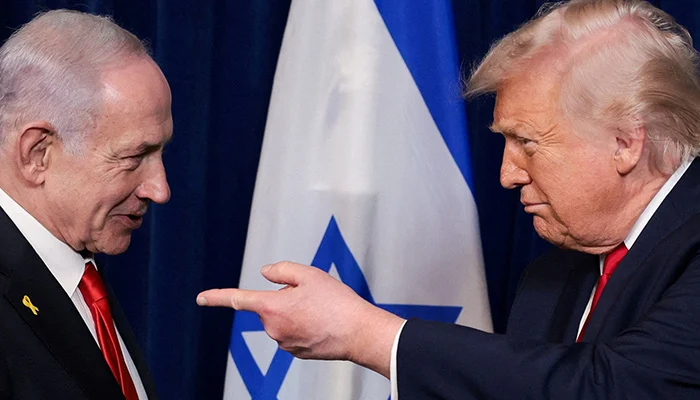
    During a press conference at Trump’s Mar-a-Lago club in Palm Beach, Florida, on December 29, 2025, US President Donald Trump pointed at Israeli Prime Minister Benjamin Netanyahu, signaling a tense moment between the two leaders.

    – Trump and Netanyahu’s meeting comes amid ongoing tensions concerning Iran’s strategies.
    – Netanyahu is actively seeking Trump’s support as Israel prepares for upcoming elections.
    – Trump is under scrutiny over calls for increased US involvement in the Iran conflict.

    Prior to their scheduled White House meeting on Tuesday, Trump expressed frustration with Netanyahu, indicating displeasure over leaked details of the Israeli leader’s talking points on Iran. When asked about reports that Netanyahu planned to discuss Iran’s underground facility near one of its nuclear sites—known as Pickaxe Mountain—Trump dismissed the importance, suggesting Netanyahu only brought it up to keep him engaged. He stated, “I don’t need Bibi to tell me that. Bibi’s telling me that because he wants me to stay involved,” and questioned why Netanyahu would publicly announce such information instead of sharing it privately during their meeting.

    The New York Post reported that Netanyahu was prepared to provide intelligence indicating Iran is expanding its nuclear infrastructure at Pickaxe Mountain while falsely claiming to pursue peace. Netanyahu’s office has yet to respond to comments about Trump’s remarks.

    Photographs shared by Netanyahu’s office showed the two leaders smiling broadly during their meet in the Oval Office, joined by Vice President JD Vance, Secretary of State Marco Rubio, and Defense Secretary Pete Hegseth. Trump had first briefed with Ukrainian President Volodymyr Zelenskyy in private before joining Netanyahu. Both meetings were described as “positive and productive,” with relations between the U.S. and Ukraine warming as Kyiv has made advances against Russian forces. Netanyahu faces increased frustration from the White House over the stalled progress in broader efforts to resolve Iran’s nuclear ambitions and is also under pressure from Trump supporters skeptical of deeper American involvement in the Middle East.

    The Israeli and Ukrainian leaders attended a memorial service in Washington honoring Senator Lindsey Graham, a staunch supporter of both Israel and Ukraine. Meanwhile, the conflicts in Ukraine and the Middle East are at pivotal stages. Trump announced a pause in US airstrikes, hoping to give diplomacy more room, while Zelenskyy emphasized the importance of advancing peace talks to end Russia’s invasion of Ukraine.

    Netanyahu’s relationship with Trump has been inconsistent, at times needing to be restrained from provocative military actions against Hezbollah in Lebanon. Netanyahu is reportedly seeking Trump’s endorsement for his reelection bid on October 27, aiming to bolster his standing at home, where polls remain unfavorable. Their upcoming discussion is expected to cover the Abraham Accords—agreements brokered during Trump’s administration to normalize relations between Israel and the UAE, Bahrain, Morocco, and Sudan. Trump has also expressed interest in including Saudi Arabia in these accords and recent efforts to negotiate a nuclear deal with Riyadh, which has so far rejected joining without a pathway to Palestinian statehood.

    Relations have improved between Trump and Zelenskyy since early tensions, especially as Kyiv has achieved some success in its fight against Russia, including targeted attacks on Moscow’s oil infrastructure. Zelenskyy post-meeting emphasized the need to intensify diplomatic efforts to end Russia’s invasion. They also discussed cooperation on missile defense and drone production, with Zelenskyy mentioning talks about licensing production of interceptors for Patriot systems and joint drone initiatives. Following their discussions, Zelenskyy was scheduled to meet with US senators at the Capitol.

  • US Assessing Drone Risks from Cuba: New Report

    US Assessing Drone Risks from Cuba: New Report

    A vintage car passes by images of the late Cuban President Fidel Castro, Cuba’s former President Raul Castro, and current President Miguel Diaz-Canel on a billboard in Havana, May 15, 2026. — Reuters

    – Cuba’s foreign minister dismisses reports and accuses the U.S. of making false claims.
    – Cuba claims the U.S. is unjustifiably scheming for its next conflict.
    – Cuban officials assert that they do not threaten or seek war, as stated by Rodriguez.

    Cuba reportedly has acquired more than 300 military drones and has recently been discussing plans to deploy them against the Guantanamo Bay U.S. military base, American military ships, and possibly even targets in Florida, according to classified intelligence sources cited by Axios on Sunday.

    The story emerges amid rising tensions between Washington and Havana, with speculation increasing that the U.S. is contemplating military intervention on the island. U.S. officials are particularly concerned about advancements in drone warfare and the presence of Iranian military advisors in Havana, Axios reported, quoting a senior U.S. official.

    Since 2023, Havana has been importing attack drones from Russia and Iran and is intent on acquiring more, according to U.S. officials. In response, Cuba’s Foreign Minister Bruno Rodriguez accused the U.S. of unfounded plotting, reiterating that his country aims for peace and is prepared to defend itself against external threats, invoking the UN Charter’s recognition of the right to self-defense.

    The report coincides with a recent visit to Havana by CIA Director John Ratcliffe, who warned Cuban officials against engaging in hostilities. Ratcliffe emphasized that Cuba should no longer serve as a platform for adversaries pushing hostile agendas in the hemisphere. The island has been embroiled in a standoff with U.S. administrations since the 1960s, with Florida hosting a significant Cuban exile community.

    Earlier this month, President Trump declared that the U.S. would take control of Cuba “almost immediately,” suggesting it might be the next target following U.S. actions against Venezuela’s long-standing leader Nicolas Maduro. Reports indicate that U.S. authorities are considering indicting Raul Castro, Fidel Castro’s 94-year-old brother.

  • Iran’s GuardsWarn US Mideast Sites Amid Trump’s Awaited Response

    A woman from Iran walks past a mosque decorated with a banner showing Iran’s current leader, Ayatollah Mojtaba Khamenei, in Tehran on May 9, 2026. — AFP

    – The IRGC warns that any attack on Iranian ships will be met with a strong response.
    – Trump anticipates Iran’s reply to a U.S. peace proposal soon.
    – The U.S. deems it unacceptable for Tehran to control the vital oil route.

    Iran’s Revolutionary Guards have issued a warning that any assault on Iranian commercial vessels will provoke a severe retaliatory strike against U.S. bases and enemy ships in the region. This warning comes following U.S. actions the previous day targeting two Iranian tankers in the Gulf of Oman.

    President Donald Trump indicated on Friday that he expects Iran’s response to a recent U.S. peace offer “very soon.” However, there has been no public response from Tehran, and Iran’s Foreign Minister Abbas Araghchi questioned American leadership’s credibility, stating that recent U.S. provocations in the Persian Gulf have increased suspicions about America’s true intentions in diplomacy.

    Earlier this week, a U.S. fighter jet fired to disable two Iranian-flagged ships accused of challenging the U.S. blockade of Iran’s ports. Iran’s navy reportedly responded with strikes of their own. This incident follows another clash in the Strait of Hormuz, a critical international waterway, where Iran aims to exert control to benefit economically from tolls and challenge U.S. influence.

    The U.S. has proposed a ceasefire extension in the Gulf through mediators in Pakistan to facilitate negotiations aimed at resolving the ongoing conflict that started 10 weeks ago with U.S. and Israeli strikes on Iran. Trump told a French reporter that he expects to hear Iran’s reply “very soon,” while Iran’s foreign ministry has said the proposal remains under review.

    Meanwhile, U.S. diplomat Marco Rubio met with Qatar’s leadership to coordinate efforts to deter threats and promote stability across the Middle East. Qatar’s Sheikh Mohammed bin Abdulrahman Al Thani met with Vice President Vance to discuss Pakistani-backed peace negotiations, although Iran has previously attacked sites within Qatar, citing the emirate’s hosting of a major U.S. airbase.

    Satellite images reveal an oil spill spreading off Iran’s Kharg Island, a key oil export terminal. The spill’s cause is unclear, but it is estimated to cover over 20 square miles. The Conflict and Environment Observatory suggests the spill could be due to leaks from oil infrastructure. Kharg Island plays a crucial role in Iran’s oil exports, which are vital to its struggling economy, especially after Iran closed the Strait of Hormuz earlier this year, upsetting global markets.

    In Lebanon, conflicts persist along the tense front with Israel. There have been daily exchanges of fire between Israel and Hezbollah, backed by Iran. Recent Israeli airstrikes in southern Lebanon resulted in at least nine deaths, with targeted attacks including strikes on a highway near Beirut. Hezbollah claims to have responded with drone attacks in northern Israel. Israel reports its forces have shot down explosive drones, with injuries among army reservists. The ongoing hostilities occur as Lebanon and Israel prepare for direct talks in Washington, which Hezbollah strongly opposes.

  • UN Summit on Nuclear Proliferation Amid Global Conflicts

    Signatories of the historic nuclear non-proliferation treaty will gather at the United Nations starting Monday, as optimism dims about reaching a consensus and tensions escalate among nuclear-armed nations. In 2022, during the previous review, UN Secretary-General Antonio Guterres warned that humanity was “just one misunderstanding, one miscalculation away from nuclear annihilation.” The situation has only deteriorated since then.

    Izumi Nakamitsu, the UN High Representative for Disarmament Affairs, expressed concern, stating, “All member states seem to share a sense of crisis.” She highlighted that there are currently no bilateral arms control agreements between the world’s two largest nuclear powers, especially noting the expiration of the New START treaty between Moscow and Washington in February. She added, “We are also seeing an overall increase in nuclear capabilities across all nuclear-armed nations.”

    Nakamitsu emphasized that rising geopolitical conflicts have halted the post-Cold War momentum toward disarmament. The nuclear non-proliferation treaty (NPT), ratified by nearly every country—except notable outliers like Israel, India, and Pakistan—aims to curb nuclear weapons proliferation, promote disarmament, and foster cooperation on civilian nuclear technology.

    As of January 2025, the nine countries with nuclear arsenals—Russia, the United States, France, the UK, China, India, Pakistan, Israel, and North Korea—possessed a combined total of 12,241 nuclear warheads, according to SIPRI. The U.S. and Russia hold nearly 90% of these weapons and have recently invested heavily in modernizing them. China’s nuclear stockpile has also expanded rapidly, prompting G7 nations to warn about Moscow and Beijing’s growing nuclear capabilities.

    Former President Donald Trump has hinted at the possibility of conducting new nuclear tests, citing other countries’ actions. In March, French President Emmanuel Macron announced a significant upgrade to France’s nuclear force, which now totals about 290 warheads.

    Seth Sheldon from the International Campaign to Abolish Nuclear Weapons (ICAN), a Nobel laureate organization, noted, “Trust is clearly eroding inside and outside the NPT framework.” He questioned the summit’s prospects, pointing out that decisions require consensus and previous conferences failed to produce formal political statements. In 2015, disagreements mainly stemmed from U.S. opposition to establishing a nuclear-free zone in the Middle East, while in 2022, disputes centered around Russia’s objections to references to Ukraine’s Zaporizhzhia nuclear plant, which Moscow occupies.

    This year’s summit faces numerous hurdles, including ongoing conflicts in Ukraine, Iran’s nuclear ambitions, proliferation fears among non-nuclear states, and North Korea’s expanding nuclear arsenal. If the summit ends in failure for a third consecutive time, experts suggest the NPT could gradually disintegrate, even if it doesn’t collapse overnight.

    Artificial intelligence is emerging as a key issue on the agenda, with some nations advocating for maintaining human control over nuclear weapons to prevent accidental or unauthorized use.

  • US Seizes Iranian Ship, Mideast Ceasefire in the Balance

    US Seizes Iranian Ship, Mideast Ceasefire in the Balance

    Iran announces plans to respond to what it describes as “armed piracy,” as tensions escalate. According to IRNA, Iran has rejected initiating new talks, citing the U.S. blockade and recent hostile rhetoric. Meanwhile, Islamabad is preparing for a second round of negotiations.

    On Monday, fears heightened that the fragile ceasefire between the U.S. and Iran might not last, following the U.S. claim of seizing an Iranian cargo vessel attempting to breach the blockade. Iran has promised retaliation. Efforts to establish a more durable peace appear uncertain, as Iran declined to participate in additional negotiations that the U.S. hoped to start before the ceasefire’s deadline on Tuesday.

    The U.S. continues its blockade of Iranian ports, while Iran has intermittently reimposed its own restrictions on maritime traffic through the Strait of Hormuz, which typically accounts for about 20% of global oil shipments.

    Sunday saw the U.S. military fire on an Iranian-flagged cargo ship heading toward Bandar Abbas port, with President Trump announcing on social media, “We have full custody of their ship, and we are inspecting its contents!”

    Iran’s military stated that the vessel was en route from China. A military spokesperson warned that Iran would soon retaliate against what it called US military “armed piracy.”

    As traders weigh the impact of ongoing disruptions, oil prices surged and stock markets faltered, reflecting concerns over continued minimal traffic through the Gulf.

    Iranian state media reported that Tehran has rejected new peace negotiations, criticizing the ongoing blockade, hostile rhetoric, and what they describe as the U.S. pushing for narrow, superficial deals that could drag on for years.

    Iran’s First Vice President, Mohammadreza Aref, emphasized, “You can’t restrict Iran’s oil exports and then expect everyone else to enjoy free security.” He added that the choice is clear: a free oil market for all or the potential for significant costs for everyone.

    Earlier, Trump warned that the U.S. would destroy Iran’s infrastructure if Tehran refused his terms, continuing a pattern of aggressive ultimatums.

    Iran has threatened to target power stations and desalination plants in Gulf Arab neighbors if attacked by the U.S.

    President Trump stated that his envoys are scheduled to arrive in Islamabad on Monday evening, one day before the two-week ceasefire expires. A White House official mentioned Vice President JD Vance would lead the delegation, supported by Trump’s envoy Steve Witkoff and Jared Kushner. However, Trump later indicated Vance would not participate.

    Pakistan, acting as the mediator, appears to be gearing up for the talks. Two large U.S. C-17 cargo planes landed at an airbase on Sunday, carrying security gear and vehicles. The city of Islamabad has suspended public transportation and heavy freight, with barbed wire placed near the Serena Hotel, where last week’s discussions took place, which has now evacuated all guests.

    The ongoing conflict, now in its eighth week, has severely interrupted global energy supplies, causing oil prices to soar due to the near-closure of the Strait of Hormuz.

    Since February 28, the war has resulted in thousands of casualties from U.S.-Israeli strikes on Iran and an Israeli invasion of Lebanon. Iran has responded with missile and drone attacks on Israeli and nearby Arab nations hosting U.S. bases.

    Iran’s parliamentary speaker, Mohammad Baqer Qalibaf, who has led Iran’s negotiation efforts, noted that while progress has been made, significant differences remain on nuclear issues and access to the Strait.

    European allies, often criticized by Trump for not supporting his military efforts, are concerned that Washington’s negotiating team aims for a quick, superficial deal that might require extensive, technical follow-up talks over months or years.

  • Italy halts defense agreement with Israel

    Italy halts defense agreement with Israel

    Italy’s Prime Minister Giorgia Meloni announced Tuesday that her government is halting a defense cooperation agreement with Israel, highlighting strained relations amid ongoing Middle Eastern conflicts.

    Although Meloni’s conservative government has traditionally been supportive of Israel within Europe, recent weeks have seen criticism of Israel’s strikes on Lebanon, which resulted in numerous casualties and injuries.

    Last week, Israeli forces fired warning shots at Italian personnel serving in Lebanon under a United Nations mandate, damaging a vehicle in the process.

    “Given the current climate, the government has decided to pause the renewal of the defense treaty with Israel,” Meloni stated during a visit to Verona in northern Italy.

    Sources close to the decision, speaking anonymously, revealed that Meloni made the call on Monday after consultations with her foreign and defense ministers, Antonio Tajani and Guido Crosetto, along with Deputy Prime Minister Matteo Salvini.

    The Israeli foreign ministry declined to comment.

    Opposition parties had previously been urging the government to suspend the agreement, making the announcement a notable departure from Meloni’s earlier cautious approach toward Israel. Elly Schlein, leader of Italy’s center-left Democratic Party, said, “We’ve been pushing for this for some time, alongside other progressive groups.” She also suggested Italy should support suspending the European Union-Israel Association Agreement.

    This memorandum, originally signed in 2003 by former Prime Minister Silvio Berlusconi and enacted in 2006, provides for ongoing automatic five-year renewals unless explicitly canceled by either side. It seeks to enhance Italian-Israeli defense capabilities through collaboration in procurement, training, and the import, export, and transit of military equipment.

    Amid rising diplomatic tensions, Rome summoned the Israeli ambassador last week to protest the Lebanon incident involving Italian troops. On Monday, Israel’s government summoned Italy’s ambassador in turn to discuss the ongoing situation.

  • Iran vows ‘ferocious’ response to any US attack, even minor strikes

    Iran vows ‘ferocious’ response to any US attack, even minor strikes

    Iran warned that any form of strike, even a limited one, would be seen as an act of aggression, prompting a fierce response. The European Union called for diplomacy before upcoming talks, with Iran and Oman confirming the schedule, though the U.S. has not yet done so.

    After President Donald Trump announced he was contemplating limited strikes against Iran, the country’s foreign ministry reiterated that any attack would be considered an act of aggression and would be responded to with vigorous self-defense. Tehran maintains that the recent indirect negotiations in Switzerland, mediated by Oman, are solely focused on Iran’s nuclear program, which the U.S. and allies suspect aims to develop a nuclear weapon, a claim Iran denies.

    Negotiations, led by Iranian Foreign Minister Abbas Araghchi, took place on Tuesday, with further talks scheduled for Thursday—confirmed by Iran and Oman, but not yet by the U.S. The EU, which has been less involved in mediation, urged a diplomatic resolution, emphasizing the region’s need to avoid another conflict.

    Fears of escalation have heightened, especially as Iran insists discussions are only about nuclear issues. The U.S. Special Envoy Steve Witkoff and Jared Kushner, President Trump’s son-in-law, are representing American interests, while tensions persist over why Iran hasn’t yielded despite increased military deployment. Iran’s response emphasizes its resilience, asserting it has never capitulated in its history.

    Despite threats of military action, protests continue within Iran, including student demonstrations marking anniversaries of those killed in recent protests. International concern has prompted several countries—India among them—to advise their nationals, estimated to number around 10,000, to leave Iran amid rising tensions.

  • Iran to Present Formal Proposal to Calm US Tensions Post-Geneva Talks

    Iran to Present Formal Proposal to Calm US Tensions Post-Geneva Talks

    Iran is poised to submit a formal proposal detailing measures to de-escalate tensions with the United States, after a series of indirect talks held in Geneva on Tuesday, according to a senior U.S. official speaking with Reuters on Wednesday. These discussions involved U.S. representatives and Iran’s chief diplomat, with the goal of preventing the crisis from intensifying further.

    Meanwhile, top U.S. national security officials convened in the White House Situation Room on Wednesday to review Iran-related issues, with instructions that all U.S. military forces in the region should be operational by mid-March. Secretary of State Marco Rubio is scheduled to meet Israeli Prime Minister Benjamin Netanyahu in Israel on February 28 to discuss Iran.

    The Geneva talks on Tuesday included U.S. envoys Steve Witkoff and Jared Kushner, alongside Iranian Foreign Minister Abbas Araqchi, in an effort to prevent an escalation of hostilities. The U.S. seeks Iran’s concession on its nuclear program, which Iran firmly denies aiming to develop nuclear weapons, asserting it’s only enriching uranium for peaceful purposes.

    Iran has committed to providing a written proposal to address U.S. concerns during these discussions. The U.S. officials are awaiting that document.

    The scope of these negotiations has expanded to include issues beyond nuclear activity, such as Iran’s missile arsenal. Iran remains firm that it will only discuss limitations on its nuclear program in exchange for sanctions relief, and it refuses to fully abandon uranium enrichment or negotiate its missile capabilities.

    White House press secretary Karoline Leavitt mentioned that some progress was achieved, but the talks still face significant disagreements on key points. In response, President Trump has ordered a significant military buildup in the region, including the deployment of a second aircraft carrier group. The full force presence is expected to be in place by mid-March.

  • US: Trump favors diplomacy with Iran but retains military options

    US: Trump favors diplomacy with Iran but retains military options

    The White House announced Thursday that diplomacy remains President Donald Trump’s top priority in handling Iran. He will wait to see if a deal can be achieved during high-stakes negotiations but has also stated that military options are available if needed.

    Preparations are underway for Friday’s meeting in Oman amidst rising tensions as the U.S. increases military presence in the Middle East—referred to by Trump as a “massive armada”—while regional countries work to prevent escalation into a broader conflict.

    Despite disagreements over the agenda—particularly whether Iran’s missile program and other issues should be on the table—talks are proceeding, though skepticism remains about reaching an agreement. Trump has warned Iran that he is prepared to order strikes if negotiations fail.

    The U.S. has clarified its desire for discussions to address Iran’s missile capabilities and other concerns, whereas Tehran insists negotiations focus solely on its nuclear program. It’s unclear if this divergence has been resolved.

    White House spokesperson Karoline Leavitt emphasized that diplomacy is always Trump’s first line of action and reiterated his demand for zero nuclear capability from Iran. She added, “He wants to see if a deal is possible,” and warned Iran that the president’s military options remain available.

    Iran’s Foreign Minister Abbas Araqchi left for Oman on Thursday. His spokesperson, Esmail Baghaei, said Tehran aims to engage in the talks with seriousness to reach a “mutually acceptable and dignified understanding” on its nuclear program, hoping America will participate responsibly.

    In Muscat, Araqchi is expected to meet with Trump’s special envoy Steve Witkoff and Jared Kushner, the president’s senior advisor and son-in-law.

    On the eve of negotiations, Iran’s state broadcaster reported that one of its most advanced long-range ballistic missiles, the Khorramshahr 4, has been deployed at an underground Revolutionary Guards’ missile site. The missile has a range of 2,000 km (about 1,240 miles) and can carry a warhead weighing up to 1,500 kg (around 3,300 pounds).

    The U.S. has pressured Iran to limit its missile range significantly.

    Tensions have prompted efforts by regional governments to de-escalate. Turkish President Tayyip Erdogan announced his government is actively working to prevent U.S.-Iran conflicts from sparking a new regional war. Erdogan has fostered close ties with Trump and is expanding Turkey’s diplomatic influence across the Middle East.

    Speaking while returning from Egypt, Erdogan suggested that high-level US-Iran talks would be helpful after lower-level negotiations scheduled in Oman.

    The week’s escalation was fueled by uncertainty over the venue and format of the talks, following Iran’s recent crackdown on protests. Trump publicly told NBC that Iran’s Supreme Leader Khamenei “should be very worried,” asserting, “Yeah, he should be.”

    Meanwhile, the location for the discussions was shifted from Istanbul to Muscat after initial agreements.

    German Chancellor Friedrich Merz voiced concern about potential conflict escalation in the Gulf region during his meetings with regional officials. He called on Iran to cease aggressive actions and help stabilize the area.

    Gulf Arab states worry that Iran might carry out threats to target U.S. military bases on their soil if the U.S. attacks Iran. China expressed support for Iran’s rights to peaceful nuclear development and criticized threats of force and sanctions.

    Iran insists its nuclear pursuits are peaceful. However, the U.S. and Israel accuse Iran of trying to develop nuclear weapons and have increased military deployments to the Middle East, including aircraft carriers, warships, fighter jets, spy planes, and refueling tankers.

    Trump has warned of “bad things” happening if a suitable deal isn’t reached, signaling readiness to act if necessary.

  • US and Iran Aim for De-Escalation in Oman Nuclear Talks: Regional Official

    US and Iran Aim for De-Escalation in Oman Nuclear Talks: Regional Official

    Tensions intensified after nationwide protests against the government in Iran. The scheduled meeting has been relocated to Oman following Iran’s insistence on bilateral talks. Iran has emphasized that the discussions should solely address its nuclear program.

    The United States and Iran are set to hold talks in Oman on Friday, as Tehran requested a change of venue to confine negotiations to its nuclear activities. A regional official confirmed that the shift from Turkey to Oman aimed to prevent the discussions from expanding to topics like ballistic missile development.

    Iran has firmly stated it will not compromise on its extensive ballistic missile arsenal, labeling this as a red line in negotiations. Since suffering attacks from Israel last year, Tehran claims to have replenished its missile stockpile and has warned it will deploy its missiles in self-defense if threatened.

    An anonymous regional official noted that Iran has consistently maintained its focus on nuclear issues, while the U.S. has sought broader discussions. The recent surge in oil prices followed the U.S. shooting down an Iranian drone and reports of Iranian vessels approaching a U.S.-flagged ship in the Strait of Hormuz, stirring fears of escalation.

    U.S. President Donald Trump warned of potential fallout if a deal is not reached, intensifying the standoff, which has seen threats of military strikes from both sides and heightened concerns over a broader conflict. On Tuesday, U.S. forces intercepted an Iranian drone approaching the aircraft carrier Abraham Lincoln in the Arabian Sea.

    Trump indicated ongoing negotiations but did not specify the location of future talks. Sources suggest Jared Kushner, Trump’s son-in-law, along with U.S. Special Envoy Steve Witkoff and Iranian Foreign Minister Abbas Araqchi, might participate. Regional countries like Pakistan, Saudi Arabia, Qatar, Egypt, and the UAE were expected to be involved, but Tehran reportedly preferred direct U.S.-Iran talks only.

    In June, the U.S. targeted Iranian nuclear sites, coinciding with the end of a 12-day Israeli bombing campaign. Recently, U.S. naval forces increased their presence in the region amid protests against Iran’s government, the fiercest since the 1979 revolution.

    Iranian leaders are increasingly concerned that a U.S. strike could threaten their grip on power by inflaming an already angry public. The primary diplomatic goal remains avoiding conflict and easing tensions, according to a regional official.

    Last week, Iran reportedly demanded three conditions for resuming negotiations: complete uranium enrichment cessation, limits on ballistic missile development, and an end to support for regional proxies. Iran has argued these conditions infringe on sovereignty, with officials indicating that missile programs are a more significant obstacle than uranium enrichment.

    Iran claims its uranium enrichment is for peaceful purposes and has halted such activities since the June strikes. On Tuesday, in the Strait of Hormuz, U.S. Central Command reported Iranian Revolutionary Guard forces approached a U.S.-flagged tanker at high speed, threatening to seize it. The tanker accelerated and continued its journey despite the threat.

  • US Jet Intercepts Iran Drone Amid Ongoing Talks

    US Jet Intercepts Iran Drone Amid Ongoing Talks

    A US fighter jet shot down an Iranian drone after it approached an American aircraft carrier in the Middle East on Tuesday, according to official statements. This incident marks the second clash between the two nations in Middle Eastern waters on the same day, following attempts by Iranian forces to detain a US-flagged tanker in the Strait of Hormuz.

    White House spokesperson Karoline Leavitt told Fox News that US envoy Steve Witkoff still plans to hold discussions with Iranian officials later this week despite the recent confrontations. Washington has expressed the desire for Tehran to limit its large-scale ballistic missile programs as diplomatic talks are scheduled for Friday. However, President Trump has avoided ruling out military action ahead of these negotiations, while Iranian President Masoud Pezeshkian insists talks will only proceed if they are conducted without threats.

    In a statement, Central Command announced that “an F-35C fighter jet from the USS Abraham Lincoln shot down the Iranian drone in self-defense.” The aircraft carrier had been deployed to the Arabian Sea last month amid increased US military presence in the region.

    Tensions soared after Trump publicly told Iranians that “help is on its way” amid protests and a harsh crackdown in Iran last month. Pezeshkian confirmed that he had authorized the start of US-Iran negotiations, provided the talks remain free of threats. Iran has indicated that the talks could be hosted in Turkey, Oman, or other regional countries, with the specifics yet to be finalized.

    Meanwhile, Iran has demanded that any discussions this week take place in Oman rather than Turkey, focusing solely on nuclear issues and excluding other regional concerns, according to a regional source. Israeli Prime Minister Benjamin Netanyahu met with Witkoff in Jerusalem, warning that Iran “cannot be trusted,” emphasizing the mistrust surrounding Iran’s nuclear ambitions.

    While both nations have reiterated their commitment to dialogue, there are active military exchanges at sea. Iranian gunboats challenged a US-flagged tanker in the Strait of Hormuz, with US forces responding with air support and escorting the vessel away. According to British maritime security firm Vanguard Tech, armed small boats from Iran’s Revolutionary Guards approached the Stena Imperative 16 nautical miles north of Oman, but the ship maintained course and speed, not entering Iranian waters. Iran’s state news agency Fars reported that an unidentified vessel entered Iranian territorial waters but left immediately after warnings.

  • Tehran Requests Shift in US Talks Venue and Topics, Source Says

    Tehran Requests Shift in US Talks Venue and Topics, Source Says

    Iran insists on switching the location of talks with the U.S. from Turkey to Oman, emphasizing a focus solely on nuclear issues. A regional source said Tehran’s demands include narrowing the agenda and changing the venue, calling for discussions only about Iran’s nuclear program. This move comes amidst escalating tensions; the U.S. has strengthened its military presence in the Middle East, including shooting down an Iranian drone approaching the aircraft carrier Abraham Lincoln in the Arabian Sea, as reported by the U.S. military.

    President Trump, who previously warned of potential “bad things” if an agreement isn’t reached, mentioned ongoing negotiations without specifying the venue. A regional diplomat familiar with Iran’s stance explained that Iran seeks to limit the talks to nuclear matters and opposes including missile development and regional proxy activities, which the U.S. prefers to discuss.

    Official word from the White House indicates negotiations are still scheduled for later this week, with Iran’s foreign ministry noting that discussions about the venue are still in progress, with countries like Turkey and Oman ready to host. Reports suggest Jared Kushner, Trump’s son-in-law, was expected to participate in the talks alongside U.S. envoy Steve Witkoff and Iranian Foreign Minister Abbas Araqchi.

    While other regional countries such as Pakistan, Saudi Arabia, Qatar, Egypt, and the UAE were initially expected to join, Tehran now only favors direct bilateral negotiations with the U.S., according to a regional source.

    Following Iran’s recent crackdown on anti-government protests, the U.S. has increased its military presence, including deploying forces and engaging in confrontations like the downing of an Iranian drone. In another incident, Iranian forces harassed a U.S.-linked tanker in the Strait of Hormuz, approaching aggressively but ultimately allowing the vessel to proceed.

    U.S. allies like the UAE have stressed the importance of avoiding further conflict, fearing escalation that could see Iran targeting U.S. bases in the region. Tensions also involve Iran’s nuclear program, with recent U.S. demands for Iran to cease uranium enrichment and limits on missile development, which Iran considers infringements on its sovereignty. Despite these pressures, Iran has expressed willingness to show flexibility on uranium enrichment—potentially even handing over highly enriched uranium—while opposing preconditions.

    Iran’s influence has waned recently due to Israeli attacks on its regional proxies and the loss of allies like Assad in Syria. Nonetheless, regional stakeholders continue to push for diplomacy to prevent a broader escalation in the volatile Middle East zone.

  • Explosion at Iran’s Bandar Abbas Port, Iranian Media Reports

    Explosion at Iran’s Bandar Abbas Port, Iranian Media Reports

    Officials from the Tasnim news agency have dismissed reports suggesting that an IRCG (Islamic Revolutionary Guard Corps) officer was targeted in the recent explosion. Iranian media sources indicate that the authorities are investigating the incident but have not provided any further details. Calls to Iranian officials for comments went unanswered.

    The explosion took place at Bandar Abbas, a strategic port in southern Iran situated along the Strait of Hormuz, a crucial waterway that transports about 20% of the globe’s seaborne oil. The cause of the blast remains unknown at this time.

    This event occurs amid escalating tensions between Tehran and Washington, especially following Iran’s largest protests in three years that began in December over economic struggles. Security forces reportedly suffered significant casualties during the unrest, with an estimated death toll exceeding 5,000, including around 500 members of the security services.

    On Thursday, U.S. President Donald Trump announced the deployment of an “armada” toward Iran. Reports also indicate that the administration is considering options that include targeted military actions against Iranian security forces.

    Earlier on Saturday, Iranian President Masoud Pezeshkian accused U.S., Israeli, and European leaders of exploiting Iran’s economic difficulties to incite unrest, claiming they are providing the populace with the means to “tear the nation apart.” Despite threats of military intervention, Trump suggested that Iran might prefer to negotiate rather than face American military force.

    In an Oval Office statement, he said, “I believe they want to make a deal.” When asked if a deadline had been set for Iran to engage in talks about its nuclear and missile programs, Trump affirmed, “Yes, I have,” though he declined to specify the timeline. He also mentioned, “A large naval flotilla is heading towards Iran right now,” referencing the U.S. carrier group operating in the region.

  • Trump Optimistic: No Need for Military Action Against Iran

    Trump Optimistic: No Need for Military Action Against Iran

    US President Donald Trump listens during a cabinet meeting in the White House in Washington, DC, on January 29, 2026. — AFP
    • Iran warns U.S. bases and aircraft carriers will be targeted if attacked.
    • Trump states he’s in communication with Iran but warns time is running out.
    • Iran cautions that an American attack would prompt an immediate and decisive response.

    PARIS: U.S. President Donald Trump announced on Thursday his desire to avoid military conflict with Iran, which has issued threats to strike American military sites and ships if attacked.

    Trump mentioned ongoing diplomatic discussions with Iran and suggested that a peaceful resolution might still be possible, despite earlier warnings that Tehran’s window for negotiations was shrinking as a large US naval fleet prepares in the area.

    When asked about potential talks with Iran, Trump responded, “I have had, and I am planning on it.”

    “We are deploying a group to Iran, and ideally, we won’t need to use it,” the President added during an interview at a documentary premiere about his wife, Melania.

    Amid rising rhetoric from Brussels and Washington and Iran’s stark warnings, UN Secretary-General Antonio Guterres has called for renewed nuclear negotiations to prevent a regional crisis with devastating potential.

    An Iranian military spokesperson warned that Tehran’s retaliation to any American attack would not be just limited strikes, as it was in June last year during a short Israeli-Iranian air confrontation, but would be an immediately executed, forceful response.

    Brigadier General Mohammad Akraminia told Iranian state TV that U.S. aircraft carriers are vulnerable and that numerous American bases in the Gulf are within missile range of Iran’s medium-range weapons.

    “If the Americans miscalculate, it won’t play out as Trump might imagine—quick operations followed by a tweet declaring the mission complete,” he stated.

    Iranian officials have attributed recent protests to foreign influence, accusing certain agents of inciting riots and orchestrating terrorist acts that hijacked peaceful demonstrations driven by economic grievances.

    Authorities acknowledge over 3,000 deaths during these protests, primarily among security personnel and civilians caught in the unrest, which they claim was sparked, in part, by foreign instigation.

    In Tehran, billboards and banners have been erected to reinforce government messages, including a large poster depicting an American aircraft carrier being destroyed.

    A regional official told AFP that the threat of a U.S. strike on Iran is very real, warning it would lead to regional chaos, economic downturns, and soaring oil prices.

    Qatar’s Emir Sheikh Tamim bin Hamad Al Thani and Iranian President Masoud Pezeshkian held a phone call to discuss measures toward de-escalating tensions and promoting regional stability, according to Qatar News Agency.

    Trump had previously threatened military action if the protests, which intensified around December 29 and peaked on January 8–9, resulted in casualties among civilians.

    Recently, his focus has shifted toward Iran’s nuclear program, which Western countries suspect aims to develop atomic weapons. On Wednesday, Trump declared that “time is running out” for Tehran to negotiate, signaling that the U.S. naval forces in the Middle East are “ready, willing, and able” to strike if necessary.

  • Iran shuts airspace amid live-fire drills over Strait of Hormuz

    Iran shuts airspace amid live-fire drills over Strait of Hormuz

    Iran has issued a NOTAM (Notice to Airmen) announcing live-fire military exercises in the skies near the Strait of Hormuz, just hours after U.S. military units arrived in the Middle East, signaling increased regional tensions. The alert specifies that Iranian forces will conduct live-fire drills from January 27 to January 29 within a five-nautical-mile radius around the strait. During this period, airspace from ground level up to 25,000 feet will be restricted and deemed hazardous.

    The Strait of Hormuz, a critical global trade choke point, sees millions of barrels of oil pass through daily. Any disturbance there could impact worldwide energy markets and elevate geopolitical concerns. This NOTAM coincides with an expanded U.S. military presence in the region, including a multi-day readiness exercise led by U.S. Air Forces Central (AFCENT), aimed at showcasing rapid deployment and support capabilities.

    U.S. officials have indicated that all options remain on the table regarding Iran, including potential military action, as Washington and Israel continue to counter Tehran’s influence. Iranian leaders have warned that any attack would trigger a swift and comprehensive response, escalating regional tensions.

    The airspace restrictions will affect civilian and military flights during the exercises. Typically, NOTAMs are issued ahead of live-fire events to alert pilots and airlines of potential hazards and temporary closures.

    In regional developments, the USS Abraham Lincoln aircraft carrier, accompanied by several guided-missile destroyers, has entered Middle Eastern waters under U.S. Central Command. President Donald Trump stated that a U.S. naval “armada” is en route to Iran, expressing hope that military force would not be necessary. The deployment came after rising tensions following Iran’s crackdowns on protests. Trump has previously threatened intervention if Iran’s actions against protesters persist, although recent protests have diminished, and he reports that killings are reducing.

    The U.S. has historically increased military presence in the Middle East during periods of tension, including a significant buildup before June’s strikes on Iran’s nuclear program. Along with ships, fighter jets and air-defense systems are being repositioned to the region.

    Israeli Prime Minister Benjamin Netanyahu remarked that “Trump will decide what he decides, and Israel will decide what it does,” warning that any Iranian attack on Israel would be met with an unprecedented response.

    Iranian authorities have warned the U.S. against aggression, with President Masoud Pezeshkian condemning American threats as destabilizing regional security. Iran’s Revolutionary Guards have also issued warnings to neighboring countries, emphasizing that if Iran’s soil, sky, or waters are used against it, those states would be considered hostile. A senior Iranian official has stated that any attack would be viewed as full-scale war, and Iran’s military is prepared for the worst, ready to respond aggressively.

    Saudi Arabia and the United Arab Emirates have assured Iran they will prevent their airspace, land, or waters from being used for hostile military activities against Iran. Meanwhile, U.S. military bases like Al Dhafra in the UAE continue to be pivotal in supporting operations against ISIS and regional reconnaissance efforts.

  • China warns Japan of severe consequences, urges Chinese to avoid visits

    China warns Japan of severe consequences, urges Chinese to avoid visits

    China has issued a warning to Japan, stating that any attempt to intervene militarily over Taiwan would result in a devastating defeat for Japan. Beijing also cautioned Chinese citizens against visiting Japan, following Japanese Prime Minister Sanae Takaichi’s comments regarding Taiwan, which China claims as its own territory.

    On Friday, Japan summoned China’s ambassador to protest remarks made by a senior Chinese diplomat on social media about Takaichi. The dispute stems from Takaichi’s parliamentary comments last week, in which she suggested that a Chinese attack on Taiwan could threaten Japan’s survival and provoke a military response from Tokyo.

    Last Saturday, China’s Consul General in Osaka, Xue Jian, shared a news article about Takaichi’s Taiwan remarks on social media, accompanied by a comment calling for the “cutting off” of a “dirty neck,” a now-deleted post. Japan responded by calling in the Chinese ambassador to express its displeasure over Xue’s statements.

    Some prominent Japanese politicians have called for Xue’s expulsion, but the government has only requested Beijing to “take appropriate measures,” without specifying further actions. Chinese Defense Ministry spokesperson Jiang Bin criticized Takaichi’s statements as highly irresponsible and dangerous, warning that if Japan refuses to learn from history and takes risks or even uses force over Taiwan, it will face a crushing defeat against the resolute People’s Liberation Army and suffer significant consequences.

    On Thursday, China’s foreign ministry summoned Japan’s ambassador in Beijing to formally protest Takaichi’s comments — the first such summons in over two years, since Beijing reprimanded Japan over Fukushima’s wastewater discharge earlier this year. The Chinese government also expressed concerns about Japan’s recent military and security policies, including its ambiguity on nuclear armament. Spokesperson Lin Jian indicated that Japan’s reluctance to rule out acquiring nuclear submarines signifies a concerning policy shift.

    Late Friday, China advised its citizens to avoid traveling to Japan due to worsening relations and the potential risks posed by the diplomatic tensions stemming from Takaichi’s remarks.

    The situation is further inflamed by Chinese media, which has launched harsh editorial attacks on Takaichi, fueled by historic grievances over Japan’s wartime actions and China’s sensitive stance on Taiwan. An editorial in the Communist Party’s People’s Daily criticized Japan’s efforts to potentially revise its post-World War II pacifist constitution and pursue a more assertive military presence, accusing Japan of trying to whitewash its past aggression, citing visits to Yasukuni Shrine, denial of the Nanjing Massacre, and hyping the “China threat” theory.

    Historical disputes over Japan’s wartime invasion of China and the broader regional tensions continue to influence current relations. China asserts sovereignty over Taiwan, which is just over 110 kilometers from Japan, and relies heavily on maritime routes around the island for trade. Japan hosts the largest overseas U.S. military contingent, adding strategic complexity.

    Additionally, China’s embassy in Tokyo has reportedly advised its employees to stay indoors amid rising anti-China sentiment. Japan’s government reiterated its desire for a peaceful resolution to Taiwan’s status through dialogue, as tensions persist.

    In other developments, Chinese authorities criticized Taiwan’s Democratic Progressive Party lawmaker Puma Shen for visiting Berlin recently, claiming China was threatening to have him arrested abroad. Shen, however, dismissed these threats, asserting Taiwan’s independence efforts are nearing their end.

    Meanwhile, China issued a bounty for Taiwanese social media influencers accused of “separatism,” which they responded to humorously, with one influencer attempting to turn himself in to authorities in a viral video.

  • Iran and Qatar Raise Concerns Over Pakistan-Afghanistan Tensions

    Iran and Qatar Raise Concerns Over Pakistan-Afghanistan Tensions

    Iran and Qatar on Thursday voiced serious concern over the rising tensions between Pakistan and Afghanistan, calling on neighboring nations to play a positive and constructive role in maintaining regional peace and stability.

    This discussion took place during a phone call between Iran’s Foreign Minister Seyed Abbas Araghchi and Qatar’s Prime Minister and Foreign Minister Sheikh Mohammed bin Abdulrahman Al-Thani.

    A statement from Iran’s foreign ministry highlighted that both ministers acknowledged the ongoing strain between Pakistan and Afghanistan and emphasized the importance of continued regional diplomatic efforts to uphold peace within the area.

    Relations between Pakistan and the Taliban government in Kabul have worsened recently after Pakistan experienced two significant terrorist incidents—one at Cadet College Wana in South Waziristan and another in Islamabad.

    In Islamabad, a suicide bombing targeted the District Judicial Complex, resulting in 12 deaths and at least 36 injuries. Among the casualties were lawyers and petitioners at the courthouse.

    The same day, Pakistani troops cleared militants from Cadet College Wana in South Waziristan, killing all members of the banned Tehreek-e-Taliban Pakistan, also known as Fitna al-Khawarij, who had infiltrated the school.

    The foreign ministers also exchanged views on bilateral relations and regional developments, underlining the significance of ongoing efforts to deepen cooperation across all shared interests.

    Additionally, they discussed recent events in Gaza and the latest U.S. draft proposal to the UN Security Council, stressing the need for continuous dialogue to safeguard Palestinian rights, especially their right to self-determination.

    This story is developing and updates will follow as more details become available.