
Select Language:
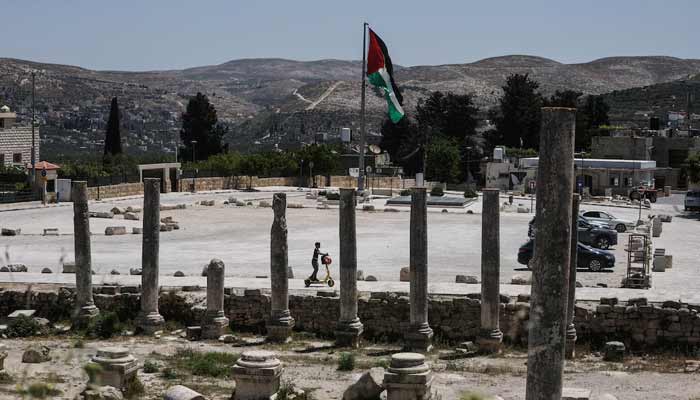
A Palestinian boy rides a scooter among archaeological ruins in the ancient village of Sebastia, near Nablus in the Israeli-occupied West Bank, June 4, 2026.— Reuters/File
An Israeli proposal to extend civil control over historical sites in the West Bank has faced opposition from Palestinians and human rights organizations within Israel. Critics argue the legislation resembles a move to annex occupied territory and could facilitate further Jewish settlements.
The “Heritage Authority in Judea and Samaria” bill was approved in one of three votes by Israel’s parliament in May. It remains uncertain whether the final vote will occur before lawmakers disband ahead of an anticipated election on October 27.
The bill aims to transfer management of sites from the Roman, Byzantine, and Crusader periods under Israeli Ministry of Heritage authority, permitting expropriation and purchase of land across the West Bank—which Israel refers to by its Hebrew biblical name. This shift would effectively diminish oversight of certain ancient locations previously managed by the Palestinian Authority, which has limited self-governance under the 1990s Oslo Accords in parts of the West Bank, territory Israel has occupied since 1967.
Hani Al-Hayek, the Palestinian Authority’s tourism minister, stated, “Controlling these antiquities is intended to increase dominance and expand settlements deep into Palestinian territory.” Israel states that the bill is designed to safeguard historical sites.
Village near the historic site of Sebastia faces potential land seizure
Peace Now, an organization monitoring Israeli settlements, called the bill a “completely annexationist move” that would result in widespread confiscation of Palestinian land. While using archaeology as a means to justify settlement expansion isn’t new, Peace Now emphasized that the current measures by the Israeli government are unprecedented in scope.
A case in point is the Palestinian village of Sebastia in the northern West Bank, where residents—many with roots tracing back centuries—depend heavily on tourism linked to a nearby archaeological site. Archaeologists identify this site as containing relics from the 9th-century BC Israelite kingdom, along with remnants from Roman, Byzantine, Crusader, and Ottoman eras. It is currently under consideration for UNESCO World Heritage status.
In late 2025, Israel announced plans to seize approximately 1,800 dunams (about 445 acres) at Sebastia, citing development projects. Village officials report that this action would impact around 5,000 olive trees cultivated in the area.
Sebastia’s Deputy Mayor, Nizar Kayed, commented, “They are claiming areas with water sources, roads, and historical sites, leaving us without vital resources. This is part of their settlement expansion effort.” Since late 2023, local tourism has declined, partly due to regional conflicts, affecting businesses like Nahed Sakha’s restaurant, which sits on land slated for confiscation.
“The Israeli plan appears aimed at disconnecting the archaeological site from the local community,” Sakha added.
Israel points to historical and biblical connections to justify its actions
Israeli parliament member Zvi Sukkot, a proponent of the bill, asserts that expanding Israeli control over these sites is meant to protect relics dating back to biblical times. “This doesn’t alter the legal status of Judea and Samaria,” he told Reuters.
He added, “Many are uncomfortable with our effort to demonstrate the ties between the people of Israel and this land. All the biblical stories and our history originate in Judea and Samaria.” Sukkot belongs to the religious Zionist party that supports settlements and opposes the creation of a Palestinian state, favoring annexation instead.
International bodies and most nations regard Israel’s settlements as illegal under international law, particularly citing the Fourth Geneva Convention, which prohibits relocating civilians into occupied territories. Israel disputes this, asserting that the West Bank is disputed land inherited from biblical and historical claims and citing security concerns.
The new bill has also alarmed some Israeli legal officials and scientists. The Israel Academy of Sciences and Humanities issued an open letter to Netanyahu and Sukkot, urging its withdrawal. They warned that the legislation could harm Israel’s international reputation in archaeology and other scientific fields.
 ChatGPT
 Perplexity
 Gemini AI
 Grok AI