Tag: West Bank

  • Palestinians oppose Israeli efforts to seize West Bank heritage sites

    Palestinians oppose Israeli efforts to seize West Bank heritage sites

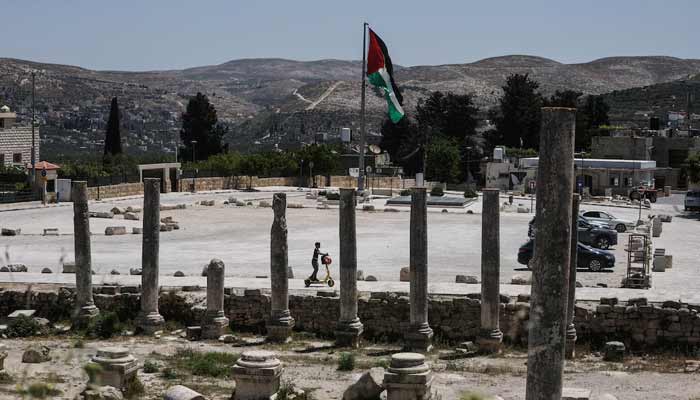
    A Palestinian boy rides a scooter among archaeological ruins in the ancient village of Sebastia, near Nablus in the Israeli-occupied West Bank, June 4, 2026.— Reuters/File

    An Israeli proposal to extend civil control over historical sites in the West Bank has faced opposition from Palestinians and human rights organizations within Israel. Critics argue the legislation resembles a move to annex occupied territory and could facilitate further Jewish settlements.

    The “Heritage Authority in Judea and Samaria” bill was approved in one of three votes by Israel’s parliament in May. It remains uncertain whether the final vote will occur before lawmakers disband ahead of an anticipated election on October 27.

    The bill aims to transfer management of sites from the Roman, Byzantine, and Crusader periods under Israeli Ministry of Heritage authority, permitting expropriation and purchase of land across the West Bank—which Israel refers to by its Hebrew biblical name. This shift would effectively diminish oversight of certain ancient locations previously managed by the Palestinian Authority, which has limited self-governance under the 1990s Oslo Accords in parts of the West Bank, territory Israel has occupied since 1967.

    Hani Al-Hayek, the Palestinian Authority’s tourism minister, stated, “Controlling these antiquities is intended to increase dominance and expand settlements deep into Palestinian territory.” Israel states that the bill is designed to safeguard historical sites.

    Village near the historic site of Sebastia faces potential land seizure

    Peace Now, an organization monitoring Israeli settlements, called the bill a “completely annexationist move” that would result in widespread confiscation of Palestinian land. While using archaeology as a means to justify settlement expansion isn’t new, Peace Now emphasized that the current measures by the Israeli government are unprecedented in scope.

    A case in point is the Palestinian village of Sebastia in the northern West Bank, where residents—many with roots tracing back centuries—depend heavily on tourism linked to a nearby archaeological site. Archaeologists identify this site as containing relics from the 9th-century BC Israelite kingdom, along with remnants from Roman, Byzantine, Crusader, and Ottoman eras. It is currently under consideration for UNESCO World Heritage status.

    In late 2025, Israel announced plans to seize approximately 1,800 dunams (about 445 acres) at Sebastia, citing development projects. Village officials report that this action would impact around 5,000 olive trees cultivated in the area.

    Sebastia’s Deputy Mayor, Nizar Kayed, commented, “They are claiming areas with water sources, roads, and historical sites, leaving us without vital resources. This is part of their settlement expansion effort.” Since late 2023, local tourism has declined, partly due to regional conflicts, affecting businesses like Nahed Sakha’s restaurant, which sits on land slated for confiscation.

    “The Israeli plan appears aimed at disconnecting the archaeological site from the local community,” Sakha added.

    Israel points to historical and biblical connections to justify its actions

    Israeli parliament member Zvi Sukkot, a proponent of the bill, asserts that expanding Israeli control over these sites is meant to protect relics dating back to biblical times. “This doesn’t alter the legal status of Judea and Samaria,” he told Reuters.

    He added, “Many are uncomfortable with our effort to demonstrate the ties between the people of Israel and this land. All the biblical stories and our history originate in Judea and Samaria.” Sukkot belongs to the religious Zionist party that supports settlements and opposes the creation of a Palestinian state, favoring annexation instead.

    International bodies and most nations regard Israel’s settlements as illegal under international law, particularly citing the Fourth Geneva Convention, which prohibits relocating civilians into occupied territories. Israel disputes this, asserting that the West Bank is disputed land inherited from biblical and historical claims and citing security concerns.

    The new bill has also alarmed some Israeli legal officials and scientists. The Israel Academy of Sciences and Humanities issued an open letter to Netanyahu and Sukkot, urging its withdrawal. They warned that the legislation could harm Israel’s international reputation in archaeology and other scientific fields.

  • Jerusalem Stone’s Popularity Persists Amid West Bank Economy

    Jerusalem Stone’s Popularity Persists Amid West Bank Economy

    A truck moves through the Jerusalem stone limestone quarry in Beit Fajar, located eight kilometers south of Bethlehem in the Israeli-occupied West Bank, on November 10, 2025. — AFP

    Despite the devastating condition of the Palestinian economy, Faraj al-Atrash, who manages a quarry in the West Bank, proudly observes a convoy of machinery actively cutting into towering walls of dusty white rock stretching into the horizon.

    “This is considered the primary income source for the entire area,” Atrash stated at the site near Beit Fajjar, close to Hebron.

    The quarry produces Jerusalem stone, the renowned light-colored rock used across the Holy Land and beyond for thousands of years, giving the region its characteristic architectural appeal.

    However, Atrash, in his fifties, expressed concern: “Our livelihood is constantly threatened.”

    “Lately, it feels like the occupation (Israel) has started targeting us economically,” he added.

    Atrash is worried about potential confiscation of industrial equipment, the ongoing expansion of Israeli settlements, and the worsening Palestinian financial crisis.

    The conflict in Gaza, initiated by Hamas’s October 2023 assault on Israel, dealt a harsh blow to an economy already in decline.

    According to a late November report by the United Nations Conference on Trade and Development, the Palestinian territories are currently experiencing “the worst economic crisis ever recorded.”

    Israel, which has occupied the West Bank since 1967, has recently established hundreds of new checkpoints, disrupting commercial transportation.

    Restrictions extend beyond mobility; the halt of permits for West Bank Palestinians seeking work in Israel has hit hard.

    Soaring Costs

    “There are issues with exports and market access because we previously exported most of our stone to Israel, but after October 7, things became difficult,” explained Ibrahim Jaradat, whose family has operated a quarry near Sair—close to Hebron—for over four decades.

    The Palestinian Authority, which holds limited civilian authority in parts of the West Bank, is approaching bankruptcy.

    Atrash remarked that public services are worse than ever, with fixed costs like water and electricity skyrocketing.

    Quarries contribute 4.5% to Palestinian GDP and employ nearly 20,000 individuals, according to the Hebron Chamber of Commerce.

    About 65% of exports go to Israel, where some municipalities require Jerusalem stone for construction.

    “Most of our buyers are Israelis who resell the stone to construction sites,” said Abu Walid Riyad Gaith, a 65-year-old quarry operator.

    He lamented what he perceives as a lack of support from Arab nations, which he claims do not purchase enough of the stone.

    ‘Afraid to Build’

    Other risks threaten the industry. Most of the roughly 300 quarries in the West Bank are situated in Area C, a region under full Israeli control that encompasses the majority of settlements.

    “Many Israeli settlers pass through here, and if Israel annexes parts of Palestine, these areas will be among the first,” stated one operator who requested anonymity.

    Certain members of Israel’s government, noted for being among the most right-wing ever, openly discuss plans to annex parts or the entirety of the West Bank.

    International law considers Israeli settlements in the West Bank illegal.

    They are expanding faster than at any time since at least 2017, when the UN began tracking such growth, according to a recent UN report.

    The physical demands of quarry work are intense, yet many Palestinians have limited alternatives as their economy deteriorates.

    “We are working ourselves to exhaustion,” Atrash said, pointing to his ten laborers shoveling in large pits, clouds of dust covering them in white residue.

    In a neighboring quarry, a former geography teacher, blinking and coughing amid strenuous work, shared that due to the Palestinian Authority’s budget crisis, he no longer receives a salary and has sought employment in the only sector still hiring.

    All workers interviewed reported suffering from back, eye, and throat issues.

    “We call it white gold because it usually brings significant income,” said Laith Derriyeh, who works for a stonemason.

    “But now, everything is complicated. It’s very hard to envision a future.”

    “People have no money, and those who do are afraid to build,” he added.

    Jamaal, who has been cutting limestone for 40 years, used a cutter alongside his colleagues at a Jerusalem stone factory in Beit Fajar, highlighting the ongoing struggles faced by workers in this essential industry.

  • Settler Violence Disrupts West Bank Olive Picking Season

    Settler Violence Disrupts West Bank Olive Picking Season

    Volunteers assist Palestinian farmers in harvesting olives in Birzeit, north of Ramallah in the Israeli-occupied West Bank, on October 23, 2025. — AFP

    The scene was shocking and emphasized the violence surrounding this year’s olive harvest in the West Bank: a masked young man hits an elderly Palestinian woman picking olives, causing her to fall to the ground.

    The incident occurred during an attack by Israeli settlers, captured by an American journalist, in the town of Turmus Ayya near Ramallah — a hotspot of violence this year.

    “Everyone was fleeing because the settlers attacked suddenly, possibly around 100 of them,” witness Yasser Alkam told AFP, adding that a Swedish activist was also injured with broken arms and legs by settlers.

    Alkam, a local official in Turmus Ayya, explained that the woman, 55-year-old Um Saleh Abu Aliya, was struck while waiting for her son to take her away from the mob of settlers.

    “Retaliation would only escalate the violence, sometimes supported by the military,” lamented Nael al-Qouq, a farmer from Turmus Ayya, who was prevented from reaching his olive trees that same day.

    Expanded settlements

    Near the scene, an Israeli flag fluttered on a settlement outpost that is illegal under Israeli law.

    The military eventually arrived in Turmus Ayya and dispersed the crowd with tear gas, an AFP journalist observed.

    But prior to that, some youths who descended on the village set fire to at least two vehicles.

    The head of West Bank Israeli police, Moshe Pinchi, reportedly instructed district commanders to find the man who attacked Abu Aliya, according to a leaked WhatsApp message shared by Israeli media.

    Israel’s military told AFP that it “collves in coordination with the Israel Police to enforce law concerning Israelis involved in such incidents.”

    However, Turmus Ayya is not an isolated incident. AFP journalists have documented at least six cases where Palestinians were denied access to their land, attacked by settlers, or vandalized during this year’s olive harvest.

    Clashes in rural areas have intensified this year, driven by the ongoing expansion of Israeli settlements and an increasing number of settlers — not all of whom participate directly in violence against Palestinians.

    More than 500,000 Israelis reside in settlements in the West Bank, occupied by Israel since 1967.

    All these settlements are considered illegal under international law.

    Uprooted

    Near Turmus Ayya, in Al-Mughayyir village, one farmer was completely barred from harvesting.

    “I own ten dunams (about one hectare) of olive trees. All that’s left are the trees in my yard… they uprooted everything,” said Abdul Latif Abu Aliya, 55.

    His land borders a road, beyond which three trailers form a recently established settlement outpost.

    After a settler was injured in an altercation near Abu Aliya’s home, the military ordered the trees his ancestors planted to be uprooted.

    Bulldozers pushed soil and roots halfway up the hillside, about 100 meters from his family’s house, creating a barrier that Abu Aliya and his family avoid crossing for fear of settler attacks.

    Palestinian farmers argue with security forces after their harvest was disrupted and halted by Israeli settlers in Sa’ir village, near Hebron, on October 23, 2025. — AFP

    Amid unprecedented violence during this year’s olive harvest, the Palestinian Authority’s agriculture minister called on the international community to help protect farmers and harvesters.

    “This is the worst season in the past 60 years,” said Agriculture Minister Rizq Salimia, noting that the harvest was already challenged by poor weather conditions.

    Ajith Sunghay, head of the UN Human Rights Office in Palestinian territories, condemned the “severe attacks” affecting this year’s harvest and highlighted the “dangerous levels of impunity” for those responsible.

    Once a peaceful tradition bringing Palestinian families together, the olive harvest in recent years has turned into increasingly violent confrontations involving settlers, soldiers, Palestinian workers, and foreign activists.

    As the harvest season begins in October and runs through mid-November, Palestinians across the West Bank harvest olives deeply tied to their national identity.

    According to the 2021 census by the agriculture ministry, the West Bank has over eight million olive trees for a population of three million Palestinians.

    Every autumn, farmers and city residents with a few trees venture into the fields to pick olives primarily by hand.

    The UN’s humanitarian agency, OCHA, reported that during the week of October 7 to 13 alone, 27 villages experienced attacks related to the harvest.

    “These included assaults on harvesters, theft of crops and equipment, and vandalism of olive trees,” OCHA stated, resulting in injuries and property damage.

  • Israel Bulldozes Trees in West Bank, No Olive Branch for Gazans

    Israel Bulldozes Trees in West Bank, No Olive Branch for Gazans

    A Palestinian man observes olive trees that have been uprooted by Israeli soldiers operating a bulldozer in the West Bank village of Al-Mughayyir, located north of Ramallah, on August 24, 2025.— AFP

    Israeli bulldozers tore out hundreds of trees in the village of al-Mughayyir in the West Bank on Sunday, with military forces on-site, according to AFP reporters.

    Most of the damaged trees were olive trees, which are vital to both the economy and culture of the region. Olive groves have historically been a contentious issue, frequently leading to disputes between Palestinian farmers and Israeli settlers.

    Local farmer Abdelatif Mohammed Abu Aliya explained he lost olive trees that were over 70 years old spanning about one hectare of land. “They completely uprooted and leveled them under false pretenses,” he said, noting that villagers have already begun replanting.

    Photographers from AFP captured scenes of disturbed soil, felled olive trees, and several bulldozers working on nearby hills.

    One bulldozer prominently displayed an Israeli flag, with military vehicles parked nearby.

    “The aim is to maintain control and force people to leave. This is just the beginning — it will spread throughout the entire West Bank,” stated Ghassan Abu Aliya, who heads a local agricultural group.

    Residents reported that the bulldozing activities started on Thursday. A Palestinian NGO revealed that 14 individuals had been detained in the village over the previous three days.

    When questioned about the event, the Israeli military responded late Sunday that they had “initiated intensive operational activity in the area” following a “serious shooting attack near the village.”

    On August 16, the Palestinian Authority announced that an 18-year-old man was shot and killed by Israeli forces in the same village.

    The military clarified that their response to stone-throwing by “terrorists” did not directly connect to the young man’s death.

    A widely circulated video in Israeli media on Friday shows a senior military officer referencing the attack in al-Mughayyir, vowing that “every village and every enemy… will pay a heavy price” for assaults against Israelis.

    Avi Bluth, the top military commander in the West Bank, states in the video that the villages of Palestinian attackers could face measures like curfews, sieges, and terrain-shaping operations aimed at deterrence.

    Violence in the West Bank has intensified since the Gaza conflict began following Hamas’s October 7, 2023, attack on Israel.

    Since then, at least 971 Palestinians—including militants and civilians—have been killed by Israeli soldiers or settlers in the West Bank, according to AFP figures based on Palestinian Authority data.

    In the same timeframe, at least 36 Israelis, both civilians and military personnel, have been killed in attacks or military actions in the region, according to official Israeli sources.

    The West Bank, occupied by Israel since 1967, is home to approximately three million Palestinians and 500,000 Israelis living in settlements that are deemed illegal under international law.

  • UN Rights Office: Israeli Settlement Plan Violates International Law

    UN Rights Office: Israeli Settlement Plan Violates International Law

    A flag representing Israel waves in the foreground, with the Israeli settlement of Maale Adumim visible in the background, located in the Israeli-controlled West Bank on August 14, 2025. — Reuters

    – Israeli minister promises the project will “eliminate” the concept of a Palestinian state.
    – United Nations warns that the plan will divide the West Bank into separate, isolated areas.
    – Approximately 700,000 Israeli settlers reside among 2.7 million Palestinians in the region.

    The UN Human Rights Office announced on Friday that Israel’s proposal to construct thousands of new homes between an established settlement in the West Bank and near East Jerusalem is illegal under international law. They also stated that the plan could force Palestinians to face eviction, which they characterized as a war crime.

    On Thursday, Israeli far-right Finance Minister Bezalel Smotrich committed to pushing forward a long-delayed settlement initiative, claiming it would effectively “bury” the idea of establishing a Palestinian state.

    The UN human rights spokesperson indicated that this plan would fragment the West Bank into disconnected enclaves and emphasized that it is “a war crime for an occupying power to transfer its own civilians into the territory it occupies.” Currently, about 700,000 Israeli settlers live amid 2.7 million Palestinians across the West Bank and East Jerusalem. Israel annexed East Jerusalem in 1980—a move most countries do not recognize—though it has not officially extended sovereignty over the West Bank.

    Most countries believe that expanding settlements undermines the prospects of a two-state solution by dividing the territory Palestinians envision for an independent state. That framework proposes a Palestinian state in East Jerusalem, the West Bank, and Gaza, all existing alongside Israel—the territories captured during the 1967 Middle East conflict.

    Israel claims historical and biblical ties to the land, asserting that settlements enhance its strategic depth and security. The Israeli government also states that the West Bank is “disputed territory,” not “occupied.”

  • Israeli Forces Arrest 30 Palestinians in West Bank: Latest Developments

    Israeli Forces Arrest 30 Palestinians in West Bank: Latest Developments

    In a collaborative announcement, the Palestinian Detainees and Ex-Detainees Commission, along with the Palestine Prisoners Society, reported that over 30 individuals have been apprehended in just the last 24 hours.

    The statement elaborated that since the onset of Israel’s extensive military campaign in the West Bank last Wednesday, more than 180 Palestinians have been detained by Israeli forces.

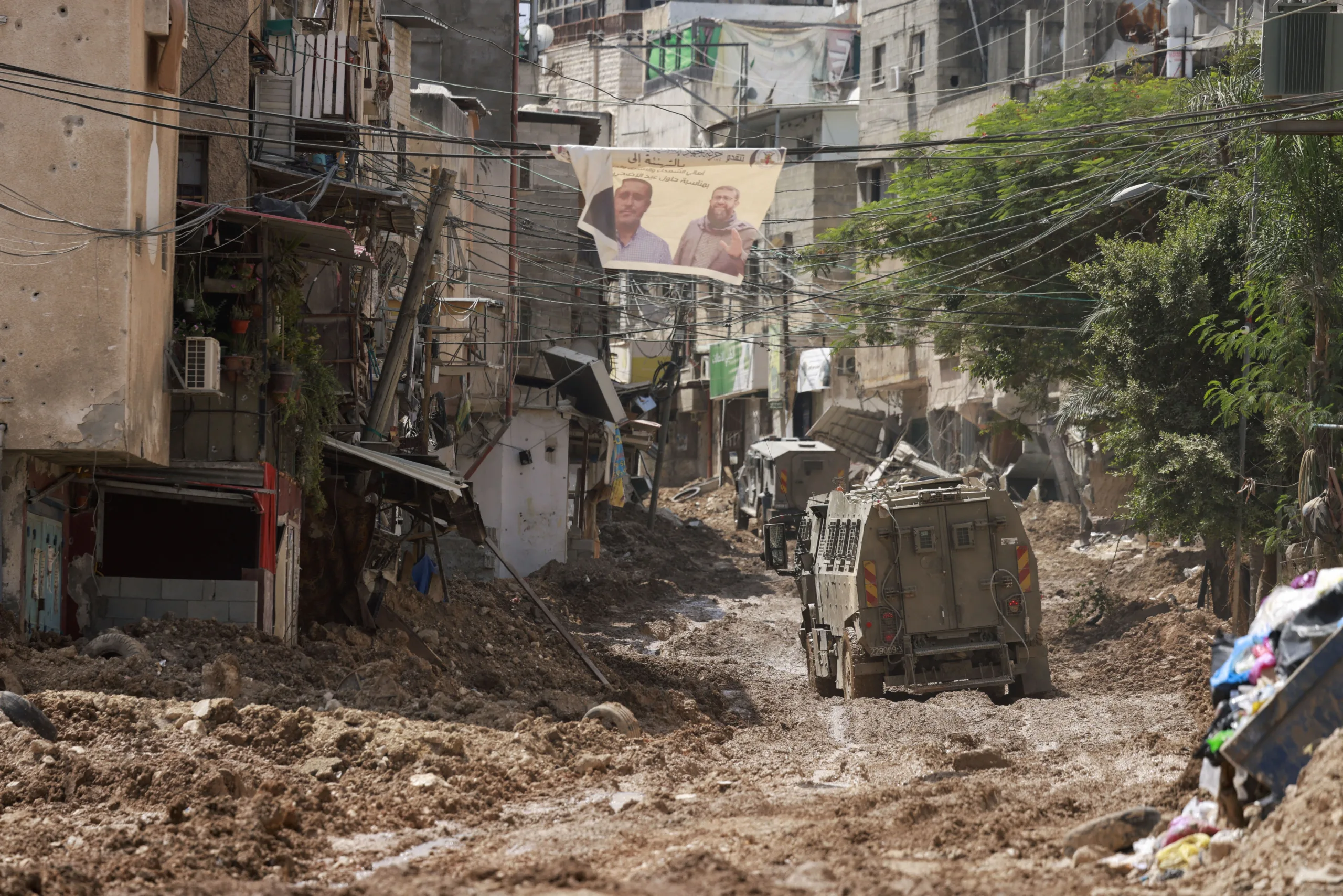
    In the meantime, Israeli soldiers have continued their assault on Jenin and its refugee camp for the seventh consecutive day. To date, these operations have resulted in the deaths of 19 people, with hundreds more injured or taken into custody, alongside the destruction of civilian properties and crucial infrastructure, including water and electricity systems.

    The Palestine Prisoners Society and the Commission noted that the total number of Palestinians detained in the occupied West Bank since October 7th has surpassed 10,400. This figure encompasses those imprisoned in their own homes, detained at military checkpoints, surrendered under duress, and those held as prisoners.

    Later that night, Israeli soldiers and a special forces unit invaded the village of Qabatiya, opening fire on residential buildings and fatally shooting a young man in the chest while he remained inside his home.

    Last night, Israeli forces detained an ambulance crew responding to an emergency medical call at Khalil Suleiman Governmental Hospital in Jenin, even attacking several members of the team.

    At dawn today, Israeli soldiers targeted the village of Muthalath Al-Shuhada, south of Jenin, deploying snipers on rooftops, raiding six homes, and apprehending several civilians before retreating.

    This past Wednesday, the Israeli military declared a “major operation,” characterizing it as the largest military action in the West Bank since the Palestinian Intifada of 2002. Hundreds of troops were dispatched to various camps, supported by drones, bulldozers, and live ammunition.

    Footage shared online demonstrated Israeli troops and bulldozers breaching the Jenin refugee camp, with additional military reinforcements arriving, as the army reportedly sealed off all entrances and exits of the camp.