

Select Language:
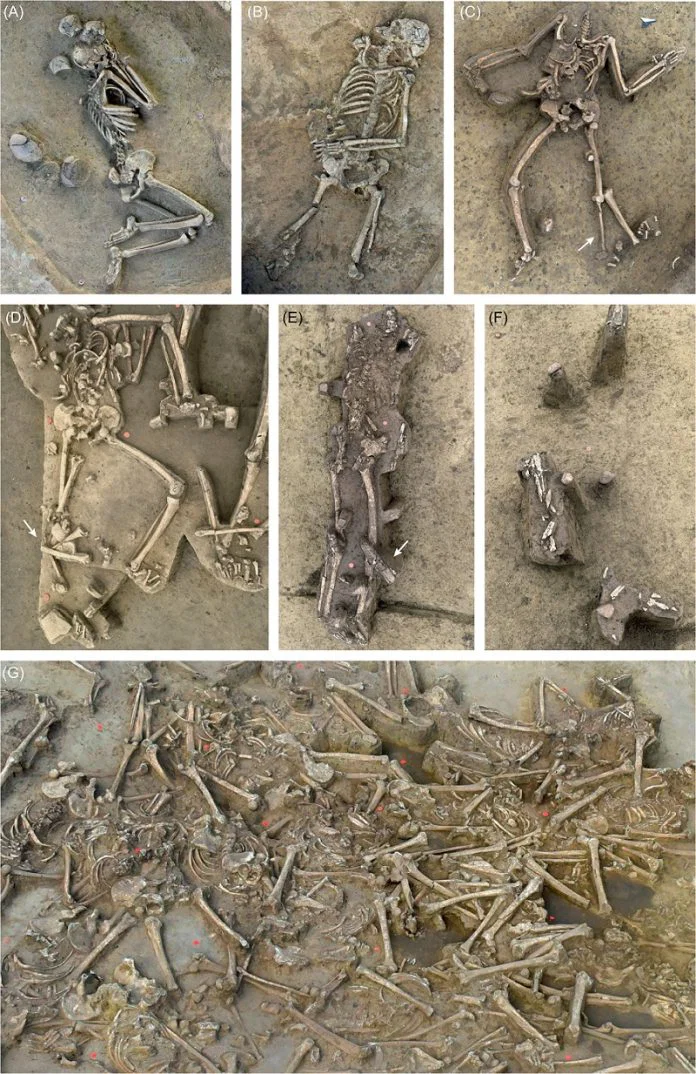
A significant archaeological find in Slovakia is challenging previous beliefs about life and death among Europe’s earliest farming communities. Since 2022, excavations at a 7,000-year-old settlement near Vráble have uncovered a striking scene: numerous human skeletons grouped together in and around a ditch, with most of the skulls missing.
Initially, these remains resembled evidence of a violent massacre. However, recent research points to a different interpretation. The site at Vráble is one of the key locations associated with the Linear Pottery culture, one of the continent’s earliest farming societies. The settlement, dating from approximately 5250 to 4950 BCE, once housed hundreds of dwellings. At its height, around 80 houses might have been occupied simultaneously.
Part of the settlement was enclosed by a ditch, likely serving as a boundary marker. Near one entrance to this enclosed area, archaeologists discovered the remains of at least 78 individuals. Notably, 77 of these bodies were missing their skulls, with only one child retaining their head. The bodies were buried in varied positions, with no clear pattern, and evidence suggests the heads were removed delicately rather than violently. The neck bones lack signs of brutal decapitation, indicating the skulls were carefully taken after death, which may have held cultural or spiritual significance.
The fate of the missing heads remains uncertain. It’s possible they were stored or buried elsewhere, although no separate skull collection has yet been identified at Vráble. Historically, such discoveries were often interpreted as signs of violence or social breakdown, especially since other sites from the same period show similar deposits of human remains.
Yet, the current research suggests that violence wasn’t the primary cause. Instead, the treatment of these bodies might reflect complex ritual practices that reinforced social bonds or spiritual beliefs within and between groups. These practices demonstrate that ancient peoples may have had very different views on death than we do today. Behaviors that seem disturbing now could have been meaningful traditions in Neolithic society.
Ongoing studies aim to identify the age, sex, and origins of these individuals by analyzing their bones, as well as examining marks on the neck vertebrae. DNA testing and isotope analysis could shed light on their diets, mobility, and familial relationships.
As new insights emerge, the mysterious headless skeletons of Vráble could prove invaluable in understanding how Europe’s earliest farmers viewed death, identity, and community thousands of years ago.
 ChatGPT
 Perplexity
 Gemini AI
 Grok AI


