

Select Language:
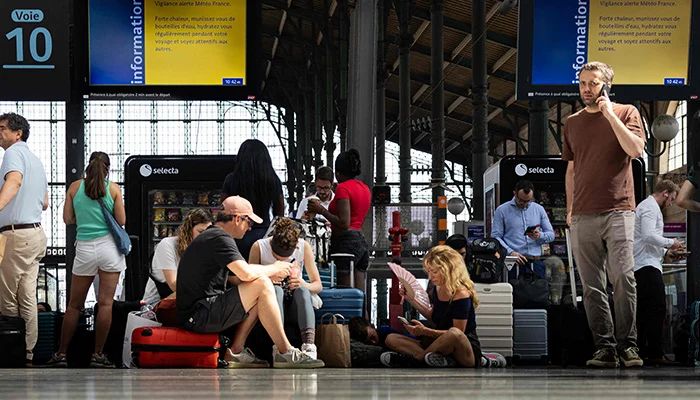
Passengers wait for their train at Gare du Nord in Paris on June 22, 2026, shielding themselves from the heat with fans underneath SNCF information panels about the heatwave. — AFP
The intense heat enveloping much of Europe this week is revealing the vulnerabilities of rail infrastructure built during cooler periods, causing delays and cancellations. Travelers with health concerns are advised to avoid trips if possible.
Overhead power lines that expand and sag, rails that slightly widen when heated by the sun, and over-heated air conditioning systems are primary issues impacting train services where maintenance spending has often fallen short.
### Why are trains getting canceled?
In France and Belgium, much of the rail network and rolling stock are several decades old, apart from newer high-speed lines. When they have air conditioning, systems often shut down automatically if the train gets too hot, prompting operators to cancel the most vulnerable routes proactively.
Belgium’s national railway SNCB has temporarily removed non-air-conditioned trains during peak hours, while France’s SNCF has pulled back 10% of Paris region trains to prevent permanent track deformation caused by excessive heat.
The overhead catenary wires, which supply electricity to trains, can also sag as the metal expands in the heat, increasing the risk of snagging or breakage. Severine Lepere, SNCF’s director for the Paris area, points to a suspected cause of a major freight train outage at Gare de l’Est on June 18 as a broken power line.
### What makes this heatwave different?
Unlike brief spikes in temperature, this heatwave is notable because high temperatures have persisted for several days without significant cooling at night. Forecasts predict sustained days with temperatures at or above 104°F (40°C). Track temperatures can hit as high as 140°F (60°C), dangerously causing metal to stretch or widen—similar to the risks faced by power lines.
Engineers are particularly worried about track buckling and derailments, which threaten safety. John Lawrence, chair of the Railway Technical Network at the UK’s Institution of Engineering and Technology, explains that such issues can lead to derailments and cause overhead lines to sag, potentially halting train movement or forcing long detours.
Electronic signaling equipment also has a chance of failing under these extreme conditions.
### Why is this happening in Europe and not elsewhere?
Trains operate in high temperatures in regions like India and Africa, but those areas typically lack high-speed networks comparable to Europe’s. The high speeds in Europe demand extremely reliable tracks and tight tolerances, according to Pierre Plaindoux, a rail expert at MC2I consulting.
In the US and Canada, passenger trains primarily operate on diesel-powered trains over major routes, with overhead power lines rarely used—mild weather and different infrastructure reduce heat-related issues.
### What are the potential solutions?
One approach involves better tracking of track temperatures to set speed limits instead of canceling trains preemptively. In countries with lower labor costs, inspectors often walk the lines, but France is planning to install more sensors to monitor conditions directly.
Another method is to paint tracks white to reflect sunlight and reduce heat absorption, a strategy increasingly adopted in Britain, Italy, and other countries. According to Antonios Kanellopoulos, associate professor at the University of Hertfordshire, reflective paint can lower rail temperatures by 5-10°C.
Installing more rigid power lines that don’t sag easily in the heat is also being explored. France has already installed such lines over several dozen kilometers on high-traffic routes, but extending these over longer distances is limited by cost, explains Plaindoux.
### Images:
– Passengers shield themselves with fans and hand fans while waiting for their train amidst the heat at Gare du Nord, Paris, June 22, 2026.
– A thermometer showing 37.6°C in Toulouse during the heatwave on June 23, 2026.
– A train on the tracks at Gare de l’Est, Paris, March 14, 2026.
 ChatGPT
 Perplexity
 Gemini AI
 Grok AI