

Select Language:
Scientists have uncovered a unique property of chicken eggs that could potentially address one of the poultry industry’s major ethical issues. By shining light into intact eggs, researchers have found a way to look inside without cracking the shell open. This method could one day help determine the sex of the developing embryo, identify fertilized eggs, and evaluate egg quality.
If this approach proves successful, it might reduce the current practice of killing male chicks shortly after they hatch. In the poultry industry, male chicks are often considered unprofitable because they can’t lay eggs and don’t grow fast enough for meat production. Consequently, over 300 million male chicks are culled annually in European hatcheries alone. This practice has faced heavy criticism from animal welfare advocates, prompting several countries to seek alternatives.
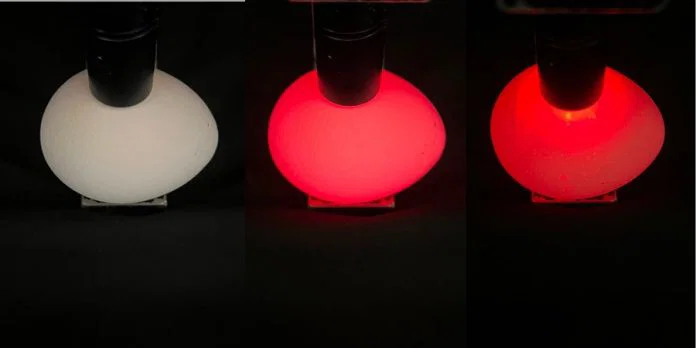
The research focused on how light behaves inside a chicken egg. Scientists discovered that when light enters an unbroken eggshell, it doesn’t just pass through; instead, the shell traps the light, causing it to bounce around repeatedly inside. Tiny particles of light, known as photons, can travel up to two meters inside an egg—despite the egg’s only about four centimeters in length. This means the photons’ paths are roughly 50 times longer than the egg itself.
The team examined how visible and near-infrared light moved through whole eggs before incubation and during the first eight days of embryo development. They described the eggshell as an “integrating sphere,” acting like a small chamber that effectively scatters and traps light. The eggshell’s ability to keep photons inside was surprising, as such long light paths are rarely observed in natural materials.
This discovery opens up exciting possibilities. Since light interacts with the structures inside the egg, scientists could someday analyze the returning light to gather information about the embryo’s development without physically disturbing the shell. This could enable non-invasive methods to determine if an egg is fertilized, monitor embryo growth, and detect the embryo’s sex.
The technique falls under the field of optical spectroscopy, which uses light to reveal physical and chemical properties. Similar methods are already employed in medicine to examine tissues and organs, as well as in agriculture to study fruits and plants.
However, the researchers note that much work remains. The light behavior inside eggs is complex and not fully understood yet. Future studies will explore how these light patterns evolve as the embryo continues to develop and how various parts of the egg influence these effects.
Scientists also speculate that this remarkable ability of eggs to scatter light may have evolved to shield developing embryos from harmful ultraviolet radiation and help conserve temperature when parent birds leave the nest. Although this technology is still in its early stages, shining light into eggs could one day lead to more humane and sustainable poultry farming practices.
 ChatGPT
 Perplexity
 Gemini AI
 Grok AI