

Select Language:
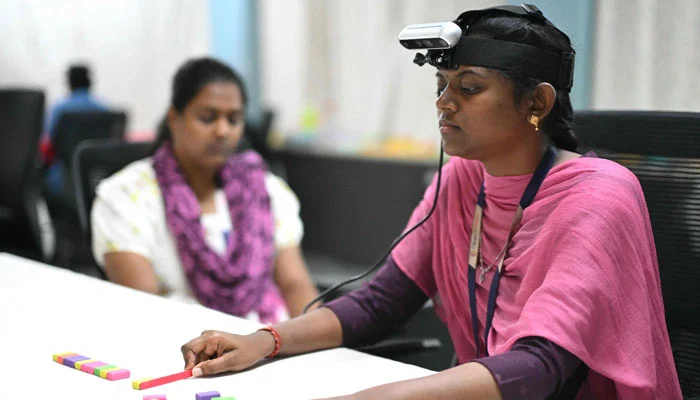
A female worker in Tamil Nadu’s Karur district, equipped with a head-mounted RGB camera, captures her actions through motion capture while organizing colored blocks at the AI data company Objectways’ office, as reported by AFP.
Clad with a smartphone on her head, Nagireddy Sriramyachandra, an Indian housewife, films herself as she slices mangoes to help train AI-powered robots for household tasks in the future. Her simple recordings, earning her just over two dollars per hour, are highly valued by global tech corporations seeking to teach machines how to operate like humans in real-world settings.
At 25 years old, she represents a growing number of thousands of AI system trainers across India. “Who else would pay INR 250 an hour just to do housework?” Sriramyachandra remarks from her Chennai kitchen. She also hopes she might get a robot of her own someday.
While chatbots and image generators process massive amounts of digital data easily, designing systems capable of navigating physical environments remains complex. Developers believe that feeding first-person footage—known as “egocentric data”—to specialized AI models can teach robots to imitate human movements. Some trainers work from home, while others in factories or dedicated studios, using video glasses, head-mounted cameras, and motion sensors.
Sriramyachandra explains that her recordings often prompt alerts like “‘hands not detected'” when not recorded properly, and she uploads these via an app to Objectways, which has offices both in India and the U.S. and serves Fortune 500 companies, including collaborations with Amazon SageMaker for machine learning development.
The humanoid robot industry is experiencing rapid growth, with Morgan Stanley forecasting over a billion robots in use by 2050 mainly for industrial and commercial purposes. “Folding clothes, making coffee, cooking—particularly specific tasks like sandwich preparation,” says Ravi Shankar, Objectways’ head, listing the types of footage clients request. “Certain jobs will be automated so humans can focus on better things.”
In India, the emerging field of spatial AI is creating new job opportunities—at least for now. Though the company’s CEO is based in the U.S., he hires from Tamil Nadu, a key hub for tech talent. At a textile factory in Karur, workers are seen wearing head cameras and smart glasses supplied by Objectways as they attach labels to caps and iron cloth bags. India has positioned itself as a global intermediary for creating, processing, and annotating AI data.
“These data collection services are likely to grow,” states Aditi Surie, a digital labor expert from the Indian Institute for Human Settlements in Bengaluru.
India is rapidly developing its AI sector, but officials recognize that alongside the promised benefits, automation also presents risks. Niti Aayog, a government think tank, notes that most discussions around AI and employment focus on white-collar jobs, predicting significant job losses without urgent government action. Little attention, the report emphasizes, is given to how AI could assist the 490 million informal workers who underpin India’s economy. The report examines how AI might impact various professions, from cobblers and sewer cleaners to farmers and tea vendors.
Ponni, 55, from Bengaluru, has been making flower garlands on the roadside for over a decade. She, too, has had a phone strapped to her forehead for data collection. “Future generations… who might have to do similar work, will face challenges,” she comments.
In Objectways’ studio, trainers film themselves performing household chores inside mock-up, fully furnished apartments. After thousands of hours of filming, the set is refreshed with new wallpapers to provide variety. Rani N., 21, an engineering graduate, takes breaks between sessions of folding towels, stating that she records around 90 videos a day, often in every corner of the bed. She finds the job “tolerable” but admits it makes her feel as though she’s constantly wearing a camera.
Other colleagues arrange and record household objects like pencil sharpeners, water bottles, and crayons using depth-sensing cameras. A subcontractor, Qanat Consulting in Andhra Pradesh, supplies recordings to a dozen larger data firms, relying on about 2,000 contributors who wear motion-sensor bands on their limbs—according to CEO Thaslim Pattan.
Meanwhile, Manish Agarwal from Bengaluru-based Humyn Labs, not affiliated with Objectways, records conversations alongside videos to help analyze speech patterns for clients. He believes that robots won’t replace human jobs but will instead work alongside humans. “Today, a welder in India might be managing an industrial robot in Prague,” he says.
 ChatGPT
 Perplexity
 Gemini AI
 Grok AI