
Select Language:
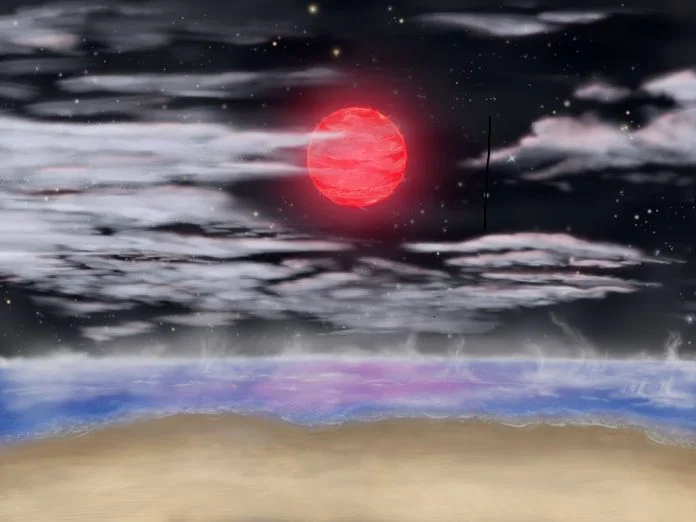
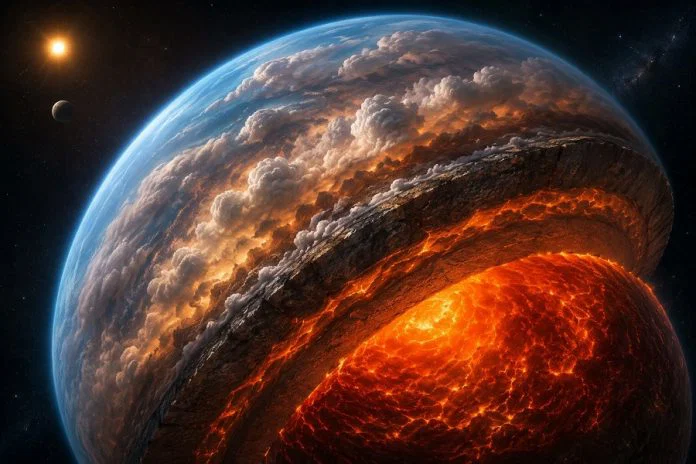
Scientists have uncovered that clouds on distant planets may serve purposes beyond just obscuring our view. Recent findings suggest these clouds are capable of trapping so much heat that they might melt the rocky surfaces of some planets, forming vast lakes or oceans of molten rock.
This breakthrough could reshape our understanding of the most prevalent types of planets in our galaxy. The planets in focus are known as sub-Neptunes—they are larger than Earth but smaller than Neptune. Despite being the most common planets in the Milky Way, their exact compositions remain a mystery. Some might be rocky bodies cloaked by thick hydrogen atmospheres, while others could be rich in water or carbon-based materials.
The James Webb Space Telescope (JWST) has been instrumental in examining these distant worlds’ atmospheres. However, it can only observe the upper atmospheric layers—not the layers beneath the clouds or deep inside the planet. This limitation makes it challenging to fully understand their true nature.
A recent study published in The Astrophysical Journal Letters suggests that clouds are more than just obscuring tools—they may actively influence the planets’ physical characteristics. Through sophisticated computer simulations, researchers from Arizona State University modeled how clouds form on sub-Neptune planets. They discovered that clouds composed of vaporized rock and salts can develop deep within the atmospheres, creating a thick insulating layer that traps heat migrating from the planet’s interior.
This heat retention leads to a significant temperature increase in the lower atmosphere, sometimes exceeding 1,000°C near the interface between the atmosphere and the planet’s core. Notably, on planets like GJ 1214 b and TOI-1231 b, such intense heating could melt the rocky surface beneath the clouds, resulting in massive magma oceans instead of solid ground.
The presence of magma oceans alters the interactions between the planet’s interior and its atmosphere. Just as volcanoes on Earth release gases, molten rock on these planets can also emit various chemicals, changing atmospheric composition. The study indicates that gases like oxygen, silicon hydride, and silicon monoxide are more readily released from the molten surface. In contrast, gases such as methane, water vapor, and ammonia tend to be absorbed back into the magma, reducing their presence in the atmosphere.
This dynamic suggests that the atmospheric signatures captured by JWST may not accurately represent the entire planet’s makeup, since internal processes could modify the gases that escape into space. Clouds aren’t just passive features—they may be fundamental to shaping a planet’s thermal evolution, size, and internal development.
Understanding these effects is crucial, especially as some sub-Neptunes are considered potential homes for life in certain conditions. Knowing how clouds influence their internal chemistry and structure can help scientists create more accurate models of these worlds.
This research marks a significant step toward solving the long-standing puzzle of what our galaxy’s most common planets are truly made of.
Source: Arizona State University.
 ChatGPT
 Perplexity
 Gemini AI
 Grok AI