الوسم: exoplanets

  • Astronomers Find 4 Unusual Planets Orbiting Nearby Star

    Astronomers Find 4 Unusual Planets Orbiting Nearby Star

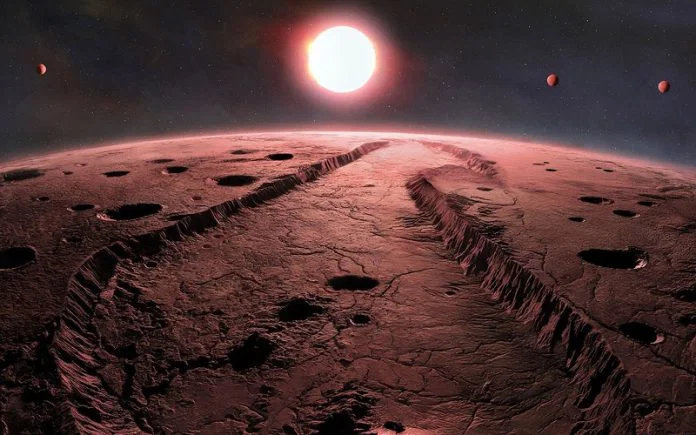
    Astronomers now have their most detailed view yet of a captivating group of small planets orbiting Barnard’s Star, one of the closest stars to our Sun. These worlds are unusual, rocky, and almost certainly incapable of supporting life.

    Barnard’s Star is less than six light-years away, making it the nearest neighbor after the Alpha Centauri system. In 2025, scientists detected four planets circling the star. All are smaller than Earth and Venus but larger than Mars, placing them in a size category with no counterparts in our solar system.

    Researchers from the University of Cambridge have now examined the star’s chemical makeup to infer what its planets might consist of. Since stars and their planets form from the same material, the elements present in the star can give important clues about their planetary compositions.

    They found that Barnard’s Star contains notably high amounts of magnesium. This indicates its planets are probably also rich in magnesium. On Earth, much of our magnesium is stored in olivine minerals, which are capable of holding water deep beneath the surface—potentially playing a role in Earth’s long-term water cycle.

    However, the planets around Barnard’s Star are likely quite different. Their high magnesium content probably results in the formation of large amounts of a mineral called periclase. Unlike olivine, which can trap water and is found near the surface on Earth, periclase is mostly located deep underground and is less effective at water storage.

    Adding to their harsh environment, the planets probably lack significant atmospheres. They orbit extremely close to Barnard’s Star—so near that even the outermost planet is about ten times closer than Mercury is to the Sun. This proximity, combined with their weak gravitational pull, suggests that radiation and stellar particles could have gradually stripped away any original atmospheres.

    It’s estimated that these atmospheres last no longer than about two billion years. Given that Barnard’s Star is roughly 10 billion years old, these planets might have been airless for most of their existence. They are also likely tidally locked, meaning one side always faces the star while the other remains in endless darkness—similar to how the Moon always shows the same face to Earth.

    Remarkably, despite these extreme conditions, the planets maintain stable orbits. The inner three planets are arranged in a resonance pattern with orbital periods in a 9:12:16 ratio, which may help keep their paths stable over time.

    Upcoming missions, like the European Space Agency’s Plato, are expected to discover many more small rocky planets like these. Although the worlds surrounding Barnard’s Star are probably uninhabitable, studying them offers valuable insights into what conditions might enable or prevent life on other planets, based on the star’s characteristics, planetary composition, and environmental dynamics.

    Source: KSR.

  • How a Slow Planet Spin Might Create a Venus-Like Scorching World

    How a Slow Planet Spin Might Create a Venus-Like Scorching World

    A planet’s rotation speed plays a significant role in shaping its climate and surface conditions. Earth, rotating approximately once every 24 hours, benefits from a rapid spin that helps distribute heat evenly and drives weather patterns, maintaining a habitable environment. In contrast, Venus takes about 243 Earth days to complete a single rotation, making it one of the slowest-spinning planets in our solar system. This slow rotation is linked to Venus’s thick, crushing atmosphere and extreme surface temperatures.

    Determining a planet’s rotation from afar isn’t straightforward. Astronomers often observe the movement of a planet’s atmosphere rather than its solid surface. For Venus, the upper atmosphere zips around the planet in just about four days, despite the planet itself rotating once every 243 days. Observing only atmospheric motion could lead scientists to overestimate the planet’s rotation rate by a factor of around 60.

    This presents a challenge when studying exoplanets, especially since we typically can’t directly see their surfaces. Looking at different wavelengths of light might be the key to disentangling atmospheric currents from the planet’s true rotation. For example, infrared observations can probe deeper atmospheric layers, allowing scientists to compare wind speeds at various depths. This approach can help distinguish how fast the planet actually spins underneath its atmospheric dynamics.

    The upcoming European Space Agency’s PLATO mission, set to launch in March 2027, aims to find hundreds of Earth-sized planets similar to Venus. By observing these planets over extended periods, PLATO will detect worlds with longer orbital periods that earlier surveys might have missed. Many of these planets are expected to orbit relatively bright stars, making them ideal targets for detailed follow-up studies with instruments like the James Webb Space Telescope.

    Studying the rotation rates of these Venus-like planets could provide vital clues as to why Venus evolved into an extremely hot, greenhouse-dominated world. If most of these planets are found to spin very slowly, it might suggest that slow rotation naturally leads to the extreme greenhouse conditions we see on Venus. Conversely, if their rotation speeds vary widely, other factors must be influencing their climates.

    Understanding these dynamics isn’t just about explaining Venus—they’re crucial for the search for life elsewhere. Accurate measurements of a planet’s rotation can improve climate models and help identify worlds with potential habitability. As we discover more planets resembling Venus and Earth, analyzing their spins could finally unravel why some become fiery hellscapes, while others become hospitable homes for life.

  • Scientists discover miniature rocky planets in perpetual darkness and daylight

    Scientists discover miniature rocky planets in perpetual darkness and daylight

    Astronomers have conducted their most detailed examination yet of the planetary system orbiting Barnard’s Star, one of our closest stellar neighbors. The findings indicate these nearby planets are quite different from anything in our own solar system. Although they are relatively close to Earth in cosmic terms, the planets appear to be dry, airless, and far too harsh to support life.

    Barnard’s Star is just under six light-years away, making it the closest individual star to the Sun after the Alpha Centauri system. In 2025, scientists confirmed that four small rocky planets orbit this star. Each planet is smaller than Earth and Venus but larger than Mars, placing them in a size range that doesn’t exist anywhere else in our solar system.

    The recent study, published in the Monthly Notices of the Royal Astronomical Society, involved researchers from the University of Cambridge who analyzed the star’s chemical makeup to better understand the composition of its planets. They found that Barnard’s Star has unusually high levels of magnesium. Lead author Xander Byrne from Cambridge’s Institute of Astronomy explains that this extra magnesium likely influenced how the planets formed billions of years ago.

    On Earth, much of the magnesium turns into minerals called olivines, which are essential for storing water deep within the planet. However, scientists believe that on the planets orbiting Barnard’s Star, the excess magnesium primarily formed a different mineral called periclase. Unlike olivine, periclase doesn’t retain water well, making these planets much drier than Earth.

    Furthermore, these planets likely lack long-lasting atmospheres. They orbit extremely close to their star — the outermost planet is about ten times closer than Mercury is to the Sun. Such proximity exposes them to intense radiation and stellar winds that can gradually strip away any atmosphere they might have had.

    Given their weak gravity and close orbits, the researchers estimate that any primordial atmospheres could have only persisted for around two billion years. Since Barnard’s Star is approximately 10 billion years old, those atmospheres would have disappeared billions of years ago.

    Another notable feature is that all four planets are probably tidally locked, meaning one side constantly faces the star while the other remains in perpetual darkness. This is similar to how the Moon always shows the same face to Earth. One side would be in constant daylight and extreme heat, while the dark side would remain cold and shadowed.

    Despite their tight spacing, the system appears surprisingly stable. Typically, planets so close together would exert strong gravitational pulls on each other, increasing the chances of collisions or ejections. However, the study found that their orbits are arranged in a pattern called orbital resonance. The inner three planets follow a repeating 9:12:16 orbital rhythm, a gravitational configuration that also helps stabilize some of Jupiter’s moons.

    Future space missions, such as the European Space Agency’s PLATO mission, are expected to discover many more small rocky planets like these. While the planets around Barnard’s Star are most likely uninhabitable, the research demonstrates that a star’s chemical composition can provide valuable insights into the nature of its planets. This knowledge may guide scientists in finding more promising worlds elsewhere in the galaxy where life could potentially exist.

  • Scientists Discover a Unique Nearby Planet System Unlike Our Solar System

    Scientists Discover a Unique Nearby Planet System Unlike Our Solar System

    Barnard’s Star is one of the brightest stars in our night sky for astronomers because of its proximity to Earth. Situated just under six light-years away, it ranks as the second-closest star system after Alpha Centauri. In 2025, researchers confirmed the presence of four small planets orbiting this nearby star.

    A recent study has provided the clearest view yet of these unusual worlds, revealing that they are rocky, incredibly hostile, and markedly different from any planets in our solar system. Published in the Monthly Notices of the Royal Astronomical Society, the study was led by scientists from the University of Cambridge. By analyzing the star’s chemical composition, the team estimated what these planets might be made of and how they have changed over billions of years.

    All four planets are smaller than Earth and Venus but larger than Mars. Interestingly, this size range is quite common in other planetary systems, even though our solar system lacks planets of this size. As more small rocky worlds are discovered, scientists are beginning to realize that our solar system may not be as typical as previously thought.

    One of the most surprising discoveries is that these planets are possibly rich in a mineral called periclase. On Earth, periclase is found deep underground, hundreds of kilometers below the surface. Barnard’s Star has a much higher magnesium content compared to the Sun, which likely influenced the mineral formation inside its planets. On Earth, magnesium is mainly stored in olivine minerals that help retain water. However, the high magnesium levels around Barnard’s Star probably led to the formation of more periclase, which isn’t as efficient at holding water. This suggests that these planets might have had significantly less water from the start.

    The planets orbit very close to their star. The farthest one circles Barnard’s Star at about ten times the distance Mercury orbits the Sun. Such proximity to the star likely caused intense radiation that stripped away any original atmospheres, which probably only lasted for around two billion years—considerably shorter than the star’s estimated age of around ten billion years.

    Because of their tight orbits, the planets are expected to be tidally locked, meaning one side constantly faces the star while the other remains in perpetual darkness, similar to how the Moon always shows one face to Earth.

    Despite their close proximity, the planets seem to maintain stable orbits. The inner three move in a resonant pattern, with their orbital periods following a 9:12:16 ratio. Gravitational interactions like this are similar to those that keep some of Jupiter’s moons in stable orbits, possibly preventing the planets from colliding.

    While these worlds are almost certainly inhospitable, the findings offer valuable insights into planetary formation around different types of stars. Upcoming space missions, including the European Space Agency’s PLATO, aim to find many more small rocky planets like these. By studying the chemistry of stars and their planets, astronomers hope to better identify which distant worlds might support life.

  • Clouds Can Raise Alien Planet Temperatures by Over 1,000°C, Astronomers Find

    Clouds Can Raise Alien Planet Temperatures by Over 1,000°C, Astronomers Find

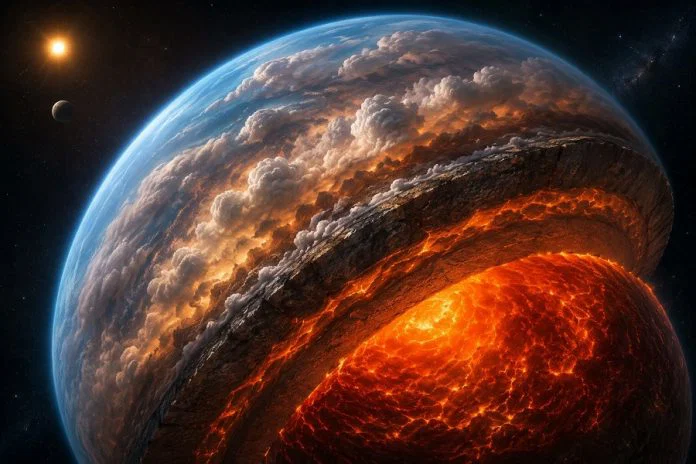
    Scientists have uncovered that clouds on distant planets may serve purposes beyond just obscuring our view. Recent findings suggest these clouds are capable of trapping so much heat that they might melt the rocky surfaces of some planets, forming vast lakes or oceans of molten rock.

    This breakthrough could reshape our understanding of the most prevalent types of planets in our galaxy. The planets in focus are known as sub-Neptunes—they are larger than Earth but smaller than Neptune. Despite being the most common planets in the Milky Way, their exact compositions remain a mystery. Some might be rocky bodies cloaked by thick hydrogen atmospheres, while others could be rich in water or carbon-based materials.

    The James Webb Space Telescope (JWST) has been instrumental in examining these distant worlds’ atmospheres. However, it can only observe the upper atmospheric layers—not the layers beneath the clouds or deep inside the planet. This limitation makes it challenging to fully understand their true nature.

    A recent study published in The Astrophysical Journal Letters suggests that clouds are more than just obscuring tools—they may actively influence the planets’ physical characteristics. Through sophisticated computer simulations, researchers from Arizona State University modeled how clouds form on sub-Neptune planets. They discovered that clouds composed of vaporized rock and salts can develop deep within the atmospheres, creating a thick insulating layer that traps heat migrating from the planet’s interior.

    This heat retention leads to a significant temperature increase in the lower atmosphere, sometimes exceeding 1,000°C near the interface between the atmosphere and the planet’s core. Notably, on planets like GJ 1214 b and TOI-1231 b, such intense heating could melt the rocky surface beneath the clouds, resulting in massive magma oceans instead of solid ground.

    The presence of magma oceans alters the interactions between the planet’s interior and its atmosphere. Just as volcanoes on Earth release gases, molten rock on these planets can also emit various chemicals, changing atmospheric composition. The study indicates that gases like oxygen, silicon hydride, and silicon monoxide are more readily released from the molten surface. In contrast, gases such as methane, water vapor, and ammonia tend to be absorbed back into the magma, reducing their presence in the atmosphere.

    This dynamic suggests that the atmospheric signatures captured by JWST may not accurately represent the entire planet’s makeup, since internal processes could modify the gases that escape into space. Clouds aren’t just passive features—they may be fundamental to shaping a planet’s thermal evolution, size, and internal development.

    Understanding these effects is crucial, especially as some sub-Neptunes are considered potential homes for life in certain conditions. Knowing how clouds influence their internal chemistry and structure can help scientists create more accurate models of these worlds.

    This research marks a significant step toward solving the long-standing puzzle of what our galaxy’s most common planets are truly made of.

    Source: Arizona State University.

  • Scientists find potential habitable super-Earth exoplanet

    Scientists find potential habitable super-Earth exoplanet

    A nearby planet that might support life appears to be more Earth-like than scientists initially believed. Recent observations indicate that GJ 3378b is smaller and rockier than previous estimates suggested, making it an even more intriguing candidate in the quest to find life beyond Earth.

    Located approximately 25 light-years away in the direction of the constellation Camelopardalis, GJ 3378b remains relatively close in astronomical terms. The planet orbits a small, cool red dwarf star, which makes it a compelling target for study.

    One major reason GJ 3378b has garnered attention is its position within the star’s “habitable zone,” the area around a star where conditions might permit liquid water to exist on a planet’s surface. Since all known life on Earth depends on water, scientists often prioritize planets found within these zones when searching for extraterrestrial life.

    “Our guiding principle is ‘follow the water,’” explained lead researcher Paul Robertson from the University of California, Irvine. The presence of liquid water increases the likelihood that a planet could host life.

    Red dwarf stars are significantly smaller, cooler, and dimmer than our Sun, and they are the most abundant stars in the Milky Way, accounting for about 70% of all stars. Because of their prevalence, astronomers consider them prime locations to hunt for potentially habitable planets.

    Detecting small planets around these faint stars isn’t straightforward. The research team employed the Habitable-zone Planet Finder, a sophisticated instrument attached to the Hobby-Eberly Telescope at the McDonald Observatory in Texas. This instrument is specially designed to detect infrared light, which is the dominant emission from red dwarf stars.

    Instead of observing the planet directly, scientists tracked the star’s subtle wobble caused by the planet’s gravitational pull. By measuring these tiny movements with high precision, they could refine estimates of the planet’s size and orbit.

    The updated findings reveal that GJ 3378b has a mass roughly 2.3 times that of Earth, significantly less than the previously estimated five times Earth’s mass. Smaller “Super Earths” like this are more likely to be rocky worlds, rather than thick, atmosphere-covered planets that are less conducive to life.

    Additionally, the planet completes an orbit around its star every 21 days, a shorter period than previously thought. Despite being closer to its star, the star’s cooler temperature means the planet remains within the habitable zone.

    Scientists remain cautious, though. Its proximity to the star could expose GJ 3378b to intense radiation, potentially stripping away its atmosphere over time—a key ingredient for life. Further observations are needed to determine whether the planet has managed to retain its atmosphere.

    Looking ahead, upcoming giant telescopes such as the Giant Magellan Telescope and the Extremely Large Telescope will offer much more detailed views of nearby exoplanets like GJ 3378b. Researchers hope these powerful observatories will eventually detect biosignatures—chemical indicators that could confirm the presence of life.

    For now, GJ 3378b stands out as one of the most promising nearby worlds in humanity’s ongoing effort to answer one of science’s biggest questions: are we alone in the universe?

  • Super Earth Nearby Might Still Support Life

    Super Earth Nearby Might Still Support Life

    A rocky exoplanet named GJ 3378b was discovered in 2024 orbiting a red dwarf star just 25 light-years from Earth, in the direction of the constellation Camelopardalis. Based on radial velocity data, scientists estimate this planet is approximately 2.3 times Earth’s mass, classifying it as a “Super Earth.” Recent revisions by a team led by researchers from the University of California, Irvine, suggest this planet resides within its star’s habitable zone (HZ).

    The research was headed by Paul Robertson, an Associate Professor of Physics and Astronomy at UC Irvine. He collaborated with experts from the University of Texas Center for Planetary Systems Habitability, the Astrophysics & Space Institute, the Anton Pannekoek Institute for Astronomy, the Center for Exoplanets and Habitable Worlds, the Astrobiology Research Center, NASA’s Jet Propulsion Laboratory (JPL), Goddard Space Flight Center, along with various other academic and research institutions.

    Red dwarf stars are the most common type of star in the universe, making up 70-75% of stars in the Milky Way and up to 90% in elliptical galaxies. Studies of nearby red dwarfs indicate they frequently form rocky planets within their habitable zones, making them prime targets in the search for extraterrestrial life. However, red dwarfs are known for their variability and flare activity, which could potentially make planets in their habitable zones inhospitable. Their faintness also complicates the detection of Earth-like planets, which are small compared to other types like Super Earths, mini-Neptunes, or gas giants.

    To detect these planets, astronomers rely on specialized tools, such as the Habitable-zone Planet Finder (HPF) instrument mounted on the Hobby-Eberly Telescope. This device measures tiny stellar wobbles caused by orbiting planets through radial velocity techniques.

    Paul Robertson explained in a McDonald Observatory release: “Our approach is ‘follow the water.’ It’s the one resource all known life needs, so that’s what we target when looking for environments capable of supporting life. The Habitable-zone Planet Finder is tailored for infrared light because, as stars get cooler and smaller, most of their energy emissions are in infrared wavelengths. By using an infrared spectrometer on a large telescope, we gain increased ability to observe faint stars.”

    Since 2018, the HPF has helped astronomers identify numerous exoplanets and assess which might be potentially habitable. Michael Endl, an astronomer at the University of Texas and the McDonald Observatory, emphasized: “Precision is everything. Detecting low-mass planets requires spotting very subtle signals. If your instruments aren’t precise enough, you simply won’t find them.”

    Initially, GJ 3378b was thought to be five times more massive than Earth. A planet this massive could retain an atmosphere, but its density might be so high as to make surface life impossible. The latest analysis reduces its estimated mass to about 2.3 times Earth’s, increasing the chances it might lack a thick, crushing atmosphere. Additionally, the refined orbital period from 25 days to 21 brings the planet firmly into the star’s habitability zone.

    However, being closer to its star could mean higher radiation levels, which might strip away any atmosphere over time. More detailed observations will become feasible as upcoming telescopes come online, including the Giant Magellan Telescope (GMT), the Extremely Large Telescope (ELT), and the Habitable Worlds Observatory (HWO). These advanced telescopes will be equipped with enormous mirrors, adaptive optics, coronagraphs, and spectrometers, enabling direct imaging and search for signs of life, called biosignatures. Endl noted, “Our ultimate goal is biosignatures. We want to find out if we’re truly alone in the universe. Currently, we’re in the reconnaissance phase, studying nearby stars because they are the easiest to analyze for signs of life.”

    GJ 3378b is a significant step toward understanding our planetary neighbors and identifying which worlds might support life beyond Earth.

  • Astronomers find Sun-like star that probably consumed a planet

    Astronomers find Sun-like star that probably consumed a planet

    A team of astronomers has gathered compelling evidence suggesting that a star similar to our Sun might have consumed one of its own planets.

    This star, identified as TOI-5882, is approximately 1,300 light-years away from Earth.

    Scientists found that TOI-5882 contains an unusually high level of lithium, a chemical element that could indicate a significant event in the star’s history.

    The idea that “you are what you eat” applies to stars as well. While stars naturally contain small amounts of lithium, planets tend to be much richer in this element.

    When a star engulfs a planet, it can absorb a large dose of lithium, leaving behind a chemical signature. This process, known as “planetary engulfment,” occurs very rapidly on cosmic timescales—sometimes within days or weeks.

    Because such events happen so quickly, astronomers rarely have the chance to observe a star swallowing a planet in real-time. Instead, they must piece together clues left behind long after the event.

    Lead researcher Brooke Kotten from the University of Michigan explains that this investigative work is what makes the field so engaging. Since they can’t observe the “crime” directly, scientists analyze data to reconstruct what likely happened.

    Studying these occurrences helps us understand how often stars consume planets and the various mechanisms behind it.

    In the distant future, our own solar system might experience a similar fate. In about five billion years, the Sun is expected to swell into a red giant, potentially swallowing Mercury and Venus, and possibly even Earth.

    However, TOI-5882 hasn’t expanded enough for that explanation to fit. Instead, scientists suspect that another object—the brown dwarf orbiting the star—may have played a role.

    This brown dwarf is a massive object, over 20 times the mass of Jupiter, larger than planets but too small to become a true star. Researchers believe it might have disrupted the orbit of a nearby planet, eventually causing it to spiral into the star.

    The scientists estimate that the planet likely had a mass somewhere between a few Earth masses and Neptune.

    They used a technique called spectroscopy to study the light emitted by TOI-5882. Since different elements leave unique patterns in starlight, spectroscopy helps identify the chemical makeup of stars from great distances.

    To confirm that TOI-5882’s lithium level was truly exceptional, the team compared it with 62 similar stars matching in age, size, and temperature. In all cases, TOI-5882 stood out—containing more lithium than at least 97% of the comparison stars.

    Interestingly, a few other stars also showed higher-than-normal lithium levels, hinting that there may be additional ways for stars to become enriched with this element. While one mystery is solved, many new questions have arisen for astronomers to explore.

  • Scientists Find Many Alien Planets as Massive Soot-Producing Worlds

    Scientists Find Many Alien Planets as Massive Soot-Producing Worlds

    Many planets in the universe might be shrouded in thick soot-laden hazes, according to a recent study by scientists at the University of Chicago. Their research suggests that extreme temperatures and intense pressures inside these planets could create “soot factories,” similar to combustion engines on Earth, which produce smog and haze that obscure the planets’ surfaces and atmospheres.

    When astronauts take pictures of Earth from space, they see beautiful blue oceans, white clouds, and lush green land. But this clarity might be rare elsewhere. Many distant planets could be covered in dense, smoky clouds, making them look more like giant smog machines than the stunning worlds depicted in science fiction.

    Published in The Astrophysical Journal Letters, this study could help explain a mystery that has puzzled astronomers for years. Scientists have identified thousands of exoplanets—planets orbiting stars beyond our solar system—and among them, a common type known as “mini-Neptunes.” These are planets larger than Earth but smaller than Neptune, with thick atmospheres. Interestingly, there’s no direct equivalent of mini-Neptunes in our solar system.

    As astronomers have studied these planets more closely—especially with NASA’s James Webb Space Telescope—they’ve noticed something strange. Instead of clear atmospheric signatures, many of these planets appear oddly featureless, cloaked in opaque atmospheres that hide their true nature.

    The surprising explanation may come from an unlikely source: internal combustion engines. Jeehyun Yang, a postdoctoral researcher at the University of Chicago and a trained chemical engineer, observed a pattern in the data that reminded him of engine behavior. The relationship between temperature and atmospheric opacity on these planets resembled the patterns seen in gasoline, diesel, and jet engines.

    On Earth, when fuel combusts at high temperatures, it creates tiny carbon particles called soot—complex molecules known as polycyclic aromatic hydrocarbons. These black particles dominate emissions from engines and industrial processes. Initially, the temperatures on these exoplanets didn’t seem hot enough to form soot. But Yang and team realized that conditions deep inside a planet’s thick atmosphere—where pressure is high—can generate the necessary heat for soot formation.

    The scientists found a close match between the conditions predicted for soot production and what the telescopes observed. They suggest that soot forms deep within the atmosphere and slowly rises, creating a dense haze that blocks light and makes the atmosphere appear opaque from afar.

    Most of these worlds are inhospitable to life. Many orbit very close to their stars, experiencing scorching heat, some with oceans of molten rock, or subjected to pressures so intense that materials behave in bizarre ways. Despite this, understanding their atmospheric composition offers important clues about planetary formation and evolution.

    The presence of soot in an exoplanet’s atmosphere might reveal details about the original balance of carbon and oxygen during the planet’s formation. These chemical clues could help scientists unravel the history of distant planetary systems and refine their search for worlds that might support life.

    This discovery also highlights the value of interdisciplinary research—learning from engine technology on Earth can shed light on how alien worlds behave light-years away.

  • How Small Is Too Small? New Study Finds Planets That Can Hold Atmospheres

    How Small Is Too Small? New Study Finds Planets That Can Hold Atmospheres

    Scientists exploring possibilities of life beyond Earth have introduced a new method to identify distant planets that could potentially support life. Their innovative approach, called the Smaller Than Earth Habitability Model (STEHM), addresses a key question: Can a planet retain its atmosphere long enough for life to develop?

    Since the discovery of the first exoplanet in 1992, astronomers have confirmed over 6,000 planets outside our solar system, with many more awaiting verification. With such a vast number of worlds to investigate, researchers need more efficient ways to narrow down promising candidates.

    An atmosphere is critical for supporting life as we know it. It shields a planet’s surface from harmful radiation and helps regulate temperatures suitable for living organisms. Additionally, scientists can analyze a planet’s atmosphere remotely, making it an essential aspect of the search for extraterrestrial life.

    Michelle Hill, a researcher at Stanford University, developed STEHM to study how a planet’s size influences its ability to sustain an atmosphere over billions of years. Using computer simulations, Hill examined rocky planets ranging from half to the full size of Earth. The study focused on planets with carbon dioxide-rich atmospheres and solid surfaces, unlike Earth’s tectonic plate movements.

    Findings suggest that planets need to be at least approximately 80% the size of Earth to reliably maintain an atmosphere for 10 billion years or longer, assuming they orbit a star similar to the Sun at an appropriate distance. Smaller planets tend to lose their atmospheres much sooner. Those around 70% of Earth’s size might still retain an atmosphere under ideal conditions, but their likelihood is significantly reduced.

    The research emphasizes that a planet’s initial carbon content is crucial. Carbon dioxide plays an essential role in trapping heat and keeping the planet warm. Volcanic activity continually replenishes carbon dioxide, counteracting gases lost to space. Moreover, internal heat sources, such as uranium, thorium, and potassium, decay slowly over time, generating heat that sustains geological activity and helps maintain the atmosphere. As these heat sources diminish, volcanic activity decreases, and atmospheric replenishment slows down.

    Interestingly, the model indicates that planets starting out extremely hot might struggle to hold onto their atmospheres. Excessive early heat can expose the atmosphere to intense stellar radiation, causing gases to escape more readily.

    To validate STEHM, Hill applied it to Venus and Mars. The model accurately predicted Venus’s thick atmosphere and Mars’s thin, depleted one. The results suggest that Mars’s small size and lack of tectonic activity have historically hindered its ability to retain an atmosphere.

    This research offers a valuable tool for upcoming planet-hunting missions. By focusing on planets large enough to preserve atmospheres, scientists can more effectively target worlds where life might exist, amid the countless planets orbiting distant stars.

    Moreover, the study underscores how unique Earth might be. Out of the thousands of exoplanets discovered to date, Earth’s particular combination of size, geological activity, atmosphere, and orbital position appears to be exceptionally favorable for life to flourish over billions of years.

  • Webb Telescope Detects Methane in Rare Saturn-Size Exoplanet’s Atmosphere

    Webb Telescope Detects Methane in Rare Saturn-Size Exoplanet’s Atmosphere

    Astronomers leveraging NASA’s James Webb Space Telescope have uncovered a massive planet with an atmosphere abundant in methane, providing scientists a rare glimpse into a type of world that’s scarcely represented in our current catalog of known planets.

    This planet, designated TOI-199b, is roughly the size of Saturn but maintains surprisingly mild temperatures similar to Earth’s, contrasting with most giant planets we’ve studied so far.

    The discovery was published in The Astronomical Journal by researchers from Pennsylvania State University and NASA’s Jet Propulsion Laboratory.

    Most known giant planets fall into two extreme categories. In our solar system, planets like Jupiter and Saturn are extremely cold because they orbit far from the sun. Conversely, astronomers have identified many “hot Jupiters,” planets that orbit very close to their host stars and can reach searing temperatures of thousands of degrees.

    TOI-199b falls somewhere in between. It orbits its star once every 100 days and has a temperature around 175°F. While still warm for people, this is considerably cooler than most other exoplanets of similar size that scientists have observed.

    Located over 330 light-years from Earth, TOI-199b is one of only a handful of known temperate gas giants. Even more notably, it’s the first of its kind to undergo detailed atmospheric analysis.

    To study its atmosphere, scientists used a technique called transmission spectroscopy. When the planet transits in front of its star, some of the star’s light passes through the planet’s atmosphere before reaching the Webb telescope. Different gases absorb specific wavelengths of light, creating unique spectral signatures that reveal their chemical composition.

    The team observed the system for approximately 20 hours, including a seven-hour transit period. By comparing the star’s baseline light with the filtered light passing through the atmosphere, they detected clear signs of methane.

    The presence of methane in such a temperate giant planet aligns with existing predictions, reinforcing the idea that methane-rich atmospheres are common in these worlds. The observations also suggest that ammonia and carbon dioxide might be present, though further research is necessary to measure their quantities.

    Studying planets like TOI-199b helps scientists better understand planetary formation and how atmospheres change over time. Although this planet isn’t suitable for life as we know it, analyzing its atmospheric properties could offer insights into broader planetary system processes, including those that shaped Earth.

    This research also showcases the remarkable capabilities of the James Webb Space Telescope. Moving forward, astronomers aim to examine more temperate giant planets to see if TOI-199b is an exception or part of a larger population of worlds that we are just beginning to discover.