الوسم: clouds

  • Venus’s Pale Clouds Conceal a Surprisingly Dark Secret

    Venus appears as a pale yellow planet in visible light, but ultraviolet images reveal a very different picture. These UV images display striking dark and bright patterns moving across the planet’s upper clouds. Scientists have been observing these patterns for nearly a century, yet they still haven’t identified the chemical responsible for creating them.

    This mysterious substance is referred to as the “unknown absorber” because it absorbs ultraviolet and blue light. Recently, an international research team has set new constraints on what this substance could be, indicating it might be an exceptionally strong light absorber.

    The study, published in Astrobiology, integrated observations of Venus with advanced computer models to estimate how much light the particles inside the planet’s clouds would absorb if they could be examined directly in a lab. Venus’s clouds are mainly composed of sulfuric acid droplets. While these clouds appear bright from space, this doesn’t necessarily mean the liquid inside them is similarly luminous.

    The researchers compare this to cigarette smoke: tiny particles in smoke scatter light, making it look white. But when those particles are aggregated, they form a darker, tar-like substance. Similarly, Venus’s cloud particles can scatter light efficiently, but their actual liquid contents might be surprisingly dark.

    Using their models—which account for the complex ways sunlight is scattered and absorbed by the clouds and atmosphere—the team translated space observations into measurable qualities that could be tested in laboratory settings. Their findings suggest that the unknown material must absorb light extremely effectively. Specifically, between wavelengths of 365 and 455 nanometers, its estimated absorption is about 1,278 per centimeter at 375 nanometers.

    This indicates that the substance must either be a particularly powerful absorber, be present at very high concentrations in the clouds, or both. Certain carbon-based molecules could potentially fit these criteria. For instance, highly efficient pigment-like molecules might need concentrations around 10 grams per liter. However, the researchers emphasize that this does not imply Venus contains chlorophyll or any biological pigments—“organic” in chemistry simply means carbon-based, not necessarily alive.

    Another challenge is that simple organic compounds exposed to concentrated sulfuric acid can transform into dark, tar-like mixtures that absorb light broadly, appearing brown or black. Yet, Venus’s absorber behaves differently, with its absorption sharply declining between 365 and 455 nanometers. If an organic compound is responsible, it might need to be a specific chemical that can withstand the harsh acid environment without breaking down into a tar-like form.

    These results don’t prove the presence of life on Venus or confirm the absorber is organic. Instead, they provide much clearer criteria for scientists to test potential candidates. Future missions equipped with advanced instruments could help directly identify the substance—searching for complex organics and fluorescence in cloud particles.

    By analyzing the clouds themselves, scientists hope to finally uncover the identity of Venus’s century-old ultraviolet mystery and gain deeper insights into the planet’s chemistry, shedding more light on our enigmatic neighbor.
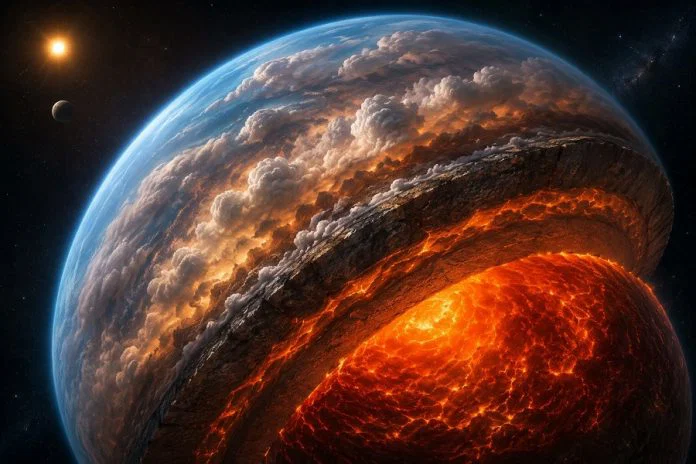
  • Clouds Can Raise Alien Planet Temperatures by Over 1,000°C, Astronomers Find

    Clouds Can Raise Alien Planet Temperatures by Over 1,000°C, Astronomers Find

    Scientists have uncovered that clouds on distant planets may serve purposes beyond just obscuring our view. Recent findings suggest these clouds are capable of trapping so much heat that they might melt the rocky surfaces of some planets, forming vast lakes or oceans of molten rock.

    This breakthrough could reshape our understanding of the most prevalent types of planets in our galaxy. The planets in focus are known as sub-Neptunes—they are larger than Earth but smaller than Neptune. Despite being the most common planets in the Milky Way, their exact compositions remain a mystery. Some might be rocky bodies cloaked by thick hydrogen atmospheres, while others could be rich in water or carbon-based materials.

    The James Webb Space Telescope (JWST) has been instrumental in examining these distant worlds’ atmospheres. However, it can only observe the upper atmospheric layers—not the layers beneath the clouds or deep inside the planet. This limitation makes it challenging to fully understand their true nature.

    A recent study published in The Astrophysical Journal Letters suggests that clouds are more than just obscuring tools—they may actively influence the planets’ physical characteristics. Through sophisticated computer simulations, researchers from Arizona State University modeled how clouds form on sub-Neptune planets. They discovered that clouds composed of vaporized rock and salts can develop deep within the atmospheres, creating a thick insulating layer that traps heat migrating from the planet’s interior.

    This heat retention leads to a significant temperature increase in the lower atmosphere, sometimes exceeding 1,000°C near the interface between the atmosphere and the planet’s core. Notably, on planets like GJ 1214 b and TOI-1231 b, such intense heating could melt the rocky surface beneath the clouds, resulting in massive magma oceans instead of solid ground.

    The presence of magma oceans alters the interactions between the planet’s interior and its atmosphere. Just as volcanoes on Earth release gases, molten rock on these planets can also emit various chemicals, changing atmospheric composition. The study indicates that gases like oxygen, silicon hydride, and silicon monoxide are more readily released from the molten surface. In contrast, gases such as methane, water vapor, and ammonia tend to be absorbed back into the magma, reducing their presence in the atmosphere.

    This dynamic suggests that the atmospheric signatures captured by JWST may not accurately represent the entire planet’s makeup, since internal processes could modify the gases that escape into space. Clouds aren’t just passive features—they may be fundamental to shaping a planet’s thermal evolution, size, and internal development.

    Understanding these effects is crucial, especially as some sub-Neptunes are considered potential homes for life in certain conditions. Knowing how clouds influence their internal chemistry and structure can help scientists create more accurate models of these worlds.

    This research marks a significant step toward solving the long-standing puzzle of what our galaxy’s most common planets are truly made of.

    Source: Arizona State University.

  • Gorgeous Cotton Candy Clouds Reveal Hubble’s Image Processing

    Gorgeous Cotton Candy Clouds Reveal Hubble’s Image Processing

    The latest breathtaking photograph captured by the Hubble Space Telescope might remind you of cotton candy, but it’s actually a glimpse into a nebula found in the neighboring Large Magellanic Cloud. This satellite galaxy of the Milky Way lies approximately 160,000 light-years away. The nebula features a vibrant array of dust and gas that emits various colors, reflecting the different physical processes occurring within it.

    To understand how Hubble achieves its striking and colorful imagery, it’s important to know how its cameras operate. Unlike your smartphone camera, which takes a quick snapshot, Hubble’s instruments, like the Wide Field Camera 3, perform multiple observations of the same object while utilizing different filters.

    Each of these filters allows the camera to isolate specific wavelengths of light. In this instance, five distinct filters were employed, targeting not only visible light but also portions of the ultraviolet and infrared spectrum.

    This technique enables Hubble to collect multiple black-and-white images of the same celestial object at different wavelengths. When these images are combined, they form a single, vibrant colored photograph, which you can admire in detail below.

    “When image-processing experts combine raw data from these filters into a colorful composite, they assign colors to each filter,” Hubble scientists state. “Visible-light data corresponds to the color that the filter permits, while shorter wavelengths, like ultraviolet, are usually represented as blue or purple. In contrast, longer wavelengths like infrared tend to be shown in red.” This coloring method provides a clearer understanding of phenomena happening in wavelengths outside of human visibility.

    The process of creating these images is akin to the techniques used by the James Webb Space Telescope, utilizing filters and composite methods to produce incredible representations of hidden cosmic entities. This work demands a blend of scientific acumen and a touch of artistic sensibility from the image processors.