

Select Language:
The construction sector ranks among the largest contributors to global carbon emissions. In 2022, producing essential materials like steel, concrete, and timber accounted for over 7% of worldwide emissions. But what if many of those materials were unnecessary from the start?
Researchers at the Massachusetts Institute of Technology have created a new computer-aided design approach that could drastically cut down the amount of material needed for building bridges, skyscrapers, and other structures. In some cases, this method can reduce material requirements by as much as 90%, which could lower costs and decrease pollution without compromising safety or strength.
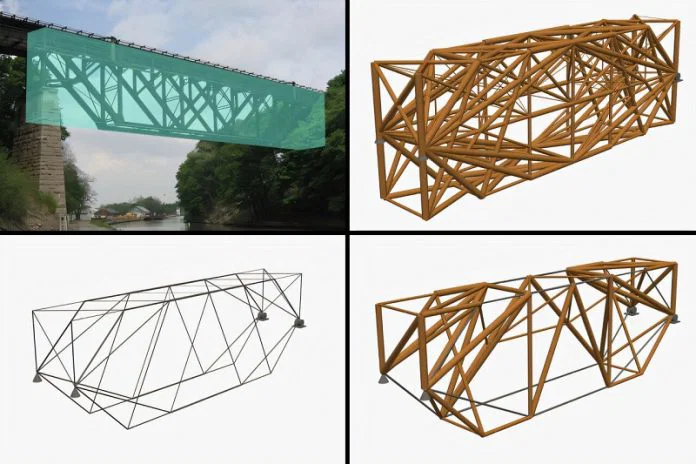
This innovative technique is based on topology optimization—a computer process that identifies the most efficient use of materials within a structure. It eliminates excess material while maintaining enough support to bear significant loads. Designs generated through this process often feature unconventional, web-like structures with slender branches, quite different from traditional architectural forms.
While highly efficient, these designs are usually too intricate to construct with current building methods, leading to their typical use in research labs or for small, 3D-printed objects rather than large-scale projects. MIT researchers aimed to change that by developing a new framework that allows engineers to control the complexity of the final design.
This system enables the creation of practical, buildable structures by setting limitations such as the maximum number of components at a single joint, the smallest permissible piece size, and the minimum angle between connected parts. These parameters help produce designs that are easier to manufacture, transport, and assemble on-site.
The technology also considers different building materials simultaneously, rather than assuming a single material in all parts. It intelligently assigns steel, timber, or other materials based on their strength, weight, cost, and environmental impact. For example, steel is ideal for supporting heavy loads, while timber tends to have a smaller carbon footprint. The program combines these options, maximizing sustainability while ensuring structural integrity.
Further improvements include better handling of connections between different parts of the structure. Since securing beams, cables, and supports safely is a significant engineering challenge in real-world construction, the new model incorporates these considerations from the start rather than adding them later.
To validate their approach, the team redesigned various truss frameworks used in bridges and buildings. They also tested the design on the Lockport “Upside-Down Bridge” in New York, analyzing how different practical constraints affected the outcome. The results demonstrated that incorporating realistic construction limits produced designs that remained highly efficient yet more feasible to build.
Although this modern technique demands more computing power than older methods, the team successfully ran their simulations on a standard MacBook Pro. They believe the technology is already viable for many engineering firms.
Looking ahead, they plan to create small-scale prototypes of their computer-generated structures to verify performance and safety. They also aim to incorporate additional practical design rules, making the software more accessible for everyday engineering projects.
Overall, the researchers contend that many critical decision points that influence carbon emissions occur well before construction begins. By designing buildings and bridges that only use the essential materials, engineers can significantly reduce waste, lower expenses, and foster a more sustainable construction industry.
 ChatGPT
 Perplexity
 Gemini AI
 Grok AI