الوسم: sustainable design

  • AI Design Tool May Reduce Building Material Use by 90%

    AI Design Tool May Reduce Building Material Use by 90%

    The construction sector ranks among the largest contributors to global carbon emissions. In 2022, producing essential materials like steel, concrete, and timber accounted for over 7% of worldwide emissions. But what if many of those materials were unnecessary from the start?

    Researchers at the Massachusetts Institute of Technology have created a new computer-aided design approach that could drastically cut down the amount of material needed for building bridges, skyscrapers, and other structures. In some cases, this method can reduce material requirements by as much as 90%, which could lower costs and decrease pollution without compromising safety or strength.

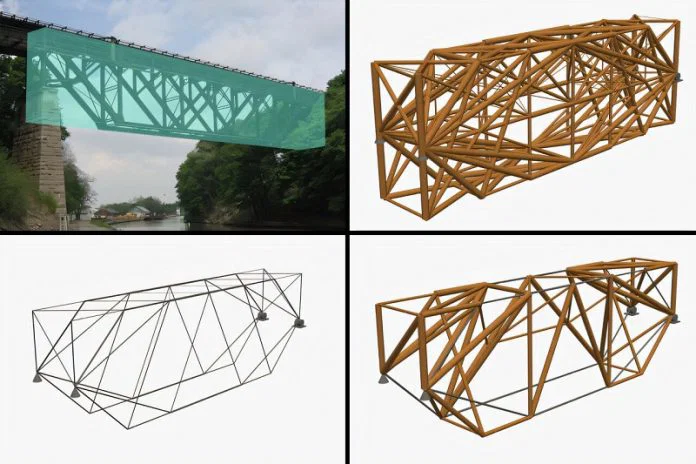
    This innovative technique is based on topology optimization—a computer process that identifies the most efficient use of materials within a structure. It eliminates excess material while maintaining enough support to bear significant loads. Designs generated through this process often feature unconventional, web-like structures with slender branches, quite different from traditional architectural forms.

    While highly efficient, these designs are usually too intricate to construct with current building methods, leading to their typical use in research labs or for small, 3D-printed objects rather than large-scale projects. MIT researchers aimed to change that by developing a new framework that allows engineers to control the complexity of the final design.

    This system enables the creation of practical, buildable structures by setting limitations such as the maximum number of components at a single joint, the smallest permissible piece size, and the minimum angle between connected parts. These parameters help produce designs that are easier to manufacture, transport, and assemble on-site.

    The technology also considers different building materials simultaneously, rather than assuming a single material in all parts. It intelligently assigns steel, timber, or other materials based on their strength, weight, cost, and environmental impact. For example, steel is ideal for supporting heavy loads, while timber tends to have a smaller carbon footprint. The program combines these options, maximizing sustainability while ensuring structural integrity.

    Further improvements include better handling of connections between different parts of the structure. Since securing beams, cables, and supports safely is a significant engineering challenge in real-world construction, the new model incorporates these considerations from the start rather than adding them later.

    To validate their approach, the team redesigned various truss frameworks used in bridges and buildings. They also tested the design on the Lockport “Upside-Down Bridge” in New York, analyzing how different practical constraints affected the outcome. The results demonstrated that incorporating realistic construction limits produced designs that remained highly efficient yet more feasible to build.

    Although this modern technique demands more computing power than older methods, the team successfully ran their simulations on a standard MacBook Pro. They believe the technology is already viable for many engineering firms.

    Looking ahead, they plan to create small-scale prototypes of their computer-generated structures to verify performance and safety. They also aim to incorporate additional practical design rules, making the software more accessible for everyday engineering projects.

    Overall, the researchers contend that many critical decision points that influence carbon emissions occur well before construction begins. By designing buildings and bridges that only use the essential materials, engineers can significantly reduce waste, lower expenses, and foster a more sustainable construction industry.

  • Architecture Award Highlights Innovative Solutions for Global Challenges

    Architecture Award Highlights Innovative Solutions for Global Challenges

    Seven architecture projects that protect communities from climate hazards, conserve cultural heritage, and develop affordable housing were honored at the Aga Khan Award for Architecture ceremony held at the Kyrgyz National Philharmonic Hall.

    His Highness the Aga Khan attended the event alongside His Excellency Adylbek Kasymaliev, Chairman of the Cabinet of Ministers of Kyrgyzstan, to oversee the proceedings.

    The selected projects, sharing a prize of $1 million, showcase architecture’s ability to tackle some of humanity’s most urgent issues. Notable designs include flood-resistant bamboo homes that can be moved when river courses change; a community-driven urban heritage restoration project; and a repurposed oil company site transformed into a vibrant public space with a community center.

    Attendees included distinguished winners, government officials, architecture specialists, the Award’s Steering Committee and Master Jury members, and other prominent guests. This celebration marks the close of the Award’s 16th triennial cycle.

    Throughout the week in Bishkek, a series of events gathered architects, urban planners, policymakers, and community leaders to explore how architecture and city planning can be catalysts for positive change worldwide.

    One of the award recipients was Vision Pakistan, based in Islamabad, which won recognition for its innovative, socially impactful, and eco-conscious design. The project features a multi-story building with lively facades inspired by Pakistani and Arab craftsmanship, hosting a charity dedicated to empowering youth through vocational training.

    The jury praised the building for offering a new educational approach, filling spaces with light, creating interesting spatial experiences, and maintaining cost efficiency.

    Founded in 1977 by the late His Highness Prince Karim Aga Khan IV, the Aga Khan Award stands out among architectural honors. It emphasizes projects that combine design excellence with tangible improvements to quality of life, highlighting the roles of municipalities, builders, clients, artisans, and engineers alongside architects.

    Since inception, the award has recognized over 130 projects globally, influencing architectural dialogue within the Muslim community and beyond.

    His Highness stressed the vital role of architects today: “With today’s climate fluctuations, architects have a profound responsibility—and a unique opportunity—to design structures that buffer these changes and protect the most vulnerable. Flexibility to adapt to unforeseen circumstances was central to this cycle’s jury considerations,” he said.

    He further explained that in addition to environmental justice, architecture holds great promise for advancing social justice. “Affordable housing, access to green spaces, education, healthcare, and cultural preservation all depend on the creativity of architects and wise urban planning,” he pointed out. Buildings, he noted, can elevate living standards, inspire reverence, and provide solutions for future generations.

    “Exceptional architecture directly addresses critical development challenges and helps create an inclusive, safe, and dignified world for all,” he concluded. Earlier that day, His Highness also took part in a special stamp cancellation ceremony, commemorating the awards with a postage stamp issued by Kyrgyzstan’s postal service.