Tag: construction

  • AI Design Tool May Reduce Building Material Use by 90%

    AI Design Tool May Reduce Building Material Use by 90%

    The construction sector ranks among the largest contributors to global carbon emissions. In 2022, producing essential materials like steel, concrete, and timber accounted for over 7% of worldwide emissions. But what if many of those materials were unnecessary from the start?

    Researchers at the Massachusetts Institute of Technology have created a new computer-aided design approach that could drastically cut down the amount of material needed for building bridges, skyscrapers, and other structures. In some cases, this method can reduce material requirements by as much as 90%, which could lower costs and decrease pollution without compromising safety or strength.

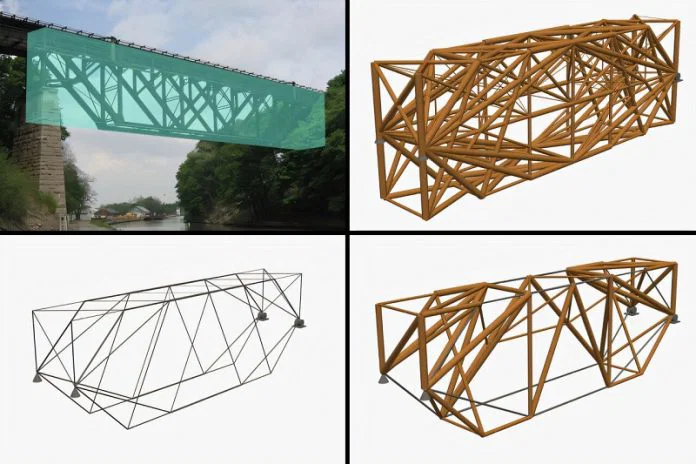
    This innovative technique is based on topology optimization—a computer process that identifies the most efficient use of materials within a structure. It eliminates excess material while maintaining enough support to bear significant loads. Designs generated through this process often feature unconventional, web-like structures with slender branches, quite different from traditional architectural forms.

    While highly efficient, these designs are usually too intricate to construct with current building methods, leading to their typical use in research labs or for small, 3D-printed objects rather than large-scale projects. MIT researchers aimed to change that by developing a new framework that allows engineers to control the complexity of the final design.

    This system enables the creation of practical, buildable structures by setting limitations such as the maximum number of components at a single joint, the smallest permissible piece size, and the minimum angle between connected parts. These parameters help produce designs that are easier to manufacture, transport, and assemble on-site.

    The technology also considers different building materials simultaneously, rather than assuming a single material in all parts. It intelligently assigns steel, timber, or other materials based on their strength, weight, cost, and environmental impact. For example, steel is ideal for supporting heavy loads, while timber tends to have a smaller carbon footprint. The program combines these options, maximizing sustainability while ensuring structural integrity.

    Further improvements include better handling of connections between different parts of the structure. Since securing beams, cables, and supports safely is a significant engineering challenge in real-world construction, the new model incorporates these considerations from the start rather than adding them later.

    To validate their approach, the team redesigned various truss frameworks used in bridges and buildings. They also tested the design on the Lockport “Upside-Down Bridge” in New York, analyzing how different practical constraints affected the outcome. The results demonstrated that incorporating realistic construction limits produced designs that remained highly efficient yet more feasible to build.

    Although this modern technique demands more computing power than older methods, the team successfully ran their simulations on a standard MacBook Pro. They believe the technology is already viable for many engineering firms.

    Looking ahead, they plan to create small-scale prototypes of their computer-generated structures to verify performance and safety. They also aim to incorporate additional practical design rules, making the software more accessible for everyday engineering projects.

    Overall, the researchers contend that many critical decision points that influence carbon emissions occur well before construction begins. By designing buildings and bridges that only use the essential materials, engineers can significantly reduce waste, lower expenses, and foster a more sustainable construction industry.

  • How To Build a Foundation in Paralives: Completing and Solving

    How To Build a Foundation in Paralives: Completing and Solving

    If you’re looking for the perfect home for your Para and can’t find anything in town that suits your taste, it’s time to build your own using the straightforward but detailed build mode in Paralives.

    Building a home can mean different things to different players. Some may be fine with a simple square layout with separate rooms inside, while others want more complex designs with uniquely shaped rooms and a strong foundation. If you prefer the latter, this guide will help you understand how to create a solid foundation for your Para’s house.

    How to Build a Foundation in Paralives

    There isn’t a special tool specifically for foundations in Paralives, but you can easily do it with the Walls tool, making some adjustments as you go. A foundation allows for more dynamic layouts and makes it easier to add features like verandas or patios.

    To start, select Build Mode and then switch to the Wall Placement Mode. Use the wall tool to outline the shape of your foundation; initially, it will appear as a series of straight, standard-length walls. Next, click on a wall and drag the top arrow downward to adjust its height. We suggest lowering the walls to about the third dot, but feel free to customize it to your preference.

    Once you’ve shaped your foundation, you’ll notice it looks like a large space for short characters, but this will change. Use the Move Up One Floor arrow to lift the floor to the top of the walls, creating a proper foundation. Now, you can freely build on top of it, adding patios and outdoor areas for your Paras to enjoy.

    Foundations can be decorated just like walls. Consider adding contrasting brick patterns, plants, shrubs, or outdoor furniture like barbecues and patio chairs for a finished look. Remember, the foundation is considered part of the first floor, so keep that in mind if you decide to make changes later.

  • Why Is Trump Partially Demolishing the White House?

    Why Is Trump Partially Demolishing the White House?

    Demolition crews started tearing down part of the White House’s historic East Wing on Monday to make way for President Donald Trump’s new ballroom, a project he claimed wouldn’t disrupt the landmark. Heavy machinery was seen dismantling the building’s facade, which houses the first lady’s offices, a theater, and a visitor entrance for foreign officials.

    The estimated cost of building the ballroom is over $250 million, with Trump stating in July that he and donors would personally cover the expenses. “It will be stunning,” Trump remarked at the time. “It won’t interfere with the existing structure. It’ll be adjacent but not touching it. It respects the current building — which I admire the most. It’s my favorite.”

    The White House did not comment publicly on Monday regarding the demolition. Trump announced that construction had officially begun after images of the ongoing work appeared in news reports.

    “Right behind us, we’re constructing a ballroom,” Trump told visiting college baseball players from Louisiana State University in the White House’s East Room. “I didn’t expect to be standing here right now because there’s a lot of construction happening just on the other side, which you might hear now and then.”

    Future events will kick off with cocktails in the East Room before guests move into what Trump promises will be the country’s finest ballroom, with views of the Washington Monument and space for nearly 1,000 attendees.

    “Separated entirely from the White House, the East Wing is being modernized and will look better than ever when finished,” he added later on Truth Social.

    Before his political career, Trump was a real estate developer and has made numerous cosmetic enhancements to the White House, including gold accents in the Oval Office and a redesigned Rose Garden inspired by his golf courses. He also proposed creating an Arc de Triomphe-style monument to mark the U.S. bicentennial in 2026.

    The East Wing was constructed in 1942 under Franklin D. Roosevelt during World War II, built over a bunker designed for emergency presidential use. Still, the complex often struggles to accommodate the number of staff, visitors, and guests, sometimes hosting state dinners in tents on the South Lawn.

  • Trump Reveals Bold Plans for Large Ballroom at the White House

    Trump Reveals Bold Plans for Large Ballroom at the White House

    Construction is underway on the East Wing of the White House, where a new grand ballroom is being constructed, marking one of the most significant updates to the residence in over a century. Workers have begun dismantling parts of the East Wing to clear space for this major project, which President Donald Trump describes as “large, stunning, and built to stand for generations.”

    Photographs taken at the scene show a mechanical excavator tearing through the East Wing’s exterior, leaving behind debris and twisted steel. During a visit with college baseball players on Monday, Trump mentioned, “There’s a lot of construction happening just on the other side that you might hear now and then.”

    Later that day, the president formally announced the commencement of work on the ballroom, which will become the largest addition to the White House in more than 100 years. He shared on his Truth Social platform, “I’m happy to report that the new, magnificent White House Ballroom has officially broken ground.” Trump also highlighted that the East Wing is being “completely updated” and will be more beautiful once finished.

    Typically, the East Wing houses the offices of the first ladies, while the president operates from the West Wing, and the residence itself is the main mansion. Although Trump stated the East Wing is separate from the main building, it’s actually connected via a covered colonnade.

    The new ballroom is planned to cover 90,000 square feet and will seat up to 1,000 guests. It aims to accommodate large state dinners and events that are currently held in temporary tents. Trump hosted a high-profile dinner at the White House last week to raise funds for the project, inviting representatives from major companies like Amazon, Apple, Meta, Google, Microsoft, Palantir, and Lockheed Martin, many of which have commercial ties with the government. The event also featured twins Cameron and Tyler Winklevoss, founders of the crypto platform Gemini, famously portrayed in “The Social Network.”

    Trump emphasized that the ballroom’s funding is coming from “many generous Patriots, great American companies, and myself,” and expressed confidence that it will be a treasured space for future generations. This project is part of a broader overhaul of the White House since Trump’s return to power in January, which has included decorating the Oval Office with gold accents and transforming the Rose Garden.

    Additionally, Trump has proposed an arch in Washington, dubbed the “Arc de Trump,” a plan first reported by AFP, highlighting his ongoing efforts to revitalize and expand the iconic residence.

  • Hong Kong to Evacuate 6,000 Over WWII Bomb Discovery

    Hong Kong to Evacuate 6,000 Over WWII Bomb Discovery

    On Friday, authorities in Hong Kong arranged to evacuate thousands of residents after an unexploded World War II bomb was uncovered at a construction site. The bomb was approximately 4.9 feet long and weighed around 1,000 pounds. Officials believe it was still “fully functional,” posing significant danger.

    Hong Kong Police District Commander Andy Chan explained, “Because of the extreme danger involved in safely dismantling and removing the bomb, we have activated the emergency evacuation plan.” About 6,000 residents from 18 apartment buildings in the Quarry Bay neighborhood are set to be evacuated overnight, with removal work scheduled to start early Saturday.

    Historically, Hong Kong was among the initial targets during Japan’s wartime expansion in the early 20th century. The region endured intense combat between Japanese forces and Allied troops, leading to the ongoing discovery of unexploded ordnance nearly a century later. In 2018, a similar bomb was found in Wan Chai, prompting the evacuation of 1,200 residents. The dismantling of that device took approximately 20 hours.

    The bomb detected this week matches the type previously found in 2018, and similar disposal operations have become a routine part of maintaining safety in the area.

  • How to Complete Repairing Railroad Tracks in Lego Voyagers

    How to Complete Repairing Railroad Tracks in Lego Voyagers

    Most of the puzzles in Lego Voyagers are quick and simple, designed to keep the story moving fast. However, the train track puzzle is much bigger and takes a whole chapter to complete. Some chapters may only last a minute or so, but once you reach Chapter 29 and see the scene in front of you, you’ll realize this puzzle will require some effort.

    In this part, the red brick and blue brick each have specific jobs. You need to work together to steer a vehicle and gather the materials needed to rebuild the train tracks so you can keep your train ride going.

    Where to Find Pink Bricks to Repair the Train Tracks

    At the start of Chapter 29, you’ll come to some train tracks that are broken and missing pieces.

    Your task is to gather bricks from the drop sites and take them to the top left section of the map by opening doors and clearing the way for your vehicle. To your immediate left, there’s a two-brick truck you can use as you look for materials to fix the tracks.

    Use the white lever on the left to move the vehicle forward and backward. The back white brick controls the direction of the wheels.

    Follow the road to the right, then down the path until you reach the first drop of materials.

    Next, park the vehicle under the blue conveyor belt. The blue brick needs to connect with the lever to activate it and cause a group of bricks to drop into the truck.

    Collect the pink bricks that fall, then move further east.

    Continue heading east and park your vehicle in a corner below another conveyor belt. Use the lever with the blue brick to grab more pink bricks, then keep moving forward.

    Head north through an open gate, passing through another fence by having one brick hold the lever in place.

    You’ll see a small path blocked with two railings. To cross, align the vehicle so one brick opens the path with the lever. The driver then moves straight over the barrier before rejoining the brick holding the lever.

    Proceed along the path to the southeast and park your vehicle just below another conveyor belt. Activate the lever with the blue brick to gather more pink bricks, then continue.

    Move north through the open gate and pass through the fence by using the lever held by a brick.

    You’ll find an exit door to the left that can be opened by connecting to the console nearby.

    Keep moving east along the path and return up under the final drop zone to the northeast, following the red arrow.

    Once there, take the pink bricks to the very top left where you will see a smelting machine.

    How to Turn the Pink Bricks Into Train Tracks

    Take the pink bricks upward to the smelting machine located at the top left of the area.

    Use the collected bricks to repair the missing pieces of the train tracks at the beginning of the section.

    Bring the bricks back to the starting point and assemble the new segments to complete the track.

    After the tracks are fixed, climb onto the boxes southeast of the train and attach them to the yellow slots on the top to finish Chapter 29.

    How to Repair the Train Tracks

    Once you have the supplies, bring the train tracks back to the missing pieces at the start and repair them. Collect the supplies from the boxes and connect the pieces to rebuild the tracks. When finished, go to the top of the boxes to the southeast of the train and attach them to the yellow slots to conclude the chapter.

  • All You Need to Know Before Completing Lego Voyagers and Solving Challenges

    All You Need to Know Before Completing Lego Voyagers and Solving Challenges

    Lego Voyagers provides a simple approach to cooperative platformer games, but it adds its own Lego-themed flavor by focusing on two cute characters: a red brick and a blue brick. The game is quick and easy to start, with intuitive controls, but it takes most of its five-hour gameplay to learn all the tools needed to reach your rocket.

    Although the main idea involves building your way across the game using Lego blocks, you’re given little guidance at the beginning of your Lego adventure. To help you out, here are some useful tips for starting in Lego Voyagers.

    ### Use the Attach Ability Freely

    The most important mechanic in the game is that you are a Lego brick that can connect to different pieces in the environment. Attaching yourself to various bricks speeds up puzzle solving and testing solutions. Press B or Circle to attach to another brick—be it the ground, a buildable block, or your co-op partner. This button helps you try different interactions and can lead to successful outcomes in puzzles.

    A handy tip is to use the attach button when jumping from one ledge to another. Attaching to a brick can make your jump more secure, especially if there’s something to latch onto nearby.

    ### Rotate Your Brick Pieces

    When building, don’t forget to rotate your Lego pieces by pressing Y or Triangle. Rotating pieces allows you to fit into tight spaces or stretch your creations to form bridges. This saves time and gives you more control when customizing vehicles or structures.

    ### Recognize When Collaboration Is Needed

    If you’re stuck in a certain part, it probably means you need to work together. Many puzzles require one brick to hold or operate a switch while the other jumps across panels or fans. While early sections can often be completed solo, later stages demand careful teamwork, especially during a mini-game involving rocket landings that needs precise coordination.

    ### Bricks Can Substitute for You

    Sometimes, you might need to replace your character with a brick to help progress. You can grab a brick and place a handle or support to help move other bricks or cross gaps more efficiently. This method allows two bricks to work together in sections designed for a single character, enabling smoother progress.

    ### Speed Is Important When Building

    When constructing, quick action is vital. Once you attach a brick to another, you have only a limited time to lock the pieces together before they disconnect. Move fast to keep your builds stable and to continue building efficiently.

    ### Understand Your Bricks

    Using bricks creatively can help you climb by stacking, cross gaps by building bridges, customize rockets, or weigh down certain segments. Keep these options in mind, as many puzzles can be solved in multiple ways by combining these techniques in inventive ways.

    ### Put Your Platforming Skills to Work

    Jumping and climbing are crucial for navigating the terrain. Walking alone won’t get you very far; expect to jump, climb, and shimmy through tight or awkward spots. Embracing these challenges early on will expand your puzzle-solving options and make exploration more fun.

    ### Look for Designated Jobs

    Throughout the game, you’ll notice red and blue markings next to interactable objects. These indicate which brick should activate or operate the mechanism. Using the wrong brick usually results in a loud beeping sound or no function at all, so pay attention to the color cues to progress smoothly.

    ### Don’t Be Afraid to Improvise

    There’s no single best way to build in Lego Voyagers. Whenever you see an opportunity to cross a gap or climb a cliff, use your imagination. You’re free to create messily or neatly—whatever works as long as it fits within the constraints. Experimenting with different solutions often leads to creative and effective results.

    ### Cheese Some Puzzles

    While the game doesn’t specify how you should approach puzzles, playing cooperatively suggests that solo play might sometimes use “cheesy” tactics. For example, in later, more challenging sections—like the rocket training—letting one person control both characters using two controllers can make tricky puzzles easier to complete. Though unconventional, this method can be a lifesaver when you’re stuck.

    Seizing opportunities to improvise, working together on puzzles, and building efficiently are all key strategies in Lego Voyagers. The game encourages creative problem-solving and offers plenty of freedom to explore different solutions.

  • Maximising Food Production in Stronghold Crusader: Completing & Solving Tips

    Maximising Food Production in Stronghold Crusader: Completing & Solving Tips

    Types of Food Production

    There are four main types of food you can produce: apples, bread, cheese, and meat. Each has different costs, setup times, and benefits. Knowing which food to build first helps keep your granary stocked and your popularity high.

    Apples

    Apple orchards are the fastest and cheapest way to get food early in the game. Each orchard requires just one building and one worker, making them perfect for boosting your food supply at the start. Place them on grassy terrain and build large patches close to your granary for easy delivery.

    Once your economy becomes stable, consider switching some orchards to bread production for better efficiency. Keep in mind that orchards take up land and are only suitable on grassy areas, which might limit placement depending on your map.

    Bread

    Bread offers the highest food yield per land area once you invest in wheat farms, a mill, and bakeries working together. For optimal setup:

    • Three wheat farms
    • One mill
    • Eight bakeries

    This system can support up to 80 peasants. Place wheat farms on grassy terrain with enough space, position the mill close to your stockpile to reduce worker travel, and locate bakeries between the stockpile and granary for smooth food flow.

    Cheese

    Cheese is made on dairy farms and adds variety to your food supply, which can boost popularity. Dairy farms should be built on grass, near your granary, and close to tanners if you’re using the cows for leather armor. While slower than apple orchards or bread, cheese provides useful variety, especially on maps with limited grassy land.

    Meat

    Hunter’s posts produce meat by sending workers to hunt nearby deer. They are inexpensive and can be placed almost anywhere. However, they depend on deer populations, which do not respawn. If deer are absent or hunted out, meat production stops entirely. Scout early to find good deer herds for temporary food sources and diversification.

    Hops Farm and Brewery

    Although not a direct food source, ale is important for maintaining high popularity, especially when avoiding taxes. To produce ale, you need hops farms, breweries, and inns. Place hops farms on grassy terrain near your stockpile, build breweries close for quick hops processing, and locate inns near housing to boost popularity. A good starting ratio is two hops farms, one brewery, and one inn. Expand as your population grows.

    How to Streamline Food Production

    Efficient food production requires strategic placement and scaling. At the start, focus on apple orchards on open grassland near your granary. Once your economy stabilizes, shift toward bread production by building wheat farms on fertile land, placing the mill near your stockpile, and setting bakeries between the stockpile and granary.

    Only add cheese or meat if you need variety or have cows and deer readily available. Scaling up bread production helps support larger populations, and with proper planning, you can feed many people and even operate without taxes or rations, especially if you utilize ale or religious bonuses.

  • Europe: 250,000 New Hotel Rooms vs. 74,000 Renovations

    Europe: 250,000 New Hotel Rooms vs. 74,000 Renovations

    The Surge of New Hotel Constructions in Europe

    The European hotel sector is witnessing a remarkable transformation, driven by an upswing in travel demand. As we delve into the various facets of this growth, one striking trend emerges: the dominance of new hotel constructions over renovations and conversions.

    Current Landscape of Hotel Developments

    According to data from Lodging Econometrics, by the end of the first quarter of 2024, Europe had over 250,000 hotel rooms under construction. This figure starkly contrasts with the 74,000 rooms currently undergoing renovation or conversion. The sheer volume of new projects indicates a robust optimism among investors and developers in the hospitality industry.

    The Shift Towards New Builds

    Building new hotels, while often more expensive, is increasingly favored for several compelling reasons:

    1. Long-term Investment Potential: Investors understand that creating a hotel from the ground up is often more aligned with contemporary consumer expectations and industry standards.
    2. Modern Design Features: Newly constructed hotels can incorporate cutting-edge designs and amenities that resonate with today’s travelers, offering greater comfort and luxury.
    3. Sustainability Initiatives: Many new constructions are built with sustainability in mind, featuring energy-efficient technologies and eco-friendly materials. This focus not only meets regulatory standards but also appeals to a growing demographic of environmentally conscious guests.

    The Economic Impact of Hotel Transactions

    The financial landscape supporting this construction boom is equally impressive. In 2023, Europe saw hotel transactions reach €16.9 billion, covering 787 properties and almost 106,000 rooms. This surge indicates a vigorous recovery post-pandemic, demonstrating renewed confidence among stakeholders in the hospitality sector.

    Positive Trends Continuing into 2024

    The momentum has carried into early 2024, where an additional €10.6 billion in hotel transactions were recorded. This represents an astounding 123% increase year-on-year. Such growth in capital investment clearly highlights the sector’s resilience and the inclination toward establishing new hotel properties rather than revitalizing existing ones.

    The Role of Renovations and Conversions

    While new constructions steal the spotlight, renovations and conversions still hold significant value, particularly in historical and rural settings. These projects often seek to blend modern amenities with traditional aesthetics, offering unique experiences that attract certain types of travelers. However, the primary trend remains a shift towards investing heavily in new builds, reflecting changes in consumer preferences and market demands.

    Future Outlook of the Hotel Industry

    The landscape of the hotel industry in Europe is set for continued growth. As travel demand rebounds, the focus on constructing new hotels will likely persist. This development not only enriches the hospitality offerings in various destinations but also contributes positively to local economies through job creation and increased tourism.

    The eBook, The Titans of Travel: How Small Businesses Shape Europe’s Accommodation Industry in 50 Charts, provides further insights into the evolving market dynamics, illustrating how local businesses are pivotal in navigating these changes. This resource is freely available for download, ensuring that stakeholders in the industry have access to the vital data needed to make informed decisions.

  • Oracle Textura: Transforming Construction Payment Processes

    Oracle Textura: Transforming Construction Payment Processes

    Revamping Payment Systems in Construction

    The Oracle Textura Payment Management Cloud Service represents a significant step forward in the digital evolution of the construction industry. This cloud-based platform is engineered to optimize billing, payment processing, and compliance for both contractors and subcontractors.

    For procurement teams, this innovative system revolutionizes their operations by speeding up payment cycles, lowering compliance risks, enhancing cash flow predictability, and facilitating the management of lien waivers and related compliance documents.

    By simplifying these processes, the platform not only saves valuable time but also brings clarity and uniformity to payment workflows in construction. On average, it processes about $16 billion each month, underscoring its essential role in promoting efficient and secure procurement activities.

    With the removal of manual tasks and the introduction of clear payment tracking, teams can concentrate on their primary responsibilities, thereby alleviating administrative pressures.

    Tim Nottoli, the CIO of Walsh Group, shares his thoughts: “In my personal life, I handle all my bill payments through a banking app—gone are the days of writing checks. Oracle Textura has brought that same convenience to our project accounting teams, who can now manage subcontractor invoices, waivers, and payments seamlessly.”

    “We have found Textura’s customer support to be dedicated, their platform to be adaptable, and the overall process to be straightforward and efficient. Thanks to Textura, we now enjoy a standardized payment process across all our projects that is both secure and user-friendly.”