
Select Language:
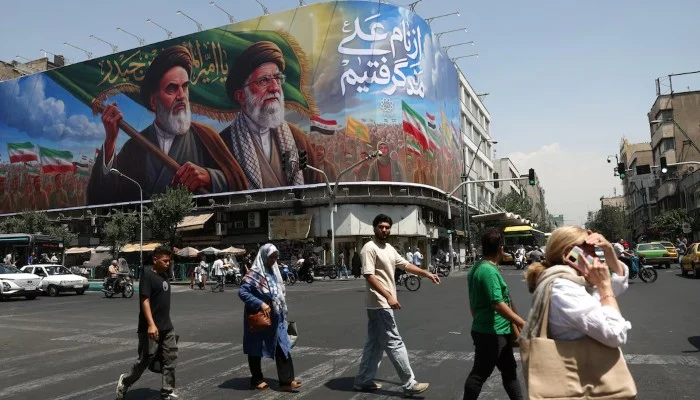
People walk past a billboard featuring the late leader of the Islamic Revolution, Ayatollah Ruhollah Khomeini, alongside Iran’s late Supreme Leader Ayatollah Ali Khamenei, on a street in Tehran, Iran, June 6, 2026. — Reuters
The United States reports shooting down two additional Iranian attack drones. Previously, Iran targeted Kuwait and Bahrain with missiles and drones. Mohsin Naqvi visits Tehran carrying a letter addressed to Iran’s Supreme Leader.
The US aims to redirect Iranian assets toward rebuilding efforts and damage repairs in Gulf states, a well-informed source revealed. This move follows Iran’s recent drone launches and strikes against Kuwait and Bahrain.
Treasury Secretary Scott Bessent has tasked a team with assessing the costs associated with damage caused to Gulf allies by Iran, the source said on Saturday. The US is also contemplating using Iranian assets for future repair needs.
This announcement comes a day after Mohsen Rezaei, an advisor to Iran’s Supreme Leader, told CNN that a peace agreement to end the three-month-long conflict relies on the release of $24 billion in Iranian assets frozen by the US.
The nature of the assets under review has not been specified. The language suggests measures might extend beyond just frozen funds.
The possibility of redirecting Iranian assets could complicate the fragile ceasefire between the US and Iran, which was tested again this weekend with strikes from both sides.
Peace negotiations seem to have stalled. Nevertheless, Mohsin Naqvi traveled to Tehran on Saturday with a letter to Iran’s Supreme Leader, Ayatollah Mojtaba Khamenei, according to Iran’s semi-official ISNA news agency.
US forces launched strikes early Saturday on Iranian radar sites in Goruk and Qeshm Island, located in the Strait of Hormuz, following Iran’s drone attacks that the US Central Command says threatened maritime traffic. Two more Iranian attack drones, which were endangering shipping, were also shot down late Saturday.
Iran’s Revolutionary Guards claimed they retaliated against US bases in Kuwait and Bahrain. Kuwait’s military reported intercepting seven ballistic missiles crossing over populated areas, causing material damage but no casualties.
In Bahrain, sirens sounded, and residents were advised to seek shelter. Both Kuwait and Bahrain condemned the strikes.
Iran later claimed it hit US bases in both nations with ballistic missiles, though the US military said six missiles were intercepted and one failed to reach its target.
OPEC+ is considering another increase in oil output, but ongoing conflict continues to hinder shipments. Negotiations between the US and Iran for a temporary deal to halt the conflict have been mostly indirect, leaving unresolved issues like Iran’s nuclear program for future talks.
Iran seeks access to billions in oil revenue, waivers on sanctions on crude exports, the lifting of US port blockades, and control over the Strait of Hormuz—a waterway now effectively blocked by Iran, which previously accounted for about a fifth of global oil trade before the war.
US President Donald Trump faces mounting domestic pressure to end the war as fuel prices rise. During an interview with NBC, he stated that most of Iran’s missile and drone manufacturing facilities have been destroyed, though Iran still retains around 20% of its missiles.
“Some missiles, some drones. Percentage-wise, probably 21% to 22% of their missiles. It’s a significant number, but not as extensive as when we first acted,” Trump told NBC’s “Meet the Press,” excerpts of which were released Friday.
The conflict has increased global oil prices and driven inflation. On Sunday, OPEC+ is expected to approve a fourth consecutive monthly increase in oil production targets, despite ongoing war-related constraints on several member countries’ production capabilities.
Israel’s military announced Sunday it intercepted two projectiles that crossed into Israeli territory from Lebanon. This followed Lebanon’s report that Israeli strikes killed two army officers and a soldier in southern Lebanon a day earlier.
 ChatGPT
 Perplexity
 Gemini AI
 Grok AI