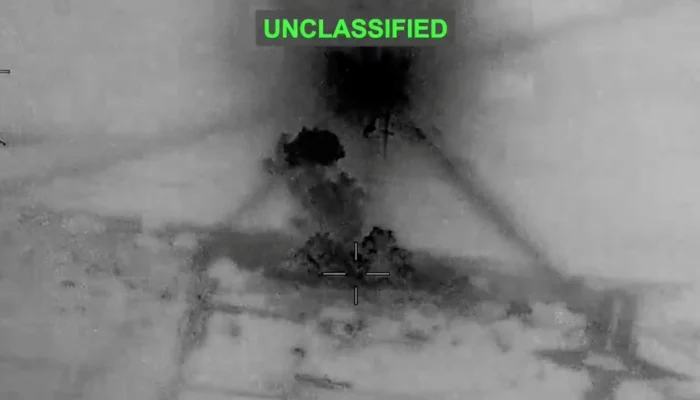
A plume of smoke rises from explosions at an undisclosed location, following what U.S. Central Command reports were strikes on Iran in retaliation for an Iranian drone attack on a cargo vessel in the Strait of Hormuz. This image is a frame from a video released on June 26, 2026. — Reuters
- Vance issues a stern warning to Iran against any further assaults on U.S. interests.
- Iran claims it targeted U.S. facilities in the Gulf in retaliation for recent strikes.
- Tensions in the Strait of Hormuz intensify concerns over global oil transportation.
The U.S. and Iran exchanged military blows after Washington accused Tehran on Friday of attacking a cargo ship, threatening a delicate ceasefire amid diplomatic efforts to de-escalate Middle Eastern hostilities.
U.S. Central Command announced that the U.S. conducted strikes on Iranian missile and drone storage sites, along with coastal radar installations, as a response to what it described as “unprovoked aggression” against commercial shipping. The operation was characterized as “a decisive counterattack to yesterday’s assault on a commercial vessel transiting the Strait of Hormuz.”
Iranian state TV, reporting from Sirik, described hearing an explosion late Friday at Taherouyeh port in the southern city. An official military source attributed the blast to a projectile impact in the area.
President Donald Trump had previously condemned what he called an Iranian drone attack on the vessel, calling it a “willful violation” of the ceasefire agreement. Vice President JD Vance directly warned via X (formerly Twitter) that “any further violence from Iran will be met with force.”
Early Saturday morning, Iranian authorities announced that the Revolutionary Guards claimed responsibility for striking U.S. targets in the Gulf, citing retaliation for the American strikes. The Guards warned, “If the aggression continues, our response will be even stronger.”
These hostile exchanges reignited doubts about maintaining open shipping lanes through the Strait of Hormuz, especially as the U.S. and Iran continue negotiations to resolve the ongoing conflict that ignited on February 28 with strikes conducted by the U.S. and Israel on Iran.
Iran has cautioned vessels against entering or exiting the Gulf via the strait without authorization, yet some ships persist in using non-approved routes, with about half of the 42 vessels passing through on Thursday opting for the southern route along Oman’s coast, according to Kpler’s tracking data.
The United Nations’ maritime agency indicated that a rescue operation had freed 115 ships and 2,500 sailors who were stranded due to the dispute before the recent attack prompted a suspension. Despite the escalation, oil prices declined sharply, reflecting investor optimism that maritime traffic through Hormuz—a key route responsible for roughly 20% of global oil and gas exports—will continue to recover despite recent tensions.
Lebanon Peace Framework
Israel and Lebanon welcomed a new agreement signed with U.S. officials aimed at fostering peace along their shared border, although Hezbollah expressed concerns that the deal might hinder efforts to resolve the broader regional conflict.
At the signing ceremony in Washington, Secretary of State Marco Rubio, flanked by representatives from Israel and Lebanon, described the trilateral accord as a foundation for lasting peace and security. “This is just the beginning, and there’s much work ahead,” he stated.
Israeli Prime Minister Benjamin Netanyahu regarded the framework as a strategic victory against Iran, which argues that the Lebanon front is part of the wider conflict and should be included in U.S.-Iran negotiations. “Iran has tried to pressure us into retreating from southern Lebanon, but now Israel, Lebanon, and the U.S. are stating: this is none of your business,” Netanyahu declared.
He elaborated that the agreement would enable the Lebanese military to re-establish control over two key areas in southern Lebanon, though Israeli troops would remain in their security zone until Hezbollah is disarmed. Civilians displaced by conflict would still be barred from returning.
Lebanese President Joseph Aoun described the framework as a “step forward” toward civilian reintegration under Lebanese sovereignty. However, protests erupted in Beirut on Friday night as Hezbollah supporters rejected the deal, with Hezbollah MP Hassan Fadlallah accusing the U.S. of undermining the broader ceasefire and warning that Lebanon could face civil war if the government enforces the agreement without Iranian backing.
Nuclear Safeguards
The head of the UN nuclear watchdog issued a warning that any final U.S.-Iran agreement must include robust safeguards to prevent Tehran from developing nuclear weapons. Iran’s nuclear program remains a contentious issue, with conflicting reports about whether international inspectors will have access to the country’s facilities. Rafael Grossi, director of the International Atomic Energy Agency, emphasized, “Iran has clearly stated it does not intend to develop nuclear weapons, but intentions alone are insufficient; we need a strong verification system in place as soon as possible.”
An interim deal specifies that Iran’s stockpile of enriched uranium—estimated that pre-war was 440 kilograms (about 970 pounds) at 60% enrichment—must be “downblended” to limit nuclear capability.