الوسم: military strikes

  • US and Iran exchange strikes for first time since Swiss peace deal

    US and Iran exchange strikes for first time since Swiss peace deal

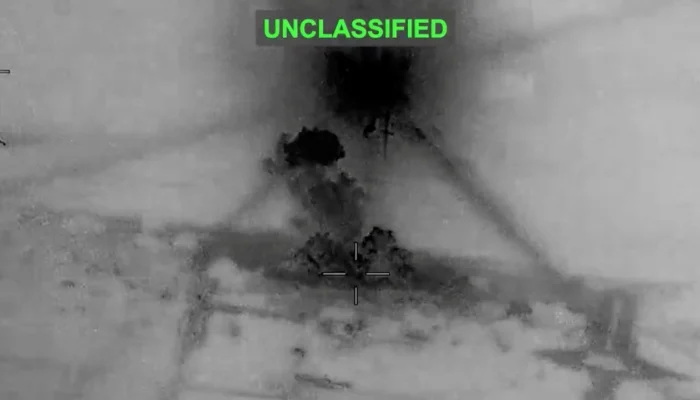
    A plume of smoke rises from explosions at an undisclosed location, following what U.S. Central Command reports were strikes on Iran in retaliation for an Iranian drone attack on a cargo vessel in the Strait of Hormuz. This image is a frame from a video released on June 26, 2026. — Reuters

    • Vance issues a stern warning to Iran against any further assaults on U.S. interests.
    • Iran claims it targeted U.S. facilities in the Gulf in retaliation for recent strikes.
    • Tensions in the Strait of Hormuz intensify concerns over global oil transportation.

    The U.S. and Iran exchanged military blows after Washington accused Tehran on Friday of attacking a cargo ship, threatening a delicate ceasefire amid diplomatic efforts to de-escalate Middle Eastern hostilities.

    U.S. Central Command announced that the U.S. conducted strikes on Iranian missile and drone storage sites, along with coastal radar installations, as a response to what it described as “unprovoked aggression” against commercial shipping. The operation was characterized as “a decisive counterattack to yesterday’s assault on a commercial vessel transiting the Strait of Hormuz.”

    Iranian state TV, reporting from Sirik, described hearing an explosion late Friday at Taherouyeh port in the southern city. An official military source attributed the blast to a projectile impact in the area.

    President Donald Trump had previously condemned what he called an Iranian drone attack on the vessel, calling it a “willful violation” of the ceasefire agreement. Vice President JD Vance directly warned via X (formerly Twitter) that “any further violence from Iran will be met with force.”

    Early Saturday morning, Iranian authorities announced that the Revolutionary Guards claimed responsibility for striking U.S. targets in the Gulf, citing retaliation for the American strikes. The Guards warned, “If the aggression continues, our response will be even stronger.”

    These hostile exchanges reignited doubts about maintaining open shipping lanes through the Strait of Hormuz, especially as the U.S. and Iran continue negotiations to resolve the ongoing conflict that ignited on February 28 with strikes conducted by the U.S. and Israel on Iran.

    Iran has cautioned vessels against entering or exiting the Gulf via the strait without authorization, yet some ships persist in using non-approved routes, with about half of the 42 vessels passing through on Thursday opting for the southern route along Oman’s coast, according to Kpler’s tracking data.

    The United Nations’ maritime agency indicated that a rescue operation had freed 115 ships and 2,500 sailors who were stranded due to the dispute before the recent attack prompted a suspension. Despite the escalation, oil prices declined sharply, reflecting investor optimism that maritime traffic through Hormuz—a key route responsible for roughly 20% of global oil and gas exports—will continue to recover despite recent tensions.


    Lebanon Peace Framework

    Israel and Lebanon welcomed a new agreement signed with U.S. officials aimed at fostering peace along their shared border, although Hezbollah expressed concerns that the deal might hinder efforts to resolve the broader regional conflict.

    At the signing ceremony in Washington, Secretary of State Marco Rubio, flanked by representatives from Israel and Lebanon, described the trilateral accord as a foundation for lasting peace and security. “This is just the beginning, and there’s much work ahead,” he stated.

    Israeli Prime Minister Benjamin Netanyahu regarded the framework as a strategic victory against Iran, which argues that the Lebanon front is part of the wider conflict and should be included in U.S.-Iran negotiations. “Iran has tried to pressure us into retreating from southern Lebanon, but now Israel, Lebanon, and the U.S. are stating: this is none of your business,” Netanyahu declared.

    He elaborated that the agreement would enable the Lebanese military to re-establish control over two key areas in southern Lebanon, though Israeli troops would remain in their security zone until Hezbollah is disarmed. Civilians displaced by conflict would still be barred from returning.

    Lebanese President Joseph Aoun described the framework as a “step forward” toward civilian reintegration under Lebanese sovereignty. However, protests erupted in Beirut on Friday night as Hezbollah supporters rejected the deal, with Hezbollah MP Hassan Fadlallah accusing the U.S. of undermining the broader ceasefire and warning that Lebanon could face civil war if the government enforces the agreement without Iranian backing.


    Nuclear Safeguards

    The head of the UN nuclear watchdog issued a warning that any final U.S.-Iran agreement must include robust safeguards to prevent Tehran from developing nuclear weapons. Iran’s nuclear program remains a contentious issue, with conflicting reports about whether international inspectors will have access to the country’s facilities. Rafael Grossi, director of the International Atomic Energy Agency, emphasized, “Iran has clearly stated it does not intend to develop nuclear weapons, but intentions alone are insufficient; we need a strong verification system in place as soon as possible.”

    An interim deal specifies that Iran’s stockpile of enriched uranium—estimated that pre-war was 440 kilograms (about 970 pounds) at 60% enrichment—must be “downblended” to limit nuclear capability.

  • US Hits Iran Again Amid Trump Denial on Hormuz Deal

    US Hits Iran Again Amid Trump Denial on Hormuz Deal

    A drone shot captures vessels anchored in the Strait of Hormuz, viewed from Musandam, Oman, on May 25, 2026. — Reuters

    • The U.S. launches targeted strikes against an Iranian military site, downing several drones.
    • A U.S. official describes the response as cautious and defensive.
    • President Trump denies any agreement with Iran and Oman regarding navigation through the Strait of Hormuz.

    The U.S. military reported conducting new defensive operations against an Iranian drone operation threatening American forces and commercial ships in the Strait of Hormuz. This comes just hours after President Donald Trump dismissed reports of a potential deal to restore shipping traffic in the waterway.

    An anonymous U.S. official told Reuters on Wednesday that the military shot down four Iranian attack drones and attacked a ground control station in Bandar Abbas before a fifth drone could be launched. A ceasefire agreement between the U.S. and Iran has been in place since early April.

    “These actions were deliberate, solely defensive, and aimed at preserving the ceasefire,” the official stated.

    Iran’s Tasnim news agency cited a military source claiming the Islamic Revolutionary Guards Navy fired warning shots at a U.S. oil tanker attempting to transgress the strait, causing it to turn back. The source also indicated that the U.S. responded with strikes on open ground around Bandar Abbas, with no reports of casualties or damage.

    Later reports from Iranian media indicated that four ships trying to pass early Thursday were turned back after warning shots in their directions.

    Additionally, the U.S. conducted strikes in southern Iran on Monday, claiming they were defensive. Iran called these actions a “gross violation” of the ceasefire.

    Oil prices, which had fallen over 5% on Wednesday, rebounded after reports of these strikes. U.S. crude futures rose nearly 2% to $90.38 per barrel early Thursday in Asian trading.

    Trump asserts no country will control the strait

    During a cabinet meeting on Wednesday, which was open to the media, Trump dismissed an Iranian state TV report claiming Iran had obtained an unofficial draft for an agreement to restore shipping to pre-war levels within a month, with Iran and Oman jointly managing traffic.

    Trump emphasized that no single country would dominate the waterway, hinting at a potential threat to Oman, a longstanding U.S. ally.

    “No one is going to control the strait,” Trump said. “It’s international waters, and Oman will act like everyone else, or we’ll take action. They get it, and they’ll be fine.”

    The White House and Oman’s embassy did not immediately comment. Iran’s UN mission was also unavailable for comments.

    Later, the U.S. Treasury announced that the Persian Gulf Strait Authority, Iran’s official body responsible for managing passage, was added to the list of sanctioned entities threatening U.S. national security.

    The Iranian report also claimed that the U.S. would lift its blockade of Iranian ports and withdraw military forces from the region, but the White House dismissed these reports as “complete fabrications.” Iran has not responded publicly.

    The U.S. has approximately 15,000 troops involved in enforcing a blockade of Iran, with thousands more stationed at regional bases. U.S. naval vessels continue routine transits, stopping at ports like Oman, although the number of daily crossings has decreased by 88% since the initial strikes in late February.

    President Trump has also urged countries like Pakistan, Saudi Arabia, Qatar, Turkey, Egypt, and Jordan to join the Abraham Accords, normalizing relations with Israel as part of efforts to end the conflict—but these nations have declined.

    Iranian officials say the proposed draft deal would involve the U.S. withdrawing military forces from the area, though the White House dismisses this as untrue. Negotiations on Iran’s nuclear program are expected to proceed separately, which some analysts view as a sticking point for Trump’s supporters. Iran insists its nuclear pursuits are peaceful.

    U.S. Secretary of State Marco Rubio has stated confidently that Iran will never develop a nuclear weapon.

    On Wednesday, Iran’s Revolutionary Guards announced that 23 ships, including oil tankers and commercial vessels, had transited the strait over the past 24 hours—far fewer than the usual 125-140 vessels before recent hostilities began.

    Despite ongoing tension, the international law governing the Strait of Hormuz grants all vessels the right to passage, though recent military actions have reduced daily traffic significantly.

  • Which Iranian Leaders Have Been Targeted in US-Israeli Assassinations?

    Which Iranian Leaders Have Been Targeted in US-Israeli Assassinations?

    Iran’s top leader, Ayatollah Ali Khamenei, who has held the position since 1989 and strengthened Iran’s control while fostering hostility toward the U.S. and Israel, was killed at age 86 in a U.S.-Israeli airstrike on his compound on February 28. His lengthy tenure was characterized by consolidating power through Iran’s security forces and expanding Iran’s regional influence, despite ongoing conflicts over its nuclear program with Western nations.

    Prominent officials also fell during this wave of strikes. Ali Larijani, the Secretary of Iran’s Supreme National Security Council and a seasoned political figure, was killed at 67 in a U.S.-Israeli attack in the Pardis area on March 17, alongside his son and one of his deputies, according to Iranian reports. A former Revolutionary Guards commander and nuclear negotiator, Larijani was a close confidant of Khamenei and played a vital role in shaping Iran’s security and foreign policy.

    Iran’s Intelligence Minister Esmail Khatib was also targeted and killed in an Israeli strike on March 18. Known as a hardline cleric and politician, he worked directly in Khamenei’s office and was mentored by him before leading Iran’s civilian intelligence agency in August 2021.

    Ali Shamkhani, a close advisor to Khamenei and a key player in Iran’s security and nuclear strategy, was eliminated in U.S.-Israeli strikes on Tehran on February 28. He had previously survived an attack on his home during the June 12-day conflict between Israel and Iran.

    High-ranking military leaders also lost their lives. Mohammad Pakpour, the commander-in-chief of Iran’s Revolutionary Guard Corps (IRGC), was assassinated during the February 28 attacks in Tehran, according to Iranian state media. He rose through the ranks to lead the IRGC following the death of Hossein Salami in June’s conflict.

    Iran’s Defense Minister Aziz Nasirzadeh, a career Air Force officer, was also killed in the February 28 assaults targeting senior leadership in Tehran. He was a key figure in military planning and defense policy. Abdolrahim Mousavi, the armed forces chief of staff, was murdered during what Iranian media described as a senior leadership meeting in Tehran on the same day. He was responsible for coordinating military branches and overseeing conventional forces.

    Gholamreza Soleimani, commander of Iran’s Basij paramilitary force, was eliminated in U.S.-Israeli strikes on March 17, according to Iranian state sources. As a senior Revolutionary Guards officer, he led the force responsible for domestic security and enforcing government authority.

    Additionally, Behnam Rezaei, the navy intelligence chief of the Revolutionary Guards, was killed in an Israeli strike in Bandar Abbas on March 26, with Israel stating he was responsible for regional intelligence collection.

  • Trump Administration Leaders Disclose Classified Info to Reporter

    Trump Administration Leaders Disclose Classified Info to Reporter

    US Defense Secretary Pete Hegseth addresses the audience after his swearing-in on the 25th. — AFP/File

    WASHINGTON: High-ranking officials from Donald Trump’s administration, including the Vice President and the Secretary of Defense, mistakenly included a journalist in a private messaging group where they were discussing classified military strategies for potential strikes against the Iran-backed Houthi rebels in Yemen. This incident has raised substantial security concerns, as reported by The Atlantic magazine.

    On March 13, The Atlantic’s editor-in-chief, Jeffrey Goldberg, was inadvertently added to an encrypted chat group on the Signal messaging app known as the “Houthi PC small group.” In this group, National Security Adviser Mike Waltz instructed his deputy, Alex Wong, to organize a “tiger team” dedicated to coordinating U.S. actions against the Houthis.

    Following increased attacks on shipping in the Red Sea, President Trump initiated a series of military strikes against the Houthis on March 15, also warning Iran, the Houthis’ primary supporter, to cease its assistance immediately.

    Just hours before these strikes commenced, Hegseth allegedly shared operational details, including target information, the types of weapons to be deployed by the U.S., and the sequence of attacks. Goldberg described this as a “shockingly reckless” use of the Signal platform to organize the military operation without releasing any specifics.

    The Defense Department directed a request for comment to the National Security Council. NSC spokesperson Brian Hughes confirmed the authenticity of the chat group, stating, “Currently, the message thread in question seems to be genuine, and we are assessing how an incorrect number was added to the chain. This thread exemplifies the thorough and thoughtful policy coordination among senior officials. The ongoing effectiveness of operations against the Houthis shows that there was no threat to our service members or national security.”