Tag: Robotics

  • Samsung’s Ballie Home Robot Could Be Coming Soon

    Samsung’s Ballie Home Robot Could Be Coming Soon

    Samsung’s rolling home robot has long been considered the industry’s most persistent “Will it ever ship?” joke, and honestly, I had mostly given up hope. But now, there’s finally a glimmer of optimism.

    The company first introduced Ballie as a concept at CES 2020. Four years later, they showcased a significantly upgraded version, yet never confirmed a release date or committed to bringing it to market.

    Recently, SammyGuru obtained the first images of Ballie’s companion smartphone app. While it appears to be a wireframe draft rather than a finished product, it’s still noteworthy. The home screen displays a status card with Ballie’s battery level, current location, and any error messages. A prominent “Streaming” button is also visible, which seems to allow remote camera feed access and control via your phone.

    The app features room-specific shortcuts, enabling you to send Ballie on patrol around the house or have it greet guests at the front door. One screenshot shows a setup process where Ballie maps your home, similar to how a robot vacuum cleaner does.

    What exactly can Ballie do, and is this real? Well, Ballie is designed to respond to voice commands, manage smart home devices, project video onto walls (which looks pretty cool), and act as a mobile security camera when you’re away.

    However, it’s important to be cautious. What’s been leaked is still just a wireframe, with no official confirmation from Samsung about developing a working version of this app or the robot itself. Still, after months of silence, even a mockup like this offers the most concrete sign yet that Ballie has not quietly been shelved.

    Ballie’s six-year hiatus echoes the fate of many ambitious CES concepts that disappear without a formal cancellation. The leak indicates ongoing internal development, and Samsung’s silence on a release timeline suggests hope, rather than certainty.

  • Innovative Robotic System Enhances Stroke Walking Recovery

    Innovative Robotic System Enhances Stroke Walking Recovery

    Credit: Unsplash+

    Each year, hundreds of thousands of people survive strokes, but the road to recovery can be long and challenging. One of the toughest parts is relearning how to walk.

    Weak muscles, poor balance, and limited leg control can make even basic movements draining, meaning many survivors spend months in physical therapy before they regain confidence and independence. A new study published in Science Robotics offers hope for improving this rehabilitation process.

    Researchers from Shirley Ryan AbilityLab and Northwestern University have designed a groundbreaking system that blends human expertise with robotic technology.

    This approach isn’t meant to replace physical therapists but to support them in delivering more effective, tailored treatments. The team refers to their system as therapist-exoskeleton-patient interaction, or TEPI.

    In typical stroke rehab, therapists often use their hands to guide a patient’s legs and body during walking practice.

    While this hands-on support is invaluable, one therapist can only assist with a few movements at a time. Complex walking training might require multiple therapists, making the process physically taxing and time-consuming.

    Robotic exoskeletons have already been introduced into rehab but usually follow preset movement patterns. Although they can help patients walk longer distances, many can’t adapt quickly to changing needs during therapy, limiting the flexibility a skilled therapist provides.

    The TEPI system changes the game. Both the therapist and the patient wear lower-body robotic exoskeletons while walking on a treadmill. These devices are connected through a virtual link, allowing real-time influence of the therapist’s movements on the patient and enabling the therapist to feel how the patient is moving.

    This bidirectional connection fosters a more natural interaction. Therapists can instantly adjust support—whether they need to increase assistance, ease up, or gently challenge the patient—based on their performance. This personalization enhances training effectiveness while reducing physical strain on therapists.

    The research team tested TEPI with eight stroke survivors, comparing it to traditional treadmill training guided by therapists. The participants using TEPI showed improved joint movement, longer and higher steps, and muscle activity comparable to conventional therapy. Many also reported enjoying the sessions and feeling motivated.

    These improvements are promising because motivation plays a crucial role in successful rehab. Patients who enjoy their therapy are more likely to stick with their routines, boosting long-term recovery. This technology could benefit physical results and patient engagement alike.

    Future plans include testing the system in more practical activities like walking on different terrains, climbing stairs, and standing up from chairs. Researchers also aim to develop simpler versions that could support home rehab or enable remote guidance by therapists.

    It’s important to note that this initial study involved only a small number of participants. Larger clinical trials will be necessary before TEPI becomes a regular part of stroke recovery treatment. Nonetheless, the results suggest that merging robotic tech with expert therapy could make rehabilitation more effective, less physically demanding for clinicians, and more enjoyable for patients.

    If you’re concerned about stroke, consider exploring studies on diet prevention strategies—eating foods rich in flavonoids has been linked to reduced stroke risk.

    For additional health insights, check out recent findings on how the Mediterranean diet can support brain health and how wild blueberries may benefit both your heart and brain.

    Source: Shirley Ryan AbilityLab.

  • MIT’s Micro-robot Boats Build Floating Bridges and Platforms

    MIT’s Micro-robot Boats Build Floating Bridges and Platforms

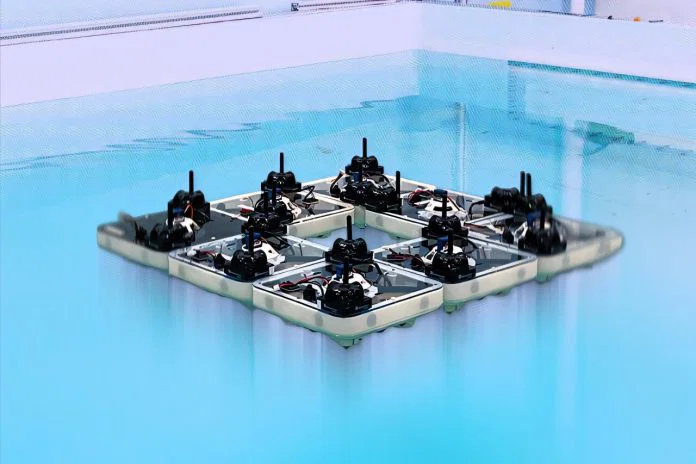
    Imagine dozens of small robotic boats drifting along a river, coming together to form a bridge, a stage, or a temporary platform anytime it’s needed. Once the task is complete, the robots split apart and move on to create something entirely different. This futuristic concept is now becoming a reality through a project called FloatForm, developed by researchers at the Massachusetts Institute of Technology (MIT).

    Published in Nature Communications, the study showcases a group of tiny autonomous robot boats capable of self-organizing into larger floating structures with minimal human input. Each boat measures about 8 inches wide — roughly the size of a dinner plate. Despite their small size, every boat is equipped with its own battery, electric motors, sensors, and magnetic connectors, enabling independent movement while collaborating with others.

    The team envisions these robotic boats transforming into adaptable floating infrastructure. Potential uses include quickly constructing temporary bridges after natural disasters, creating floating markets along canals, setting up stages for events, or providing work platforms for scientists and engineers.

    This idea was inspired by an earlier MIT project involving full-sized autonomous boats used on Amsterdam’s iconic canals, which sparked curiosity about whether smaller robots could team up to build larger structures on demand. A significant challenge was teaching numerous robots to cooperate without relying on a single controlling computer.

    To overcome this, the researchers looked to nature for clues. Fire ants, for instance, can survive floods by linking their bodies into floating rafts without a designated leader. Each ant follows simple local rules, resulting in a stable structure. Similarly, the FloatForm robots communicate solely with nearby units, determining their movements based on local information. A central computer simply assigns each robot a destination; the robots handle navigation, collision avoidance, and connections themselves.

    This decentralized approach enhances system reliability. If one robot encounters a problem, the others continue functioning smoothly. For connecting, each robot features a clever magnetic locking system tucked inside its body. A small motor extends or retracts magnets to clasp onto neighboring robots. Once linked, the magnets stay locked without using extra power, conserving battery life.

    In laboratory tests, eight robot boats successfully gathered from different starting points, formed a larger floating structure, detached, and reshaped into new configurations. They even managed to move together across the water as a single vessel. Computer models suggest that the same system could coordinate larger groups of up to 64 robots.

    Beyond urban waterways, the team sees numerous future applications. Swarms of these boats could assist search-and-rescue operations, monitor water quality, inspect offshore equipment, create temporary floating work platforms, or aid scientists studying wildlife in secluded lakes and oceans.

    Currently, the researchers are working on making the robots more durable for outdoor environments and rougher waters. They also plan to replace the indoor tracking system with GPS and other navigation technologies.

    Although still in early development, FloatForm offers a glimpse into a future where rivers, lakes, and canals become adaptable spaces capable of changing shape as needed. Instead of permanent structures, cities might rely on intelligent robot swarms to generate floating infrastructure whenever the situation calls for it.

  • Scientists develop color-changing robot skin that senses sight and touch

    Scientists develop color-changing robot skin that senses sight and touch

    Imagine a robot capable of not only visual perception but also sensing touch sensations. Researchers have developed a revolutionary material that shifts color when pressed, enabling robots to detect touch in a more straightforward and intelligent way.

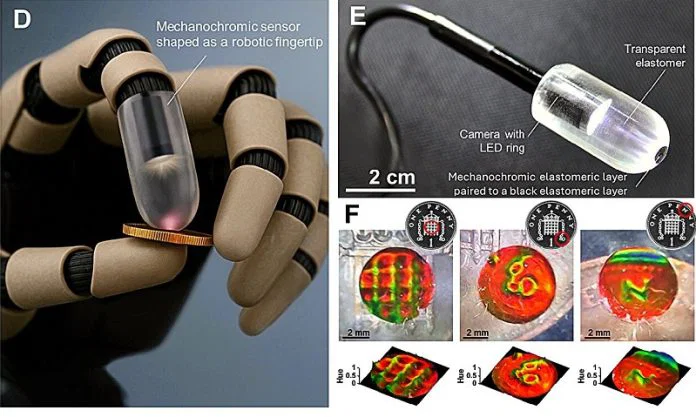
    Scientists at Queen Mary University of London have engineered a new tactile sensor that transforms applied pressure into vibrant, changing color patterns.

    Published in Science Advances, this research could enhance robotic applications in manufacturing, healthcare, and even artificial limbs.

    Touch is more complex than it appears. Every time you flip a light switch or grasp a cup, thousands of tiny sensory receptors in your skin transmit information to your brain. Your hand alone contains over 10,000 touch receptors, allowing you to feel pressure, texture, and movement with incredible precision. Replicating this level of sensitive touch in robots has been a significant challenge for engineers.

    Most existing robotic touch sensors rely on numerous miniature electronic sensors, which tend to be costly, intricate, and slow. These systems require complex data processing, delaying the robot’s response to touch.

    This new approach takes an entirely different path. Instead of filling sensors with electronics, the sensing capability is embedded directly into the material itself. When the surface is pressed, it alters color in specific areas depending on the amount of pressure.

    A simple, affordable USB camera observes these color changes and quickly generates detailed maps of the touch location and intensity. Because the tactile information is stored visually in the pattern of colors, the computer doesn’t need to perform extensive calculations to interpret the data. This results in faster, more detailed responses.

    Lead researcher Giacomo Sasso explained that the team was especially thrilled that the material could even detect the fine ridges of fingerprints. According to the scientists, no current technology provides such high-resolution detail while remaining simple and cost-effective.

    This innovative sensor could have numerous practical applications. In factories, robots could assemble small, delicate electronic components with gentle, precise force. In medicine, robotic surgical systems might detect subtle differences between healthy and diseased tissues by sensing minute variations in pressure.

    Additionally, this technology could significantly improve prosthetic limbs, offering users a much richer sense of touch. This enhancement would make everyday tasks like handling fragile objects or using tools safer and easier.

    The research involved collaboration between scientists from the UK and Italy, integrating advances in soft robotics, flexible materials, and sensor technology.

    While further development is necessary before widespread adoption, this color-changing material points toward exciting future possibilities in robotics. Instead of relying solely on complex calculations, the material visually demonstrates what is being felt, bringing robotic touch closer to the natural abilities of the human hand—faster, simpler, and remarkably intuitive.

  • Indian Workers Train AI Robots to Replace Their Jobs

    Indian Workers Train AI Robots to Replace Their Jobs

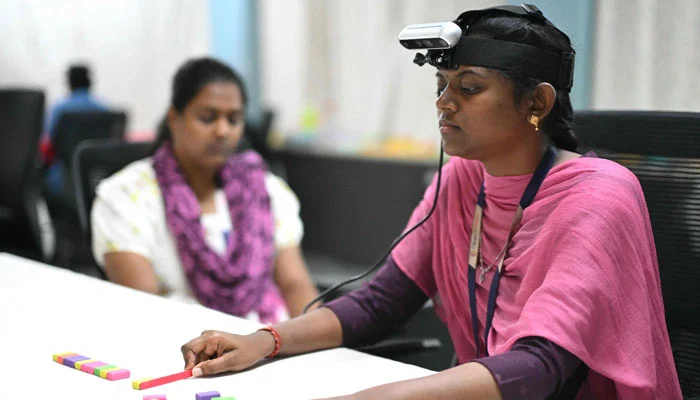
    A female worker in Tamil Nadu’s Karur district, equipped with a head-mounted RGB camera, captures her actions through motion capture while organizing colored blocks at the AI data company Objectways’ office, as reported by AFP.

    Clad with a smartphone on her head, Nagireddy Sriramyachandra, an Indian housewife, films herself as she slices mangoes to help train AI-powered robots for household tasks in the future. Her simple recordings, earning her just over two dollars per hour, are highly valued by global tech corporations seeking to teach machines how to operate like humans in real-world settings.

    At 25 years old, she represents a growing number of thousands of AI system trainers across India. “Who else would pay INR 250 an hour just to do housework?” Sriramyachandra remarks from her Chennai kitchen. She also hopes she might get a robot of her own someday.

    While chatbots and image generators process massive amounts of digital data easily, designing systems capable of navigating physical environments remains complex. Developers believe that feeding first-person footage—known as “egocentric data”—to specialized AI models can teach robots to imitate human movements. Some trainers work from home, while others in factories or dedicated studios, using video glasses, head-mounted cameras, and motion sensors.

    Sriramyachandra explains that her recordings often prompt alerts like “‘hands not detected’” when not recorded properly, and she uploads these via an app to Objectways, which has offices both in India and the U.S. and serves Fortune 500 companies, including collaborations with Amazon SageMaker for machine learning development.

    The humanoid robot industry is experiencing rapid growth, with Morgan Stanley forecasting over a billion robots in use by 2050 mainly for industrial and commercial purposes. “Folding clothes, making coffee, cooking—particularly specific tasks like sandwich preparation,” says Ravi Shankar, Objectways’ head, listing the types of footage clients request. “Certain jobs will be automated so humans can focus on better things.”

    In India, the emerging field of spatial AI is creating new job opportunities—at least for now. Though the company’s CEO is based in the U.S., he hires from Tamil Nadu, a key hub for tech talent. At a textile factory in Karur, workers are seen wearing head cameras and smart glasses supplied by Objectways as they attach labels to caps and iron cloth bags. India has positioned itself as a global intermediary for creating, processing, and annotating AI data.

    “These data collection services are likely to grow,” states Aditi Surie, a digital labor expert from the Indian Institute for Human Settlements in Bengaluru.

    India is rapidly developing its AI sector, but officials recognize that alongside the promised benefits, automation also presents risks. Niti Aayog, a government think tank, notes that most discussions around AI and employment focus on white-collar jobs, predicting significant job losses without urgent government action. Little attention, the report emphasizes, is given to how AI could assist the 490 million informal workers who underpin India’s economy. The report examines how AI might impact various professions, from cobblers and sewer cleaners to farmers and tea vendors.

    Ponni, 55, from Bengaluru, has been making flower garlands on the roadside for over a decade. She, too, has had a phone strapped to her forehead for data collection. “Future generations… who might have to do similar work, will face challenges,” she comments.

    In Objectways’ studio, trainers film themselves performing household chores inside mock-up, fully furnished apartments. After thousands of hours of filming, the set is refreshed with new wallpapers to provide variety. Rani N., 21, an engineering graduate, takes breaks between sessions of folding towels, stating that she records around 90 videos a day, often in every corner of the bed. She finds the job “tolerable” but admits it makes her feel as though she’s constantly wearing a camera.

    Other colleagues arrange and record household objects like pencil sharpeners, water bottles, and crayons using depth-sensing cameras. A subcontractor, Qanat Consulting in Andhra Pradesh, supplies recordings to a dozen larger data firms, relying on about 2,000 contributors who wear motion-sensor bands on their limbs—according to CEO Thaslim Pattan.

    Meanwhile, Manish Agarwal from Bengaluru-based Humyn Labs, not affiliated with Objectways, records conversations alongside videos to help analyze speech patterns for clients. He believes that robots won’t replace human jobs but will instead work alongside humans. “Today, a welder in India might be managing an industrial robot in Prague,” he says.

  • Beyond the Boundary Wire How Yardcare and N1600PRO Lead Mower Change

    Beyond the Boundary Wire How Yardcare and N1600PRO Lead Mower Change

    The anxiety of weekend mornings is a common experience many homeowners understand all too well. Waking up with the realization that the next few hours will involve the relentless drone of a gas-powered machine and the tiring task of pushing a heavy mower across the yard is familiar to many. We’ve all been there—sweating under the sun, striving for a lush, green lawn that looks decent at best but rarely matches the precision of a professional. An entirely automated solution should solve these issues, but finding one that’s dependable isn’t always straightforward.

    Dealing with boundary wire installation, mastering navigation, and constantly needing manual oversight doesn’t exactly sound like the ideal vision of automation. However, advancements in technology are beginning to change that, with Yardcare’s N1600PRO standing out as a prime example. The latest innovation from Yardcare ensures that lawn maintenance shifts from constant effort to effortless efficiency. If you’re a homeowner increasingly interested in automating yard chores, Yardcare makes it easy to embrace this smart transition with the N1600PRO.

    Last year alone, Yardcare sold over 100,000 units, establishing a reputation for delivering top-tier landscaping solutions that simplify yard upkeep while maintaining professional quality. By combining state-of-the-art robotics with high standards in landscaping, Yardcare has gained trust from thousands of families worldwide. Their goal is to give homeowners a premium lawn care experience, eliminating the need for continuous manual effort or constant supervision. Building on a legacy of innovation and reliability, Yardcare introduces its most advanced model yet: the N1600PRO. This flagship mower offers a completely wire-free experience, free of restrictions.

    ### Smart Lawn Maintenance for Modern Homes

    Designed to meet the demands of today’s busy lifestyles, the N1600PRO delivers impressive results with minimal effort. Whether dealing with uneven terrain, slopes, or managing multiple lawns, this robotic mower adapts effortlessly to various yard layouts.

    Its built-in automated mapping system allows the mower to learn your lawn’s structure. Plus, a no-go zone feature prevents it from entering sensitive areas like flower beds, swimming pools, or outdoor furniture. Compared to the manual labor of traditional mowers, this automated option frees up your time while delivering a pristine, professional-looking yard.

    ### What Sets the Yardcare N1600PRO Apart

    Ease of use and advanced technology are key factors when choosing lawn care solutions. The Yardcare N1600PRO introduces several significant upgrades over traditional robotic mowers. Many competing models depend on boundary wires, which are time-consuming to install, complicated to adjust, and often result in uneven mowing patterns.

    The N1600PRO overcomes these issues with next-generation engineering. It features automatic navigation, a structured mowing plan, and virtual mapping that minimize repetitive coverage. Its multi-zone control and automated mapping enable completely hands-free operation, especially useful for segmented or complex lawns. All you need is the accompanying mobile app, and you’re ready to manage your yard remotely.

    Its advanced vision-based navigation system offers centimeter-level precision, thanks to the RTK+Vision system. When operating outdoors, the mower benefits from a strong GPS signal complemented by the RTK unit, enabling detailed mapping and navigation. Unlike competitors relying solely on GPS or RTK, the added visual intelligence provides real-time stability, ensuring that walls, trees, or other obstacles don’t hinder performance. This results in fewer missed spots and a more uniform, clean finish.

    ### Control Your Lawn from Anywhere

    Yardcare emphasizes convenience with the app-controlled Smart Control feature. This intuitive mobile interface makes managing your yard simple whether you’re home or away. You can set custom mowing schedules, manage multiple zones, and adjust cutting and trimming preferences based on seasons—all with just a few taps. The mower also offers nine adjustable cutting heights between 2 and 6 centimeters, allowing you to tailor the look of your lawn easily.

    Additionally, over-the-air (OTA) updates keep the mower up-to-date with the latest features, like passage creation for seamless navigation. The U-shaped mowing pattern ensures even coverage and precise boundary trimming at the start of each session, providing a neat, professional finish without additional effort.

    ### Why the N1600PRO Could Be Your Best Bet

    Yardcare prioritizes safety and dependability. The N1600PRO includes AI-driven obstacle detection that actively avoids objects in real time and automatically returns to its dock when batteries are low. It charges fully in just over two hours, providing up to 100 minutes of mowing on a single charge—more than enough for medium to large yards.

    For added safety, the mower is equipped with emergency stop functions, lift, and rain sensors that prompt it to return to its dock when necessary. It can handle inclines of up to 20 degrees and features a low-noise, adaptive system for quieter operation. Overall, the innovations integrated into the N1600PRO make it an excellent choice for those seeking modern safety features, reliability, and convenience in yard care.

    ### Tailored Options for Every Yard

    To meet diverse needs, Yardcare offers a broad range of models suited for various lifestyles. The E400 is perfect for compact urban yards and offers simple, app-controlled operation. The V100 uses AI vision and magnetic strips to create “No-Go” zones around delicate areas such as flower beds or pools without any digging. For larger properties, the M800 Plus provides comprehensive coverage with a hybrid mowing pattern designed to handle slopes easily.

    With these options, Yardcare ensures that every backyard finds its perfect robotic mowed solution.

  • Pakistani Roads Shine Bright, Robots Get Flirty, Keyboards Slim Down

    Pakistani Roads Shine Bright, Robots Get Flirty, Keyboards Slim Down

    Pakistan’s V-SenseDrive Tackles Road Safety Using AI

    Created with Gemini

    Road accidents are a constant concern amidst Pakistan’s hectic traffic scene, but a new local initiative aims to make a difference. Developers have launched V-SenseDrive, the nation’s first driver behavior dataset designed with privacy in mind, and built entirely from data collected on Pakistani roads.

    Instead of invasive facial recordings, the dataset employs smartphone sensors such as accelerometers, gyroscopes, and GPS, combined with video footage of the road to categorize driving styles into normal, aggressive, and risky behaviors. It has been tested across various environments, from city streets to highways, reflecting the chaotic nature of Pakistani traffic.

    By organizing the data into raw, processed, and semantic layers, the project provides tools for developers and policymakers to train advanced driver-assistance systems (ADAS), enhance fleet safety, and develop insurance models that are specifically tailored to Pakistan’s driving habits.

    Advancing Toward a Skynet Future

    Source: REUTERSSource: REUTERS

    We’ve previously discussed augmented reality glasses, with Meta and Amazon rushing to develop their own versions, but Meta is taking it even further.

    In an interview with Meta’s CTO, Andrew Bosworth, journalist Alex Heath reported that Meta is delving deeper into robotics. This isn’t driven by competition but aims to develop software that other companies can license.

    Bosworth acknowledges that software remains the primary challenge in advancing robotics technology, and he hopes that Meta’s robotics team and their ‘Superintelligence Labs’ will find viable solutions.

    Initially, their focus is on enabling robots to animate a hand; progress will then extend to more complex movements. For now, humans can breathe a sigh of relief from the threat of total replacement—or even enslavement.

    Logitech Unveils a Solar-Powered Keyboard That Doesn’t Need Sunlight

    Created using GeminiCreated with Gemini

    After more than ten years of letting solar keyboards gather dust, Logitech has returned with the Signature Slim Solar Plus K980—a keyboard powered entirely by light, eliminating the need for USB cables or disposable batteries.

    Its solar panel absorbs sunlight or artificial office lighting (200 lux or brighter) to recharge a battery Logitech claims can last up to a decade.

    Once charged, the keyboard can operate for up to four months without any light. It features a full-size layout with all standard amenities, including media controls, customizable shortcuts, and even a mic mute button. The standout feature is the new AI Launch key.

    Out of the box, this button activates Copilot on Windows or Gemini on ChromeOS. Users can also reprogram it to launch ChatGPT, Perplexity, or any other AI tool to enhance productivity.

    Additional perks include Bluetooth pairing with up to three devices (or via Logitech’s Bolt dongle, sold separately), plus a sleek design available in graphite and a Mac-compatible off-white. The keyboard combines eco-friendly principles with cutting-edge AI integration—hopefully living up to these promises.

  • Roborock Shows New Vacuum and Mowers at IFA 2025

    Roborock Shows New Vacuum and Mowers at IFA 2025

    Certainly! Here’s a human-like, unique, and plagiarism-free rewrite of the content in American English:


    What’s the scoop? Roborock, the company behind our favorite robot vacuums, has introduced a wide range of new products at IFA 2025. This lineup isn’t just about a new robot vacuum; it also includes an upgraded wet-dry vacuum, a smart washer and dryer, and three new robotic lawn mowers.

    • The Roborock Qrevo Curv boasts a powerful 25,000 Pa of suction and can automatically lift its chassis to handle carpet heights up to three centimeters.

    • The trio of new robotic lawn mowers (RockMow Z1, RockMow S1, and RockNeo Q1) are currently exclusive to Europe. The Z1 stands out as the flagship model, equipped with all-wheel drive capabilities and obstacle navigation technology that matches the performance of Roborock’s vacuums.

    • Additional noteworthy innovations include the F25 Ultra wet-dry vacuum that uses steam for floor cleaning, the H60 and H60 Hub Series stick vacuums, and the Zeo X smart washer-dryer.

    Why does this matter? Roborock has long been a dominant player in the robot vacuum market, leading sales in the U.S. Many see this showcase as a sign that the company plans to continue that momentum and expand into new areas of the smart home.

    • Since the lawn mowers are built on the same foundation as Roborock’s vacuums, they should navigate outdoor spaces with impressive agility and precision.

    • The F25 Ultra, which impressed us in its review, now features steam cleaning, making it a strong choice for those seeking a premium floor cleaning solution. We anticipate it will be a hit with users looking for top-tier cleaning tech.

    • It seems that Roborock is branching out beyond robot vacuums, hinting at a lineup of advanced smart home devices that can enhance convenience across multiple segments.


    Why should you care? A smart home that automates routines means less time on chores and more time doing what you love. Roborock’s established excellence in robot vacuums makes it exciting to see how their latest offerings will perform across other smart home categories.

    • If the actual performance of the new robotic lawn mowers aligns with that of Roborock’s vacuums, we can expect a highly automated and customizable outdoor cleaning experience.

    • The improvements in the Qrevo Curv 2, including increased suction power, advanced mopping capabilities, and more automated features, promise a hands-free experience that’s even better than before.

    • Beyond automation, Roborock continues to produce high-quality manual cleaning tools, like the F25 Ultra and H60 vacuums. Many were already fans of the original F25 lineup, and the Ultra version looks even more promising.


    Why does this matter to you? Having a smart, automated home can make everyday life easier and more efficient. With Roborock’s track record, the latest lineup hints at a future where home chores become more manageable with less effort, freeing up your time for what truly matters.


    About the source:
    Digital Trends is your go-to for the latest in tech innovations, bringing in-depth coverage of the newest gadgets and smart home trends.
    Digital Trends Logo


    Let me know if you’d like any adjustments or further customization!

  • Roborock’s New Smart Vacuums Pick Up Your Socks

    Roborock’s New Smart Vacuums Pick Up Your Socks

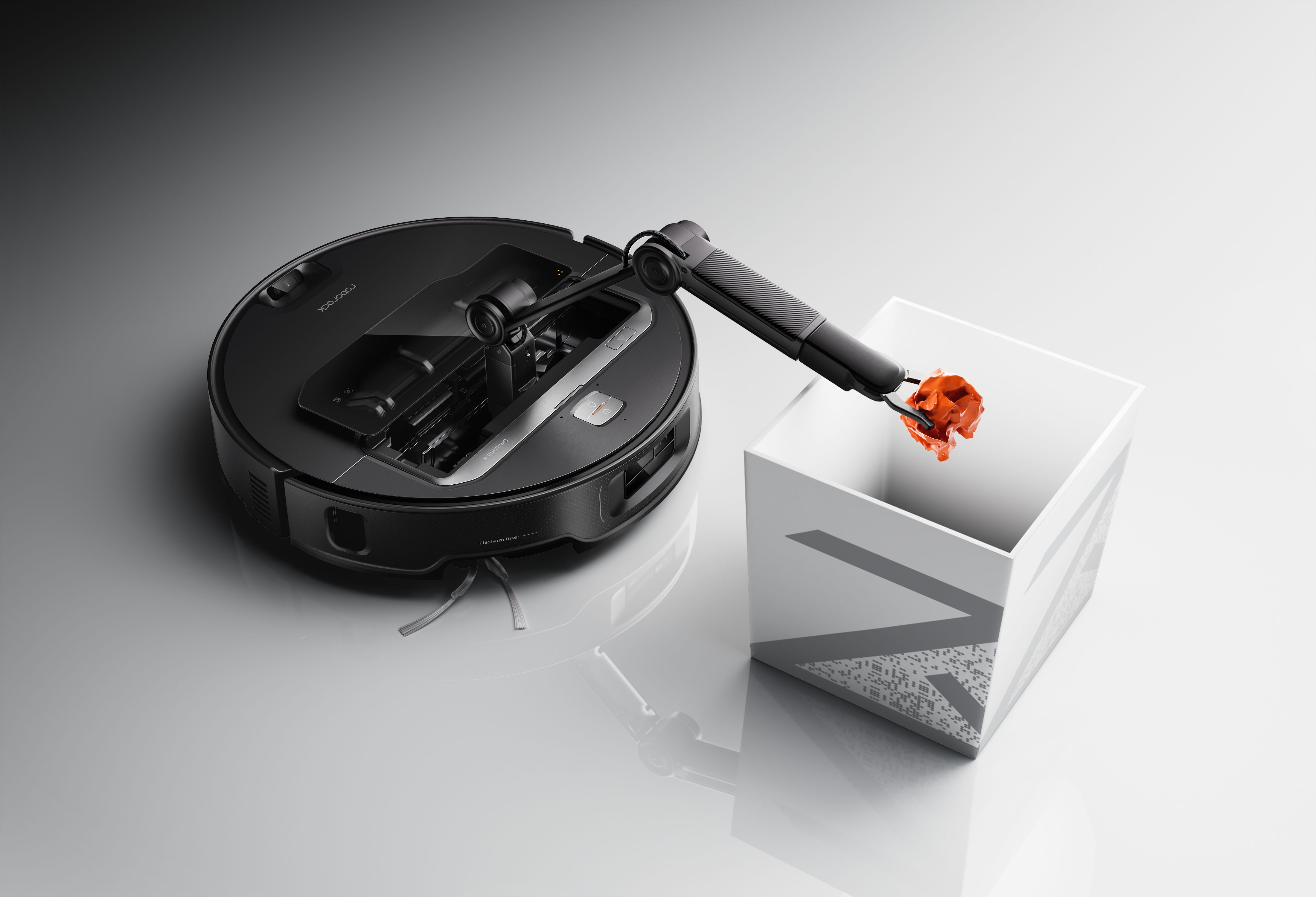
    Roborock has established itself as a leader in the realm of innovative and practical robotic vacuums, offering models like the Qrevo Curv and the Roborock S8 MaxV Ultra. At CES 2025, the company unveiled new additions to its impressive collection: the Roborock Saros Z70, Saros 10, and Saros 10R. Notably, these robots come equipped with an extendable arm designed to pick up various objects, including trash, socks, and lightweight shoes.


    Digital Trends received compensation for considering coverage of these products. The brand had no input on the editorial content and did not influence the coverage.

    The OmniGrip system transforms the basic function of a robot vacuum into a versatile in-home assistant, capable of tackling obstacles that would typically hinder a thorough cleaning. Traditionally, users would have to clear the area of any items that might obstruct the vacuum, as even a small item like a sock could stop the brush from spinning or interfere with its cleaning path. With OmniGrip, the vacuum can lift and relocate objects weighing up to 300 grams, though it initially recognizes only a limited range of items, including small towels, socks, tissues, and sandals.

    The Roborock Z70 lifting an object and depositing it.
    Roborock

    Meanwhile, the Roborock Saros 10 is equipped with the RetractSense Navigation System, allowing the arm to retract and navigate under low furniture, such as couches. With a height of just 7.98 centimeters (approximately 3.15 inches), this model features an upgraded mopping system that ensures a more effective clean.

    The Saros 10R takes a step away from the conventional Laser Distance Sensor (LDS) navigation, opting instead for a sophisticated AI-enabled camera system that creates detailed 3D environmental maps for improved obstacle detection. It shares the same slim profile as the Saros 10.

    The Roborock Saros 10 navigating under a tight, low-clearance piece of furniture.
    Roborock Image used with permission by copyright holder

    In addition to its new line of robotic vacuums, Roborock has debuted a handheld wet-dry vacuum. The F25 Series can lay nearly flat to access tight spaces beneath furniture, and its tangle-free roller design minimizes the hassle of removing entangled debris.

    Overall, these new robotic vacuums enhance the cleaning experience with superior navigation and functionality. The Roborock Saros 10 is set for release in January 2025, although its pricing remains unconfirmed. The release timelines for the Saros 10R, Saros Z70, and the Roborock F25 Series are less certain, pending further announcements for 2025.


  • Max-Planck Institute Unveils Innovative Modular Hexagon Design

    Max-Planck Institute Unveils Innovative Modular Hexagon Design

    Researchers at the Max-Planck-Institute for Intelligent Systems (MPI-IS) have made a groundbreaking advancement in robotic technology with the introduction of hexagon-shaped modular components, known as HEXEL modules. This innovative design allows for the rapid assembly and reconfiguration of high-speed robots, akin to the versatility of LEGO bricks. The findings, led by Christoph Keplinger and his team from the Robotic Materials Department, are set to be published in the prestigious journal Science Robotics on September 18, 2024.

    Each HEXEL module features a lightweight exoskeleton constructed from six rigid glass fiber plates, providing the necessary structure and durability. At the core of these modules are advanced artificial muscles known as hydraulically amplified self-healing electrostatic (HASEL) actuators. By applying high voltage, these artificial muscles activate and enable the hexagonal joints to transform from elongated shapes to broader, flatter forms.

    The unique combination of soft and rigid elements within the modules facilitates impressive movements and speeds. “By linking multiple modules together, we can generate new robot forms that can adapt to diverse operational requirements,” explains Ellen Rumley, a visiting researcher from the University of Colorado Boulder and co-first author of the upcoming publication.

    Demonstrations by the research team showcase the diverse capabilities of the HEXEL modules. In one instance, a collection of these modules maneuvers through a narrow passage, while a single unit performs rapid jumps into the air. Additionally, when configured into larger assemblies, the modules can achieve distinct motion patterns based on their arrangement—one such example being a robot capable of rolling at high speeds.

    Zachary Yoder, also a co-first author and Ph.D. student at MPI-IS, emphasizes the practicality of this modular approach. “Developing robots with adaptable designs is not only innovative but also sustainable. Instead of investing in multiple specialized robots for various tasks, users can construct a multitude of configurations using a common set of components. This flexibility can be especially advantageous in environments where resources are scarce,” he notes.

    The emergence of HEXEL modules represents a significant leap forward in robotics, promising enhanced functionality and efficiency while paving the way for future developments in modular design. As the research team continues to explore the potential of these innovative components, the horizons of robotics are broadening, ushering in a new era of adaptability and sophistication.

  • South Korean Robot Commits Suicide Due To Work Pressure

    South Korean Robot Commits Suicide Due To Work Pressure

    In a first-of-its-kind incident in South Korea, authorities have reported that a robot working as a government employee in Gumi City Council committed suicide.

    The robot, employed since October 2023, threw itself from the top of a 2-meter staircase in an unusual act of self-destruction.

    Details of the Incident

    South Korea has been utilizing robots in various fields for many years. The incident has shocked South Koreans, who witnessed the robot spinning in one place before hurling itself down the stairs, resulting in its complete destruction.

    The robot had several responsibilities at Gumi City Council, including transferring documents, providing information to residents, and promoting South Korean tourism.

    Possible Cause of the Suicide

    The robot was known for its tireless work from 9 a.m. to 6 p.m., managing multiple tasks without breaks. Speculation suggests that work pressure might have led to the robot’s suicidal act, though the exact cause remains unknown and is under investigation.

    The robot was manufactured by Bear Robotics, a California-based startup.

  • 5 Office Technology Trends to Watch in [year]

    What’s the first thing you do when you get to the office? Chances are, it involves office technology.

    (more…)