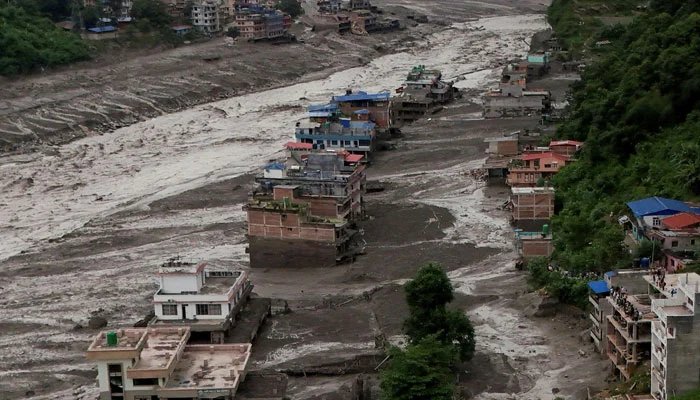
A wide view of muddy properties after a sudden flash flood at Trishuli in Nuwakot district, Nepal, August 26, 2026. — Reuters
– Prime Minister Shah announces that rescue teams and military units have been deployed.
– The government urges residents near rivers to stay vigilant and exercise caution.
– Nepali officials are concerned about the potential for significant casualties and property damage.
KATHMANDU: The death toll from the flash flood that affected Nepal’s Himalayan border region with Tibet has risen to 95, police reports state.
A powerful flash flood in Nepal’s Himalayan region has swept away villages and construction sites in areas bordering Tibet, prompting authorities to warn of possible heavy casualties. They are advising residents living along riverbanks to move to higher ground immediately.
The Tourism Ministry reports that 341 foreign nationals are currently missing following the devastating floods in the area.
The districts of Syapru Besi and Timure, located in the mountainous Rasuwa region, suffered severe damage, officials said, emphasizing the need for heightened vigilance among people living near the Bhote Koshi River.
Narendra Pariyar, the district administrator, told Reuters, “We have reports of villages and infrastructure projects being washed away,” but added that detailed estimates of casualties and damages are not yet available.
He cautioned, “There might be significant casualties or property losses, but it’s too early to confirm.”
Prime Minister Balendra Shah has confirmed that rescue and relief operations are underway, with police and military personnel dispatched to assist.
“We have instructed authorities to relocate residents from lower areas to safer locations,” Shah said.
“The government advises everyone along the river to stay alert and take extra precautions,” the official statement added.
The Bhote Koshi River begins in Tibet and flows into Nepal’s Trishuli River, which eventually joins India’s Gandak River.
Officials explained that the recent flooding was caused by the draining of a supraglacial lake on the Tibetan plateau, a phenomenon linked to regional climate changes.