الوسم: river

  • Nepal-Tibet Border Flood: Hundreds Missing, 95 Dead Amid Disaster

    Nepal-Tibet Border Flood: Hundreds Missing, 95 Dead Amid Disaster

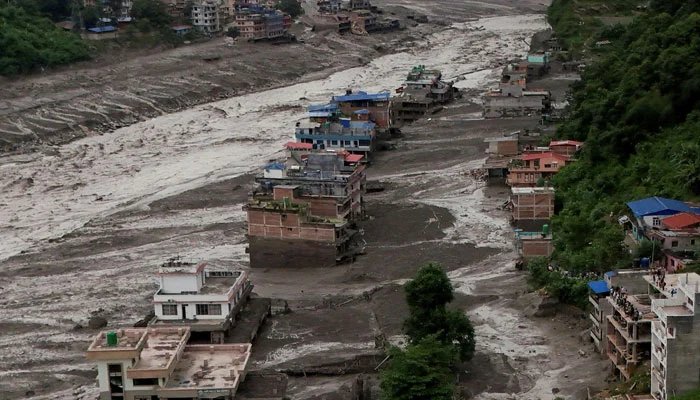
    A wide view of muddy properties after a sudden flash flood at Trishuli in Nuwakot district, Nepal, August 26, 2026. — Reuters

    – Prime Minister Shah announces that rescue teams and military units have been deployed.
    – The government urges residents near rivers to stay vigilant and exercise caution.
    – Nepali officials are concerned about the potential for significant casualties and property damage.

    KATHMANDU: The death toll from the flash flood that affected Nepal’s Himalayan border region with Tibet has risen to 95, police reports state.

    A powerful flash flood in Nepal’s Himalayan region has swept away villages and construction sites in areas bordering Tibet, prompting authorities to warn of possible heavy casualties. They are advising residents living along riverbanks to move to higher ground immediately.

    The Tourism Ministry reports that 341 foreign nationals are currently missing following the devastating floods in the area.

    The districts of Syapru Besi and Timure, located in the mountainous Rasuwa region, suffered severe damage, officials said, emphasizing the need for heightened vigilance among people living near the Bhote Koshi River.

    Narendra Pariyar, the district administrator, told Reuters, “We have reports of villages and infrastructure projects being washed away,” but added that detailed estimates of casualties and damages are not yet available.

    He cautioned, “There might be significant casualties or property losses, but it’s too early to confirm.”

    Prime Minister Balendra Shah has confirmed that rescue and relief operations are underway, with police and military personnel dispatched to assist.

    “We have instructed authorities to relocate residents from lower areas to safer locations,” Shah said.

    “The government advises everyone along the river to stay alert and take extra precautions,” the official statement added.

    The Bhote Koshi River begins in Tibet and flows into Nepal’s Trishuli River, which eventually joins India’s Gandak River.

    Officials explained that the recent flooding was caused by the draining of a supraglacial lake on the Tibetan plateau, a phenomenon linked to regional climate changes.

  • Bus plunges into river in Bangladesh during ferry boarding, 24 lives lost

    Bus plunges into river in Bangladesh during ferry boarding, 24 lives lost

    A passenger bus carrying approximately 40 passengers tumbled into the Padma River while attempting to board a ferry in Bangladesh, resulting in at least 24 fatalities, according to officials on Thursday. The incident took place on Wednesday near Daulatdia in Rajbari district, roughly 62 miles from Dhaka, when the bus lost control approaching a ferry dock. The vehicle flipped and sank nearly 30 feet below the water’s surface, with rescuers retrieving 22 bodies, including six men, 11 women, and five children. Confirmed dead numbers now stand at 24, which includes two women who died after being rescued.

    Search and rescue operations involve four fire department units, 10 divers, and support from the army, police, coast guard, and local authorities. Authorities are concerned that more passengers may still be unaccounted for. Bangladesh experiences hundreds of fatalities each year due to road and waterway accidents.

  • Heavy Rain Floods Northern India, Yamuna Surges Past Critical Mark

    Heavy Rain Floods Northern India, Yamuna Surges Past Critical Mark

    Floodwaters swept through northern India on Wednesday, resulting in the loss of at least five lives, according to officials. Authorities warn that more thunderstorms are on the horizon, and media reports indicate that around 10,000 residents have been evacuated from riverbank areas in Delhi, the capital city.

    This year’s monsoon season has been especially severe across India, claiming the lives of at least 130 people in August alone in the northern regions. Entire villages have been submerged, infrastructure has been ravaged, and widespread destruction has ensued.

    Recent floods have impacted Jammu and Kashmir, Himachal Pradesh, Uttarakhand, and Punjab, where the Chenab and Tawi rivers have surpassed dangerous levels in multiple locations. The rising waters have triggered landslides, damaged roads, and effectively cut off parts of the mountainous areas in Indian-controlled Jammu and Kashmir and Himachal Pradesh from the rest of the country.

    On Wednesday, landslides in Rajouri in Jammu and Mandi in Himachal Pradesh claimed five lives, authorities reported. The India Meteorological Department issued warnings for heavy to very heavy rain across the region, with Uttarakhand and Uttar Pradesh expected to see more downpours.

    The Central Water Commission announced that the Yamuna River in Delhi had breached its danger level earlier in the week. In response, nearly 10,000 people have been evacuated to relief camps along major highways, a precautionary move for those living in vulnerable, low-lying areas. Similar floods were seen in Delhi in 2023, when floodwaters entered homes and the river reached its highest point in 45 years.

    In Himachal Pradesh, many tourist destinations have suffered damage from landslides caused by the surging rivers, further disrupting local infrastructure. Schools and other educational institutions have been ordered shut, and residents are advised to stay indoors due to ongoing flood warnings.

    In neighboring Punjab, authorities report 30 fatalities and nearly 20,000 evacuations since August 1. The floods have devastated agriculture across 150,000 hectares of crops, with waters rushing through the plains of India’s breadbasket.

    The continuous heavy rain has led dams to release water, causing flooding in the plains of India and Pakistan. Pakistan has issued alerts for additional flooding in eastern Punjab after India announced plans to release water downstream from its dams. Delhi had previously issued four such warnings to Islamabad.

    Since the monsoon started in late June, at least 881 people have died nationwide, with the worst flooding in four decades affecting more than 3.3 million residents of Punjab since August 26, according to local disaster management authorities.