
Select Language:
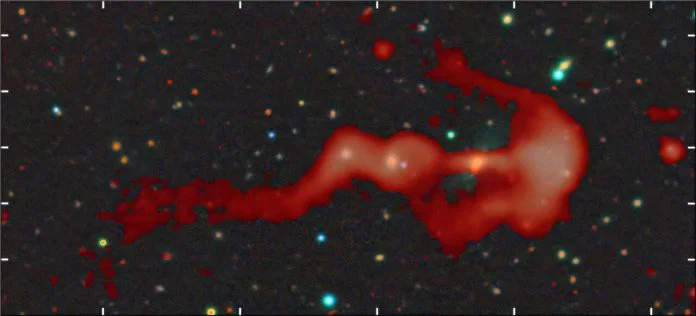
A remarkable and bizarre galaxy has been uncovered by astronomers, resembling a massive bow and arrow stretching across the cosmos. Named RAD-BAARG (Bow-And-Arrow Radio Galaxy), this extraordinary object features a massive arc-like formation that extends nearly 1.8 million light-years—about 18 times the width of our Milky Way galaxy.
What makes this find particularly exciting is that it was originally spotted by a citizen scientist in India while analyzing images from a large sky survey. The discovery was made by an international team collaborating with the RAD@home Astronomy Collaboratory, a citizen science initiative that trains volunteers to analyze data from powerful telescopes. The images were captured by LOFAR, one of the world’s most sensitive radio telescope arrays.
Radio galaxies are typically powered by supermassive black holes at their centers, which eject enormous jets of high-energy particles into space. These jets often produce recognizable structures that astronomers have studied extensively. However, RAD-BAARG looks very different from typical examples.
Dr. Ananda Hota, the lead researcher, stated that in 25 years of studying radio galaxies, he had never seen anything like this. The galaxy’s shape suggests a dramatic interaction with its environment. The team theorizes that the galaxy is moving rapidly through hot gas towards a nearby galaxy cluster at supersonic speeds. Just like a jet breaking the sound barrier creates a shock wave, RAD-BAARG appears to generate a “bow shock” as it speeds through space.
These shock waves are usually very faint and difficult to detect because the surrounding gas is extremely thin. In this case, however, the black hole’s radio jets seem to illuminate the shock front, making it visible in radio wavelengths. One side of the galaxy features a narrow jet that feeds into a vast arc-shaped structure about 560 kiloparsecs, or roughly 1.8 million light-years long. On the opposite side, another jet twists into an S-shaped pattern before fading into a long, faint tail. These features together resemble a cosmic bow and arrow.
RAD-BAARG is located in a crowded and dynamic environment, where neighboring galaxy clusters and moving gas might be distorting and shaping its radio-emitting material. The researchers believe these environmental forces are mainly responsible for the galaxy’s unique appearance.
This discovery may represent one of the clearest examples to date of a giant bow shock surrounding an infalling galaxy, something that has long been predicted by theories and computer simulations but rarely observed directly. Interestingly, the galaxy was first identified by Pranim Limbo, a citizen scientist from a remote Himalayan region who is not affiliated with major research institutions. His contribution highlights how enthusiasts worldwide can participate in cutting-edge scientific discoveries.
Looking ahead, scientists anticipate that future observatories, including the upcoming Square Kilometre Array, will uncover many more galaxies like RAD-BAARG. They also hope that artificial intelligence will play a vital role in processing the vast volumes of data, helping scientists uncover hidden structures and better understand galaxy evolution in the universe’s vast environment.
Source: Royal Astronomical Society.
 ChatGPT
 Perplexity
 Gemini AI
 Grok AI