

Select Language:
A groundbreaking discovery has revealed the earliest flickering quasar, a luminous object powered by a supermassive black hole. This finding is shedding light on how massive black holes formed so rapidly in the universe’s infancy.
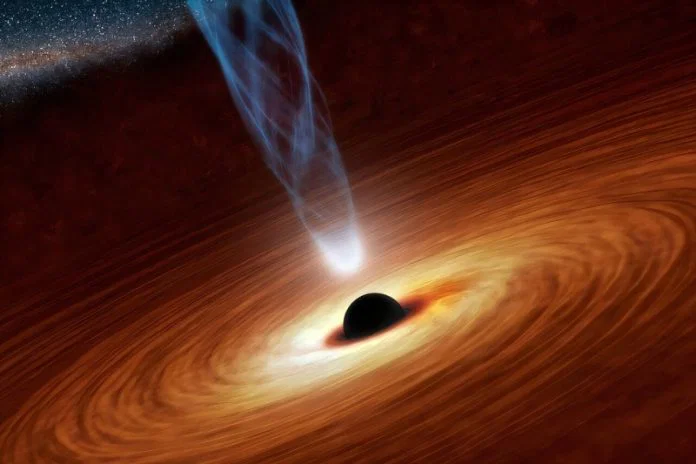
Nearly every galaxy, including the Milky Way, hosts a supermassive black hole at its core. When these black holes actively draw in gas and dust, the material spirals inward, forming a rotating accretion disk. As the gas heats up, it releases enormous energy, producing some of the universe’s brightest entities known as quasars.
Researchers from MIT and other institutions identified a quasar that existed just 850 million years after the Big Bang, making it the earliest flickering quasar ever observed. While many quasars from the early universe have been detected before, this is the first showing brightness variations or “flickering” over time.
This flickering offers valuable insights into the activities near the black hole. Similar to how a candle flame flickers due to air currents, a quasar’s brightness fluctuates when the inflow of gas into the black hole varies. Analyzing these changes allowed scientists to infer the shape of the quasar’s accretion disk — a swirling ring of gas and dust fueling the black hole.
Surprisingly, the researchers found that this ancient accretion disk was very thin and flat, resembling those around mature black holes observed today. This challenges existing ideas that early black holes should have had thick, unstable, and chaotic disks due to rapid growth.
This discovery raises intriguing questions about black hole development. Traditionally, it was thought that young black holes in the early universe would have messy, turbulent surroundings. Yet, this early black hole appears to have already settled into a stable structure despite the universe still being very young.
The findings contribute to the ongoing mystery of how supermassive black holes grew so colossal so quickly after the Big Bang. Some of these black holes were already billions of times the Sun’s mass when the universe was less than a billion years old.
The team analyzed 14 years of infrared observations from NASA’s NEOWISE mission. Because the quasar’s light has been stretched into infrared wavelengths over cosmic distances, this data allowed scientists to monitor its brightness variations over time. They determined the quasar shines with energy equivalent to about 12 trillion suns and exhibits brightness fluctuations of approximately 20%, equal to about 2 trillion suns.
By examining the flickering at different wavelengths, scientists mapped the temperature of the material surrounding the black hole, revealing the structure of the accretion disk. Their results indicate that the same feeding mechanisms seen around black holes today were already in place in the universe’s earliest quasars.
Looking ahead, researchers hope to identify even younger quasars to understand what occurred before these black holes reached such advanced stages. Future discoveries might finally unravel how the first supermassive black holes formed and expanded so swiftly in the universe’s early days.
 ChatGPT
 Perplexity
 Gemini AI
 Grok AI


