الوسم: Galaxy

  • Astronomers Observe Dying Star Releasing Material into Space

    Astronomers Observe Dying Star Releasing Material into Space

    Astronomers have captured a stunning image of a dying star’s remnants being torn apart and redistributed into the space between stars. This observation provides a rare glimpse into a key cosmic recycling process: the return of material from ancient stars, which can eventually contribute to the formation of new stars, planets, and other celestial objects.

    The finding was made during observations of the Helix Nebula, a well-known planetary nebula approximately 650 light-years from Earth. The study, led by Yale University astronomer Pieter van Dokkum, was published in Nature.

    The Helix Nebula originated when a star similar in size to the Sun reached the final stages of its life cycle. It expelled much of its outer layers into space, leaving behind a dense stellar core known as a white dwarf. This expelled gas created the nebula’s characteristic bright ring.

    However, the new observations uncovered structures far from the nebula’s core, especially on its eastern side. The team was actually calibrating a new telescope called MOTHRA, short for the Modular Optical Telephoto Hyperspectral Robotic Array, located at the El Sauce Observatory in Chile. Designed to detect extremely faint gases in space, MOTHRA unexpectedly revealed a network of previously unnoticed structures in the nebula’s outer regions.

    They identified 22 complete or partial “bow shocks” — curved formations resembling waves in front of a boat. These appear where clumps of material, expelled from the dying star, move swiftly through the sparse gas between stars. As these fragments collide with surrounding material, they produce glowing, curved features visible to astronomers.

    The shape and size of these bow shocks offer vital clues about what happens to stellar debris after its release. Closer to the star, the structures are larger, sharply defined, and thin. At greater distances, they become smaller, more diffuse, and increasingly fragmented. This pattern suggests that the fragments gradually break apart as they traverse space.

    Researchers estimate that individual clumps can survive for roughly 10,000 years after exposure to surrounding gas before being shredded and their material blending into the interstellar medium. This process plays a crucial role in the universe’s matter cycle, with materials from dying stars eventually becoming part of new stellar and planetary systems. In billions of years, our Sun will undergo a similar cycle, returning much of its material to the galaxy.

    The discovery also highlights MOTHRA’s potential. Once fully operational, the telescope will employ 1,140 telephoto lenses, advanced filters, and powerful computing to hunt for some of the faintest structures in the universe. For astronomers, the Helix Nebula has become more than just a beautiful image — it’s a glimpse into the dynamic, ongoing process of cosmic recycling.

    Source: Yale.
  • Ancient 12.5-Billion-Year Galaxy Near Andromeda Discovered as Cosmic Fossil

    Ancient 12.5-Billion-Year Galaxy Near Andromeda Discovered as Cosmic Fossil

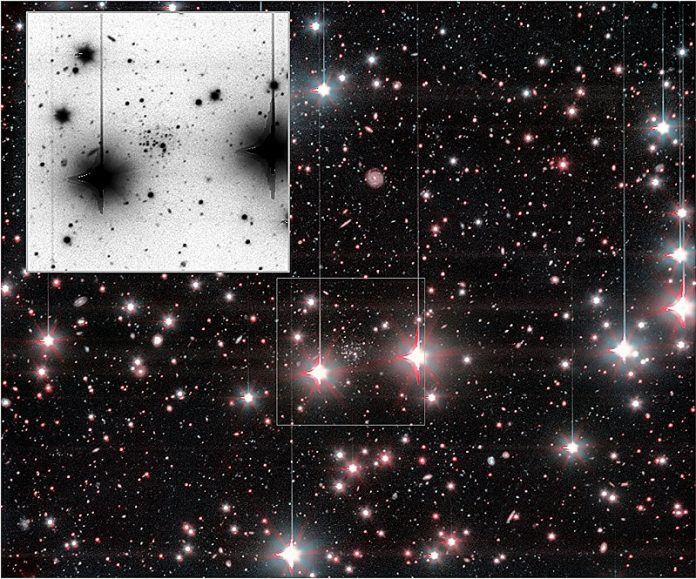
    Astronomers have identified one of the faintest galaxies ever observed near the Andromeda Galaxy. Known as Andromeda XXXVI (And XXXVI), this small galaxy is estimated to be around 12.5 billion years old, positioning it among the oldest galaxies in our local universe. This discovery presents a rare opportunity for scientists to study the conditions of the universe shortly after the Big Bang.

    The research was featured in the journal Astronomy & Astrophysics. The Andromeda Galaxy is approximately 2.5 million light-years from Earth and is the closest large spiral galaxy to our own Milky Way. Like the Milky Way, Andromeda hosts numerous smaller satellite galaxies bound by its gravitational pull. And XXXVI falls into the category of ultra-faint dwarf galaxies—these are the tiniest and dimmest galaxies known, containing very few stars and emitting minimal light, which makes detection exceptionally challenging.

    It is widely believed that these ultra-faint dwarf galaxies formed in the universe’s earliest days. Since they have changed little over billions of years, they are often considered cosmic fossils, offering insights into the formation of the first galaxies. Joanna Sakowska, the study’s lead researcher from Spain’s Instituto de Astrofísica de Andalucía, stated that the galaxy is extremely ancient with a scarcity of heavy elements like iron and oxygen. Such elements are produced inside stars over time, so their absence suggests that And XXXVI formed before many stellar generations had enriched the universe.

    Further observations are needed to pin down its exact age, distance, and chemical composition. Advanced space telescopes, such as the Hubble Space Telescope, could provide more detailed data.

    This discovery also addresses a longstanding question in astronomy. The widely accepted Lambda Cold Dark Matter (ΛCDM) model predicts that large galaxies like Andromeda should be surrounded by hundreds of tiny satellite galaxies. Currently, only around 40 satellites have been identified around Andromeda, and merely 15 are ultra-faint dwarf galaxies. Scientists suspect many more remain hidden because they are too faint for current detection methods.

    Isabel Santos-Santos from the Leibniz Institute for Astrophysics in Potsdam emphasized that each new ultra-faint galaxy found helps test theories of galaxy formation and enhances our understanding of dark matter—the elusive substance that constitutes most of the universe’s matter but cannot be directly observed.

    Interestingly, And XXXVI was initially spotted by amateur astronomer Giuseppe Donatiello while examining images from the Pan-Andromeda Archaeological Survey. Once identified as a potential galaxy, professional astronomers utilized the Gran Telescopio Canarias, one of the world’s largest optical telescopes, to capture deeper images. Despite the telescope’s capabilities, studying And XXXVI remained difficult; only around 46 stars belonging to the galaxy could be identified.

    Although this galaxy is tiny and nearly invisible, it could offer critical clues about the origins of early galaxies and the dark matter that influenced the universe’s evolution. Each new discovery like And XXXVI contributes to a clearer understanding of the universe’s birth over 13 billion years ago.

  • Webb Telescope Spots Giant Galaxy Formation Near Black Hole

    Webb Telescope Spots Giant Galaxy Formation Near Black Hole

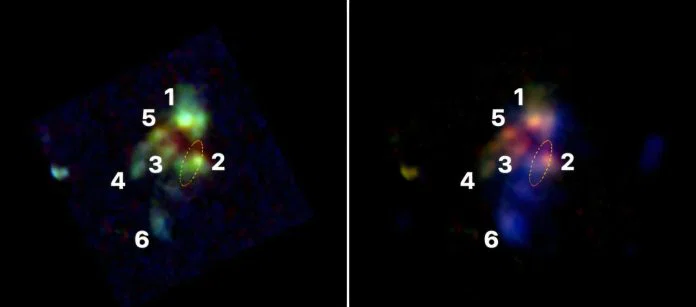
    Images from the James Webb Space Telescope show the distant galaxy complex TGSSJ1530+1049. The left image depicts at least six galaxies tightly packed in the early universe. The right image highlights fast-moving gas, shown in blue. Scientists believe these galaxies will eventually merge into a single, massive galaxy. The area inside the ellipse marks the source of intense radio emissions that prompted this study; it likely contains a growing supermassive black hole. Credit: NASA/ESA/CSA.

    Astronomers have used the Webb to observe one of the most extraordinary events ever seen from the early universe—a massive galaxy in the process of formation. Instead of a single new galaxy, researchers found a dense cluster of at least six galaxies apparently merging into one large galaxy. At the core of this cluster is a rapidly growing supermassive black hole.

    This discovery was made by an international team led by scientists from Leiden University in the Netherlands and the University of Oxford in the UK. Their research offers a rare glimpse into how some of today’s biggest galaxies might have formed billions of years ago.

    Located more than 12 billion light-years away, the system, called TGSSJ1530+1049, shows us the universe as it appeared around 1.5 billion years after the Big Bang. Since light takes time to travel, astronomers are viewing this region as it was billions of years ago. Essentially, the Webb acts like a time machine, allowing scientists to peer into the distant past.

    The team initially aimed the telescope here because earlier radio observations indicated an active supermassive black hole was feeding in the area. But the new images revealed a more dynamic scene—rather than a single galaxy, there’s a close-knit neighborhood of at least six galaxies.

    Four of these galaxies are already extremely massive, collectively containing hundreds of billions of stars. Even more remarkable, all of them are packed into a relatively small space, making this one of the densest early collections of large galaxies ever observed.

    Scientists believe these galaxies are still in the early stages of merging. Over the next few million years, they’re expected to combine into a single giant galaxy. Such systems are called protoclusters, representing the early building blocks of the massive galaxy clusters found throughout the universe today.

    At the heart of this developing system lies a young supermassive black hole—one with millions or even billions of times the Sun’s mass. As gas and dust spiral into the black hole, they heat up and release powerful energy, including radio waves.

    Using a network of radio telescopes, researchers have created a detailed image of the black hole’s activity. Observations show material falling into the black hole while some of it is ejected at extremely high speeds, indicating the black hole is still actively growing.

    What makes this discovery especially significant is that astronomers are witnessing two major cosmic events simultaneously: the formation of a giant galaxy through the merging of smaller ones, and the rapid growth of its central supermassive black hole.

    The Webb continues to uncover parts of the universe that were previously hidden, providing some of the clearest images yet of how the largest galaxies and their black holes formed over 12 billion years ago.

  • Astronomers Find 1.8M-Light-Year “Bow and Arrow” Galaxy

    Astronomers Find 1.8M-Light-Year “Bow and Arrow” Galaxy

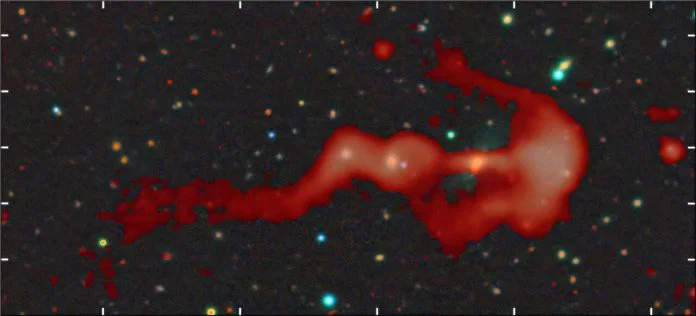
    A remarkable and bizarre galaxy has been uncovered by astronomers, resembling a massive bow and arrow stretching across the cosmos. Named RAD-BAARG (Bow-And-Arrow Radio Galaxy), this extraordinary object features a massive arc-like formation that extends nearly 1.8 million light-years—about 18 times the width of our Milky Way galaxy.

    What makes this find particularly exciting is that it was originally spotted by a citizen scientist in India while analyzing images from a large sky survey. The discovery was made by an international team collaborating with the RAD@home Astronomy Collaboratory, a citizen science initiative that trains volunteers to analyze data from powerful telescopes. The images were captured by LOFAR, one of the world’s most sensitive radio telescope arrays.

    Radio galaxies are typically powered by supermassive black holes at their centers, which eject enormous jets of high-energy particles into space. These jets often produce recognizable structures that astronomers have studied extensively. However, RAD-BAARG looks very different from typical examples.

    Dr. Ananda Hota, the lead researcher, stated that in 25 years of studying radio galaxies, he had never seen anything like this. The galaxy’s shape suggests a dramatic interaction with its environment. The team theorizes that the galaxy is moving rapidly through hot gas towards a nearby galaxy cluster at supersonic speeds. Just like a jet breaking the sound barrier creates a shock wave, RAD-BAARG appears to generate a “bow shock” as it speeds through space.

    These shock waves are usually very faint and difficult to detect because the surrounding gas is extremely thin. In this case, however, the black hole’s radio jets seem to illuminate the shock front, making it visible in radio wavelengths. One side of the galaxy features a narrow jet that feeds into a vast arc-shaped structure about 560 kiloparsecs, or roughly 1.8 million light-years long. On the opposite side, another jet twists into an S-shaped pattern before fading into a long, faint tail. These features together resemble a cosmic bow and arrow.

    RAD-BAARG is located in a crowded and dynamic environment, where neighboring galaxy clusters and moving gas might be distorting and shaping its radio-emitting material. The researchers believe these environmental forces are mainly responsible for the galaxy’s unique appearance.

    This discovery may represent one of the clearest examples to date of a giant bow shock surrounding an infalling galaxy, something that has long been predicted by theories and computer simulations but rarely observed directly. Interestingly, the galaxy was first identified by Pranim Limbo, a citizen scientist from a remote Himalayan region who is not affiliated with major research institutions. His contribution highlights how enthusiasts worldwide can participate in cutting-edge scientific discoveries.

    Looking ahead, scientists anticipate that future observatories, including the upcoming Square Kilometre Array, will uncover many more galaxies like RAD-BAARG. They also hope that artificial intelligence will play a vital role in processing the vast volumes of data, helping scientists uncover hidden structures and better understand galaxy evolution in the universe’s vast environment.

    Source: Royal Astronomical Society.

  • Samsung Galaxy S26 Ultra Might Have A Magic Private Screen

    Samsung Galaxy S26 Ultra Might Have A Magic Private Screen

    Over the last few years, every time I visit my local electronics store, the friendly salespeople always recommend a privacy screen protector for my device. Unlike standard transparent screen guards, these privacy shields make your screen appear dark when viewed from an angle, effectively blocking the view from anyone trying to look from the side. It’s likely that Samsung will include this feature as a standard option on their upcoming Galaxy S26 Ultra, eliminating the need for users to buy a separate screen protector.

    ### The Bigger Picture

    Recently, Android Authority uncovered references to a feature called Private Display (or Privacy Display) within the code of Samsung’s One UI software. Descriptions in the code suggest that this feature automatically adjusts the display’s visibility depending on the context, providing an extra layer of privacy.

    According to reports, Samsung has trademarked the technology under the name “Flex Magic Pixel.” An outlet in Korea indicated that this capability would debut first with Samsung’s next flagship device, expected early next year.

    Samsung first revealed details about this technology back in 2024. The company explained it as “a technology that adjusts the viewing angle of the screen so it is not visible to the person next to you and, when combined with advanced AI, can enhance the security of smart devices.”

    ### The Role of AI

    The privacy feature will utilize AI to detect when users are engaged in sensitive activities within an app. Based on this detection, the system will automatically modify the brightness output of the OLED pixels, making it difficult for someone viewing the screen from an angle to see what’s displayed on the device.

    The main advantage of the Flex Magic Pixel technology is that users won’t need to spend extra money on a privacy screen protector. Traditional protectors can limit screen brightness and dull the display’s appearance, detracting from viewing quality.

    Thanks to this new display technology, users won’t have to compromise on screen quality to maintain privacy. Since such a system hasn’t yet appeared on mainstream smartphones, it will be interesting to see how well it performs in real-world use.

  • Samsung Galaxy S26 Could Get iPhone-Inspired Name

    Samsung Galaxy S26 Could Get iPhone-Inspired Name

    Samsung is actively preparing for the launch of its upcoming flagship smartphones set to debut early next year, including an innovative large foldable device. As anticipation builds, leaks are surfacing rapidly. The most recent leak hints at the Galaxy S26 Pro, a device expected to rival the iPhone 17.

    ### What is the “Pro” model from Samsung?

    The “Pro” label seems to be more of a marketing move aimed at distinguishing it from a standard version, possibly to give it a competitive edge over Apple’s non-Pro models. Without focusing too much on naming, sources from AndroidHeadlines have shared what are believed to be CAD-based renderings of the Galaxy S26 Pro, which are expected to be revealed at Samsung’s Unpacked event next year.

    The most noticeable exterior change is in the rear camera design. While the number of lenses stays the same, Samsung appears to be adopting a new pill-shaped camera bump, moving away from the floating lens design seen since the Galaxy S23.

    This revamped design of the Galaxy S26 Pro has previously appeared on the Galaxy S25 Edge, and it’s encouraging to see Samsung making some fresh stylistic moves after a period of less adventurous aesthetic choices. Aside from this, other visual elements remain largely consistent with its past models.

    ### What else can we expect from the Galaxy S26 Pro?

    The next Galaxy flagship is rumored to be powered by Qualcomm’s upcoming Snapdragon 8 Elite Gen 2 chip. Interestingly, there are also rumors suggesting Samsung might bring back the Exynos chip for certain markets, similar to its approach with the Galaxy Z Flip 7 and the Exynos 2500 processor.

    Leakster Roland Quandt recently shared on Bluesky that the Galaxy S26 Pro will feature a significant upgrade in camera technology, including a 50-megapixel ultrawide sensor— a substantial leap from the 12-megapixel sensor on the Galaxy S25. Additionally, there are rumors of an improved main camera sensor that promises better light sensitivity, although the resolution will stay the same.

    According to sources at SmartPrix, the Galaxy S26 Pro is expected to sport a 6.27-inch OLED display with a 120Hz refresh rate, complemented by slimmer bezels for a modern look. The device is also anticipated to support faster wired charging at 45W and feature native Qi2 wireless charging thanks to integrated magnets beneath the rear glass, enabling seamless magnetic attachment for charging accessories.

    As we await official details, these leaks offer a promising glimpse into Samsung’s next-generation flagship, blending refreshed design elements with upgraded camera and display features.

  • Completing the Quest: Solving All Iron Galaxy Logos in THPS 3+4

    Completing the Quest: Solving All Iron Galaxy Logos in THPS 3+4

    Initially, you were on the hunt for Activision logos, then Vicarious Visions logos, and now, in Tony Hawk’s Pro Skater 3+4, you’re after Iron Galaxy logos. Along with the Secret Tapes, these logos are among the toughest collectibles in the game.

    We’ll guide you through each stage, showing you where to find these logos and how to reach them. With our tips, you’ll have all the logos collected in no time, allowing you to get back to enjoying the skating action.

    Finding Every Iron Galaxy Logo in Tony Hawk’s Pro Skater 3

    As mentioned, finding Iron Galaxy logos can be quite tricky. Some require you to unlock secret areas, while others need you to gain some serious hangtime. It’s a good idea to complete the stages first and collect stat points before going back to hunt for these logos.

    Stage

    Logo Location

    Foundry

    To collect the Iron Galaxy Logo, unlock the hidden room at the back by un-jamming five valves located around the perimeter. After that, head back to the start and skate into the reactor room. Ride up the winding ramp inside until you find the logo at the top.

    Canada

    This logo is easy to snag if you can grind the railroad tracks. At the dock, grind past the machine that raises the halfpipe, then use the elevated halfpipe to reach the bridge. From here, grind the left rail for the Iron Galaxy Logo.

    Rio

    Locate the light post northeast of your start point; the logo is floating above it. Fill your special meter, align with the post, and ride up the ramp below it to grab the logo.

    Suburbia

    Break into the backyard of the haunted house. Once inside, ride up the ramp next to your entry point to reach a halfpipe above. Transfer onto the roof—look for the Iron Galaxy Logo above the ramp and skate up to collect it.

    Airport

    The Airport’s Iron Galaxy Logo is one of the easier catches. Go to the hidden helicopter platform by hopping onto the baggage conveyor on your right. Grind through the tunnel and you’ll find a helicopter; the logo is above the blades. Just jump and grind onto the blades to grab it.

    Skater Island

    From the starting point, take your first left to exit the skate park and grind the pirate ship’s nose before falling into the water. Don’t jump off the grind or you’ll land at Bikini Bottom. If done correctly, you’ll be standing on the crow’s nest; grind the left rope to reach the logo.

    Los Angeles

    At the start of the stage, go right. Smash through the windows and jump over the ramp to access the area with grates above. Grind the rails to open the grates, which also unlocks another set on the library roof. Go back and grind the cable leading to the library roof; the logo is in plain sight, but be quick before you fall into the hole in the halfpipe.

    Tokyo

    Go to the opposite side of the stage. When you reach the ramps, build your special meter. Now launch vertically off a ramp and grind the ledge to your left. As you reach the neon signs, jump to land in a hidden halfpipe. The logo is floating above you.

    Cruise Ship

    At the beginning of the stage, jump off the left side to land on the bottom deck, where a repairman is trying to raise a ferry. Find his toolbox on the balcony above, either by skating up or wallriding. After returning it to the repairman, grind the rail along the ferry to get the Iron Galaxy Logo.

    Finding Every Iron Galaxy Logo in Tony Hawk’s Pro Skater 4

    Michelangelo grinding a power line on the Rio stage to collect the Iron Galaxy Logo in Tony Hawk's Pro Skater 3 + 4.

    In the stages of Tony Hawk Pro Skater 4, the Iron Galaxy logos are often hidden or located in parts of the stage that require unlocking specific elements. These logos can be a bit trickier to find compared to the previous game. Some may even need enhanced air stats, so be sure to bring along a strong character as you search for them.

    Stage

    Logo Location

    College

    From the starting area, go straight until you see a white tower on your left. Enter from the back and drop onto a wire to grind down to a building’s roof. Look right for the Iron Galaxy Logo on another wire and grind straight to it.

    San Francisco

    This is undoubtedly the easiest Iron Galaxy Logo to grab. Turn left at the start and face the stairs. Grind up the rail and smash through the glass to collect it in under five seconds.

    Movie Studio

    Take a right into the studio, head straight, hop over the ramp, and transfer into the green screen bowl. From there, reach the second floor catwalk. Now go straight ahead, and you’ll see the Iron Galaxy Logo above a ramp.

    Alcatraz

    From the starting point, go left through the Parade Grounds tunnel, enter the washroom to reach the prison. Skate past and take a right to a large ramp with a loop. Center yourself on the ramp to hit the Iron Galaxy Logo below; it may take a few tries, but you’ll reset back to the ramp each time, so no need to worry.

    Waterpark

    From the opening area, go left and find a piece of graffiti of a yellow ball man. Go up the ramp next to it and transfer to the roof. Grind the wires and when you’re close to the Iron Galaxy Logo, jump up to snag it.

    Kona

    Your starting point will vary, so look for a halfpipe with a sign that reads “The Skatepark Project.” Ramp up the halfpipe and grind the wire above to reach the Iron Galaxy Logo.

    Shipyard

    You’ll find the Iron Galaxy Logo high above the water on the far side of the map. Look for a shipping container being moved and when it’s at its farthest point, transfer to it from the ramp below. Wait until it’s directly under the logo and skate up to grab it.

    London

    This logo is located in the center of some scaffolding near the park area with fountains. You can simply launch up the ramp below and perform a Spine Transfer to reach it. If you struggle, you can also grind to it from the columns in the park’s corners.

    Zoo

    After the starting area, turn left, pass the jeep, then wallride up to the halfpipe above the aviary sign. Next, transfer onto the roof and go straight up the quarter pipe to collect the Iron Galaxy Logo.

    Pinball

    You start directly beneath this Iron Galaxy Logo. Complete a trick or two to build your special meter, then launch off the starting ramp to claim it.

  • Study Finds Milky Way Less Likely to Collide with Andromeda

    Study Finds Milky Way Less Likely to Collide with Andromeda

    Cosmic Collision: The Future of Our Galaxy

    An artistic representation illustrates a future scenario in which the Milky Way galaxy merges with the neighboring Andromeda galaxy. In approximately 3.75 billion years, this event may be visible in Earth’s night sky. — Reuters/File

    The Milky Way and the Andromeda galaxy are barreling toward one another at a staggering speed of about 250,000 miles per hour (400,000 kilometers per hour), raising the possibility of a galactic collision that could drastically alter both galaxies.

    But how likely is such a cosmic crash? While earlier studies estimated a collision could happen in roughly 4 to 4.5 billion years, new research incorporating recent observations and additional variables suggests that the merger is anything but guaranteed.

    This study places the chances of a collision in the next 5 billion years at less than 2%, and about 50% in the next 10 billion years.

    Unlike the chaotic wreckage of a demolition derby, galactic mergers involve a more complex merging process on a monumental scale. "If a collision occurs, it would spell the end for both the Milky Way and Andromeda," explained Till Sawala, an astrophysicist at the University of Helsinki and lead author of the study published in Nature Astronomy on Monday. The merger would disrupt their structures and result in the formation of a new, elliptical galaxy.

    "If a merger happens, it is more likely to occur 7 to 8 billion years into the future. However, our current data do not allow us to predict the timing of such an event, if it occurs at all," added Sawala.

    Right now, the two galaxies are about 2.5 billion light-years apart. A light-year is the distance light travels in one year, which is about 5.9 trillion miles (9.5 trillion kilometers).

    The anticipated collision is so distant that Earth by that time is expected to be a dramatically different environment. Scientists predict our planet will become uninhabitable in about a billion years, as the sun heats up enough to boil away our oceans.

    The sun is just one of the billions of stars in the Milky Way. The total mass of our galaxy—including its stars, interstellar gas, and dark matter (an invisible substance revealed through its gravitational effects)—is estimated to be roughly one trillion times that of the sun.

    Andromeda’s mass and shape mirror those of the Milky Way.

    To simulate the Milky Way’s trajectory over the next 10 billion years, researchers used updated data from the Gaia and Hubble space telescopes, along with various ground-based telescopes and revised mass estimates.

    Nearby galaxies will also influence the probability of a collision. Previous studies accounted for the gravitational pull of the Triangulum galaxy, also known as Messier 33 or M33. However, this latest research also included the Large Magellanic Cloud, a smaller satellite galaxy of the Milky Way. Sawala noted, "We found that while adding M33 increases the chances of a Milky Way-Andromeda merger, including the Large Magellanic Cloud actually decreases those chances."

    Interestingly, researchers concluded that a merger between the Milky Way and the Large Magellanic Cloud is nearly certain to occur within the next 2 billion years, well before any potential collision with Andromeda.

    One significant distinction between the two galaxies is the mass of their central supermassive black holes. The Milky Way’s Sagittarius A* weighs about 4 million times that of the sun, while Andromeda’s supermassive black hole is about 100 million times the sun’s mass.

    "While direct collisions between stars are exceedingly rare, the two supermassive black holes would likely drift toward the center of the newly formed galaxy and eventually merge," remarked Sawala.

    Galactic mergers have been part of cosmic history since the universe’s early days and are especially common in regions where galaxies are clustered together. Sawala stated, "In the early universe, mergers were much more frequent, occurring shortly after the formation of the first galaxies. Minor mergers—those involving smaller galaxies—are also occurring more regularly. In fact, the Milky Way is currently merging with several dwarf galaxies."

  • Galaxy S25 Edge Starts The Thin Flagship Phone Era

    Galaxy S25 Edge Starts The Thin Flagship Phone Era

    The age of sleek flagship smartphones is here with the Samsung Galaxy S25 Edge, a device many have eagerly awaited since its teaser alongside the Galaxy S25 lineup. Does it live up to the hype? We’ve had a firsthand experience and were genuinely impressed. However, if you’re looking for all the specs before making a decision, you’re in the right place.

    With a thickness of just 5.8mm and weighing 163 grams, the Galaxy S25 Edge sets itself apart from the Galaxy S25 Plus, which comes in at 7.3mm and 190 grams. The Edge shares a stunning 6.7-inch Dynamic AMOLED display with a refresh rate of 1-120Hz and a peak brightness of 2,600 nits, all while being lighter and easier to handle.

    This device boasts a robust titanium frame and holds an IP68 rating for dust and water resistance. It’s notable for being the first phone to utilize Corning’s Gorilla Glass Ceramic 2 on the display, while Gorilla Glass Victus 2 protects the back. Available in three sleek colors—Jet Black, Icy Blue, and Titanium Silver—it merges style with functionality. Under the hood, you’ll find the Qualcomm Snapdragon 8 Elite processor paired with 12GB of RAM and storage options of either 256GB or 512GB.

    The phone incorporates Samsung’s comprehensive Galaxy AI suite, similar to the Galaxy S25 Ultra, featuring the Now Brief, Now Bar, and an array of photo editing tools. It runs on One UI 7 built over Android 15, with Samsung promising seven years of updates, covering both major OS versions and security patches. The 3,900mAh battery supports both wired charging at 25W and wireless charging options.

    The camera array on the Galaxy S25 Edge makes an interesting statement, differentiating it from other models in the S25 series. It features a 200-megapixel primary camera (slimmed down by 18% from the S25 Ultra) alongside a 12MP wide-angle camera, although it lacks a telephoto lens. However, Samsung assures that the main camera can produce “optical quality” photos at 2x zoom, and a 12MP selfie camera rounds out the package.

    Pre-orders for the Galaxy S25 Edge start on May 13, with an official release date set for May 30. The pricing is set at £1,099 for the 256GB version and £1,199 for the 512GB model. In conjunction with the launch, Samsung has rolled out the Galaxy Club in the U.K., allowing buyers to finance their purchase over 24 months at 0% interest, and includes the option for an upgrade after 12 months with at least a 50% trade-in value, along with 24 months of Samsung Care+ protection against accidents and damage.

  • Samsung Galaxy S25 FE May Prioritize Power Over Price

    Samsung Galaxy S25 FE May Prioritize Power Over Price

    The Samsung Galaxy S25 FE is anticipated to debut later this year, promising flagship-level capabilities at a more budget-friendly price point. Initially, it was expected to feature the Exynos 2400e chip, but a recent report indicates that Samsung might consider the MediaTek Dimensity 9400 instead, due to production challenges faced at Samsung Foundry.

    This information comes from NotebookCheck’s Anil Ganti, who cites insider sources. While Samsung plans to launch the Galaxy S25 FE with the Exynos 2400e, they have a contingency plan in place involving the Dimensity 9400 should production issues arise. Samsung has utilized MediaTek processors in the Galaxy Tab S10 series before, but this switch carries some noteworthy drawbacks compared to the Exynos option.

    Cost is a primary factor influencing this decision. Although the Dimensity 9400 may offer enhanced performance, it comes with a higher price tag due to its specifications and the requirement to source it from MediaTek. In contrast, using the Exynos 2400e would allow Samsung to manufacture the necessary chips in-house, contributing to revenue generation at Samsung Foundry.

    In the Galaxy S24 lineup, the Galaxy S24 FE was the sole model to incorporate Exynos 2400e chips. Speculation suggests that production could be shared between the Galaxy S25 FE and the Galaxy Z Flip FE, raising concerns. Earlier reports indicated that Samsung Foundry would reduce its chip production by 50% to tackle quality issues, along with delays in the fabrication of 2nm chips last year. These setbacks have stirred doubts among fans about the Foundry’s capacity to meet market demand.

    The Galaxy S25 FE is designed to be a cost-effective option, and the choice of chip greatly influences this aspect. Utilizing an Exynos chip facilitates lower costs for Samsung. Should they opt for the Dimensity 9400, it could elevate production expenses and, consequently, the retail price of the smartphone.


  • Samsung Galaxy S25 FE Might Arrive Sooner Than Expected

    Samsung Galaxy S25 FE Might Arrive Sooner Than Expected

    Great news for Samsung enthusiasts: the Galaxy S25 FE is expected to launch by the year’s end. Since the Galaxy S20, Samsung has introduced a Fan Edition (FE) version of its flagship models every year, with 2021 being the only exception. Although rumors about the Galaxy S25 FE circulating in various leaks have been abundant, SamMobile has recently unearthed the firmware for the US model, alleviating concerns that Samsung might skip this iteration altogether. Some fans were worried that the impending Galaxy S25 Edge would overshadow the release of a Fan Edition in 2025.

    As reported by SamMobile, the US model of the Galaxy S25 FE carries the model number SM-S731U and has the firmware version S731USQU0AYDH. While this information might seem trivial, it serves as a definitive marker that a US version is in the works. If Samsung adheres to its usual schedule, we can anticipate the debut of the Galaxy S25 FE around September or October.

    The Galaxy S25 FE is anticipated to be powered by Android 16 and One UI 8.0, maintaining the same 6.7-inch display size as the Galaxy S25 Plus. There are whispers that the S25 FE might feature a slimmer design, although it likely won’t be as thin as the Galaxy S25 Edge. Some rumors suggest a MediaTek processor might be included, but other recent leaks lean toward the Exynos 2400e instead.

    For memory and storage, the Galaxy S25 FE will likely offer options of either 8GB or 12GB of RAM, with storage choices of 256GB or 512GB. While the battery capacity remains uncertain, a switch to a silicon-carbide battery, as opposed to standard lithium-ion, could lead to significantly enhanced battery life in a more compact form. However, it’s essential to remember that all of this remains speculative until Samsung makes an official announcement, which is expected to occur around July.

  • Samsung Launches Good Lock Customization App for Galaxy Users

    Samsung Launches Good Lock Customization App for Galaxy Users

    Back in January, Samsung announced that its Good Lock customization application would soon be available to all users, and that moment has finally arrived. The Good Lock app is being launched globally today, so check your Play Store for availability. If it’s not accessible to you just yet, it should be soon. Reports from various countries indicate that users can now download the app.

    The application’s Play Store listing has also seen updates. Previously marked with an “early access” tag since 2024, that banner has now been removed, and the app has a refreshed look. One thing to note, however, is that it is generally only available for users operating on the latest versions of Samsung’s software, specifically One UI 7 or One UI 6.1. This news comes as a breath of fresh air, especially following the recent pause of the One UI 7 rollout.

    The Play Store currently lists only the Galaxy S25 series as compatible, but the team at 9to5Google successfully installed the app on a Galaxy S24 Ultra. They reported difficulties installing it on a Galaxy Z Fold 6, however.

    This news is certainly a pleasant surprise, although hints had been dropped by Samsung Newsroom in recent days about the potential of Good Lock when used with One UI 7. If you’ve been considering ways to personalize your home screen, this is your perfect opportunity to get creative.

    For those unfamiliar with Good Lock, it enables extensive customization of your Galaxy device. You can transform the appearance of your home screen in remarkable ways, tailoring it to suit your personal preferences. The app allows you to install individual modules, rearrange them, and more.

    If you’re unable to install it, make sure your device is updated and that you’re using one of the compatible models.

  • Samsung Galaxy S25 Edge Nears Launch Amidst Upcoming Threat

    Samsung Galaxy S25 Edge Nears Launch Amidst Upcoming Threat

    The story surrounding Samsung’s sleek Galaxy S25 Edge has taken several intriguing turns, some of which aren’t particularly favorable. Let’s start with some positive news: it’s been reported that internal management challenges at Samsung may have pushed the phone’s official launch to the May-June timeframe.

    However, it seems the company has now set a release date that’s sooner than many anticipated. A trusted source (via SamMobile) has claimed that the official announcement of the Galaxy S25 Edge will be made on May 13. Earlier, there were expectations for a launch in mid-April before the company underwent some leadership changes.

    As far as the announcement is concerned, it appears it will be an online-only event, foregoing a traditional launch spectacle. The significant question remains whether the device will hit shelves in the same month or the following one, and what its price might be in light of recent geopolitical developments.

    The Galaxy S25 Edge is anticipated to feature a 6.7-inch OLED display, powered by Qualcomm’s latest Snapdragon 8 Elite SoC. Allegedly, its casing will be crafted from titanium, with a thickness reportedly under six millimeters.

    Furthermore, the phone is expected to boast a groundbreaking 200-megapixel primary camera, complemented by a 12MP ultrawide lens. Unfortunately, given its slim profile, the battery size may be even smaller than that of the standard Galaxy S25.

    Pricing Concerns

    A more pressing concern lies in the pricing landscape. Most industry insiders have forecast that the price will be positioned between the Galaxy S25+ and its Ultra variant, likely exceeding a thousand dollars.

    The industry has recently been shaken by President Trump’s announcement of new tariffs that affect global manufacturing hubs crucial to companies like Samsung and Apple, including Vietnam, China, and India. Experts predict that these tariffs will likely result in price increases for the devices.

    As stated by CounterPoint Research, “Apple, Samsung, Google and others rely on intricate global supply chains. Transitioning manufacturing back to the U.S. isn’t a quick fix without significant government support and readily available skilled labor, and even then, costs will ascend steeply due to lost economies of scale.”

    The repercussions of this situation won’t be uniform across the board, as different brands will feel the effects varying degrees. For Samsung, more than half of its smartphones are assembled in Vietnam, which is facing a staggering 46% tariff, according to Korea’s Chosun News.

    Experts agree that, as a result of the tariff fallout, both Samsung and Apple will be compelled to raise prices for their smartphones in the U.S. It will be interesting to see how Samsung navigates these tariffs amid rising production costs in its supply chains.

    Returning to the Galaxy S25 Edge, it was already anticipated to be a high-priced device. With the recent tariffs impacting almost all of Samsung’s manufacturing locations, it raises the question: will Samsung absorb the heightened manufacturing costs or pass them on to consumers?

    There’s a possibility that Samsung might introduce a promotional pricing strategy initially to encourage sales, only to raise the price later on.

  • Samsung Galaxy Z Flip 7 Size Upgrade Teased In New Leak

    Samsung Galaxy Z Flip 7 Size Upgrade Teased In New Leak

    The anticipated Samsung Galaxy Z Flip 7 seems to be approaching, and new leaks might have exposed some intriguing specifications.

    This upcoming flip phone from Samsung is rumored to feature an increased size compared to its predecessor, the Flip 6 model.

    According to fresh phone case designs shared by the well-known leaker Ice Universe, both displays are set to receive enhancements.

    Samsung Galaxy Z Flip 7 render
    Ice Universe

    The new screens are rumored to measure 4 inches for the exterior display and 6.85 inches for the internal folding display.

    While this may not seem like a significant upgrade from the Flip 6, which boasts a 3.4-inch outer display and a 6.7-inch inner display, the experience could feel more substantial due to slimmer bezels on both screens, allowing for additional display space without increasing the overall size of the phone.

    Although there’s no update on screen brightness, any new screen size enhancements are likely to include improvements in brightness as well, given Samsung’s expertise in display technology. For reference, the transition from the Flip 5 to the Flip 6 resulted in a notable brightness increase, with peak brightness climbing from 1,504 nits to an impressive 1,942 nits.

    Could the Galaxy Z Flip 7 surpass the 2,000 nits threshold?

    Additionally, the leaker mentioned that there may be a protective film for the internal display included with the new model. It’s unclear at this point whether this will be a standard feature or if it can be replaced.

    The formal announcement of the Samsung Galaxy Z Flip 7 is expected to occur during the usual release window in July or August this year. A price increase is likely if the display size enhancements are indeed confirmed.

  • The Farthest Galaxy Ever Found Contains An Unexpected Secret

    The Farthest Galaxy Ever Found Contains An Unexpected Secret

    Advanced instruments like the James Webb Space Telescope are enabling researchers to delve deeper into the universe’s past than ever before, uncovering incredibly ancient structures, including galaxies that formed within the first few hundred million years after the Big Bang. Recently, astronomers focused on galaxy JADES-GS-z14-0, the most distant galaxy detected, and made a surprising discovery: signs of oxygen.

    This galaxy is located so far away that the light from it has traveled 13.4 billion years to reach us, providing a glimpse into its appearance just 300 million years after the universe began. In such a nascent galaxy, scientists typically expect to find primarily hydrogen and helium—key elements present in the universe’s earliest formations. However, observations made with the Atacama Large Millimeter Array (ALMA) revealed the presence of oxygen, a finding that was unforeseen at such an early stage in cosmic history.

    “It’s as if we’ve encountered a teenager when we expected only infants,” remarked lead researcher Sander Schouws from Leiden Observatory. “These findings indicate that the galaxy formed and matured at an unexpectedly rapid pace, contributing to a growing body of evidence that galaxy formation occurs much quicker than previously thought.”

    A wide-field view from the Digitized Sky Survey 2 surrounding JADES-GS-z14-0, the most distant galaxy known. The galaxy is located at the center but is too faint to be seen. ALMA has detected the presence of oxygen in this galaxy, marking the furthest detection of oxygen to date.
    A wide-field view from the Digitized Sky Survey 2 surrounding JADES-GS-z14-0, the most distant galaxy known. The galaxy is located at the center but is too faint to be seen. ALMA has detected the presence of oxygen in this galaxy, marking the furthest detection of oxygen to date.
    ESO/Digitized Sky Survey 2. Acknowledgment: Davide De Martin

    Since the James Webb Space Telescope began examining some of the universe’s earliest galaxies, scientists have begun to question whether their theories about the early universe might be inaccurate or at least incomplete. It now appears that the cosmos during its infancy is much more dynamic and luminous than previously imagined, with galaxies emerging and evolving at an unexpected pace, leaving researchers puzzled as to why this is the case.

    “I was amazed by the unexpected results, as they offer new insights into the initial stages of galaxy evolution,” said researcher Stefano Carniani from the Scuola Normale Superiore in Pisa, Italy. “The fact that a galaxy can be considered mature at such an early time raises crucial questions about how and when galaxies came to be.”

    The oxygen was detected using spectroscopy, a technique that involves separating light from distant objects into various wavelengths to identify which wavelengths have been absorbed. By analyzing these absorption lines, scientists can deduce the composition of an object from afar. In this instance, two independent research teams identified signs of oxygen in this galaxy after examining data from ALMA, a ground-based array of 66 radio telescopes located in Chile that operate in unison.

    This data from ALMA also served to confirm the remarkable distance of the galaxy. “Although the galaxy was initially discovered by the James Webb Space Telescope, ALMA was essential for confirming and accurately measuring its extensive distance,” explained Rychard Bouwens from Leiden Observatory. “This illustrates the incredible collaboration between ALMA and JWST in enhancing our understanding of the earliest galaxies’ formation and evolution.”

    These findings will be detailed in an upcoming paper in Astronomy & Astrophysics, as well as another paper in The Astrophysical Journal.

  • Samsung Galaxy Tab S10 FE Leak Reveals Bad News

    Samsung Galaxy Tab S10 FE Leak Reveals Bad News


    Samsung is set to unveil a new lineup of tablets soon. Recent leaks have surfaced showing alleged designs for the Galaxy Tab S10 FE and its Plus version, along with internal specifications and suggested pricing.

    The images have been leaked by WinFuture, revealing various angles of the tablets in three color options. The design follows the typical Samsung style, showcasing a metallic body with flat edges in silver, blue, or dark gray.

    Let’s hope Samsung has other plans with pricing

    Leaked image of Samsung Galaxy Tab S10 FE in blue color.
    WinFuture

    Both tablets will be available in Bluetooth-only and 5G versions. Pricing for the Galaxy Tab S10 FE is reported to begin at EUR 579, which translates to around $630 based on current exchange rates. By comparison, the Galaxy Tab S9 FE debuted at $450, while the Plus model was priced at $600.

    The Galaxy Tab S10 FE+ features a larger 13-inch display, which is expected to start at EUR 749, approximately $815, with prices potentially reaching $924 for the cellular model. Earlier reports speculated that the larger version could initially be priced around $650.

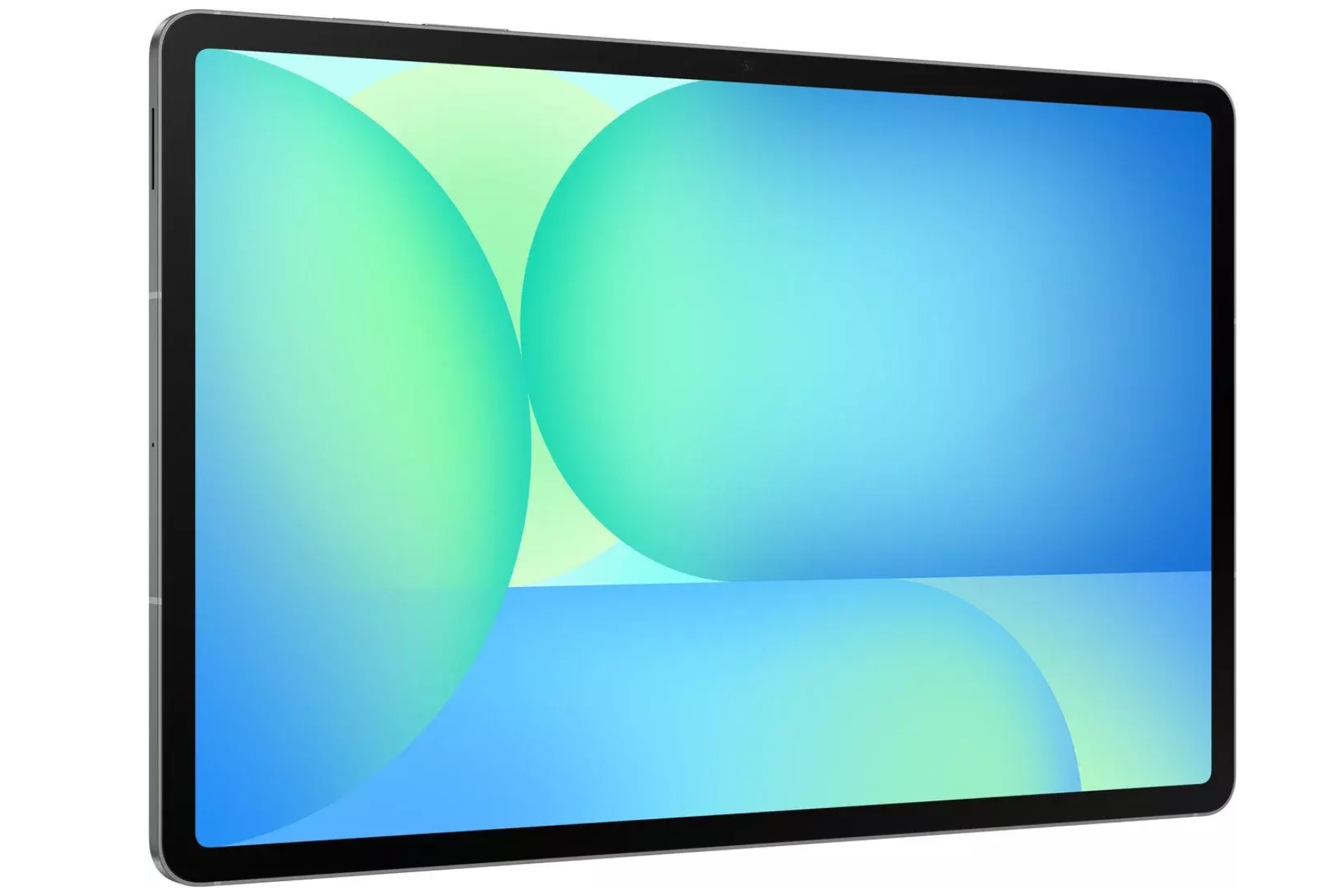
    Leaked image of Samsung Galaxy Tab S10 FE showing its display
    WinFuture

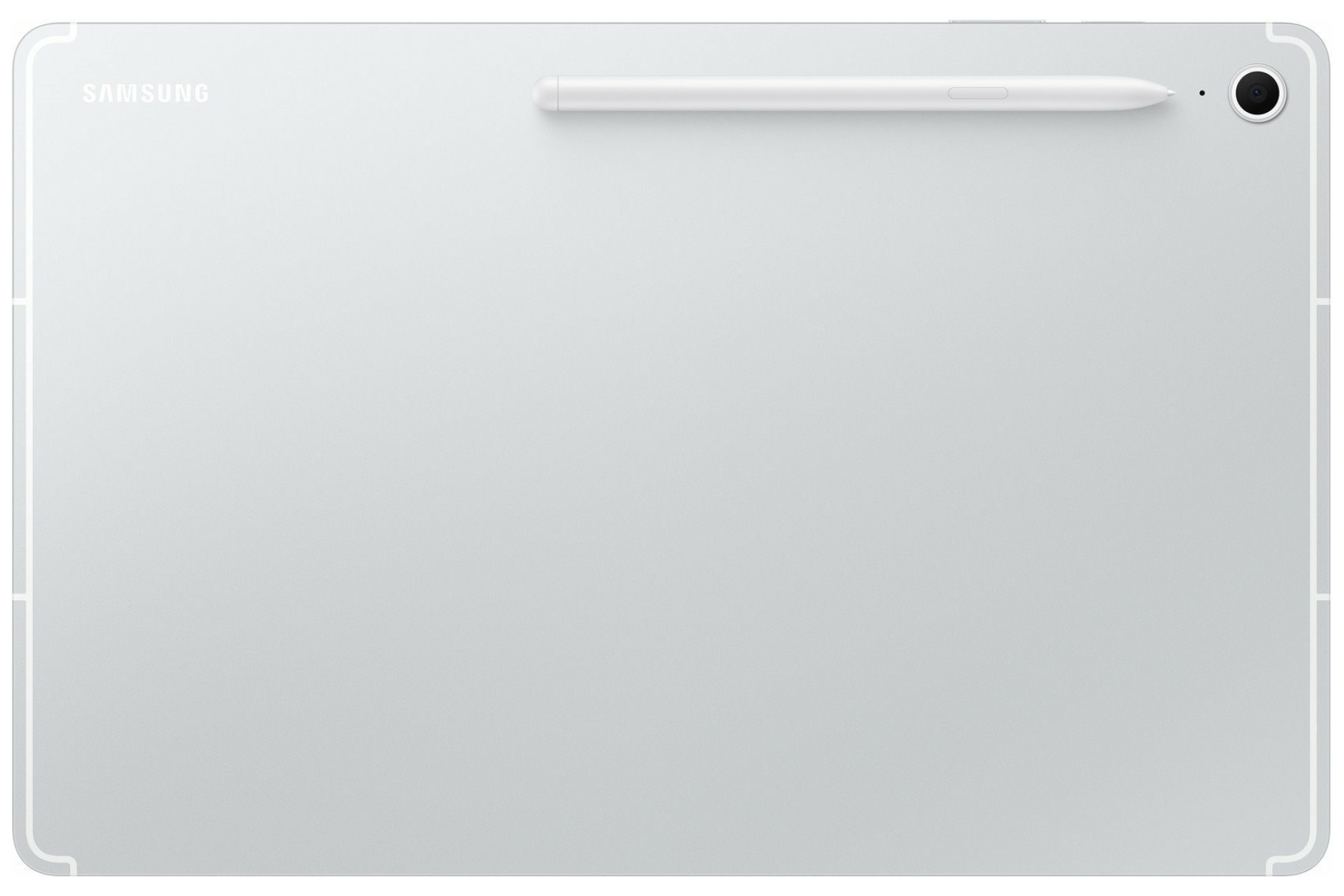
    Notably, Samsung has replaced the previous pill-shaped camera bump with a single, floating lens design for the rear camera, giving the Galaxy Tab S10 FE series a more refined look reminiscent of the iPad Air, with some exceptions in the antenna lines and aspect ratio.

    Going bigger, not bolder

    In terms of specifications, the Galaxy Tab S10 FE is expected to feature a 10.1-inch display with a resolution of 2304 x 1440 pixels. The Plus version will boast a larger 13.1-inch screen with a resolution of 2880 x 1800 pixels, aligning more closely with the iPad Air.

    Leaked image of Samsung Galaxy Tab S10 FE in silver.
    WinFuture

    Both models are expected to utilize Samsung's Exynos 1580 chip, an octa-core processor manufactured on a 4nm process. It features a 1+3+4 core configuration, where a high-performance Arm Cortex-A720 core operates at 2.9 GHz for demanding tasks, while three Cortex-A720 cores handle mid-range workloads at 2.6 GHz.

    For lighter tasks, the Exynos 1580 includes four Cortex-A520 cores. Graphics processing will be managed by Samsung’s Xclipse 540 GPU, and the image signal processor (ISP) supports up to 200MP photos and 4K video recording at 60fps. This processor is also found in the new Galaxy A56 mid-range smartphone.

    Leaked image of Samsung Galaxy Tab S10 FE in vertical orientation.
    WinFuture

    While the Exynos 1580 provides decent performance, it might not stand up against more powerful rivals like the OnePlus Pad 2, which comes in at $550 and includes a previous-generation Qualcomm flagship processor, the Snapdragon 8 Gen 3, paired with 12GB of RAM and an OLED display.

    Additionally, benchmarks suggest the Exynos 1580 may struggle with multitasking, particularly with split-screen operations and multiple apps running simultaneously. Users may notice performance limitations, especially when using DeX mode on a larger display.

    Leaked image of Samsung Galaxy Tab S10 FE in dark grey.
    WinFuture

    Samsung is expected to provide multiple configurations for the new tablets, with options of 8GB and 12GB of RAM, paired with either 128GB or 256GB of internal storage. Notably, both models will feature a microSD card slot, allowing for additional storage expansion.

    In terms of camera capabilities, the rear will host a 13-megapixel sensor, while selfies and video calls will use a 12-megapixel front-facing camera. The smaller tablet will come with an 8,000 mAh battery, while the larger variant will likely be equipped with a 10,090 mAh battery, featuring support for 45W fast charging.

  • Samsung Galaxy S25 May Get Big Software Update Soon

    Samsung Galaxy S25 May Get Big Software Update Soon

    Earlier this week, a reliable source hinted that Samsung might bypass One UI 7 and jump directly to One UI 8, referencing the delays that have affected the current iteration of the software. Today, the initial builds of One UI 8 were discovered on an internal test server. While this doesn’t imply that One UI 8 will be available immediately, it does suggest that development has commenced at least two months sooner than anticipated.

    One UI 7 has been undergoing beta testing since December and has been rolled out to only a limited number of devices so far. Samsung confirmed that the stable version of One UI 7 will be available in April, with additional devices, including foldable models, being incorporated into the beta program. The Samsung Galaxy Z Fold 6 and Flip 6 have started receiving updates as well, allowing them to finally participate in the Android 15 ecosystem.

    One UI 7 brings a wealth of valuable features, including the Now Bar, which is Samsung’s version of Apple’s Dynamic Island, along with specific functionalities like parental controls and content restrictions.

    Concerns have emerged among fans regarding the delays of One UI 7, particularly since even entry-level Android devices are already running Android 15. Many believe that Samsung has lagged behind in recent years, and the delays associated with One UI 7 are a result of the efforts needed to catch up.

    By initiating development on One UI 8 now, Samsung allows enough time to address potential bugs and ensures the software will be ready to launch with the Samsung Galaxy S26. The company has reassured its customers that despite the setbacks, One UI 7 is on its way, and those who have tested it commend its animations, smooth operation, and AI features, even if some of these functionalities are not available on older devices due to hardware limitations.