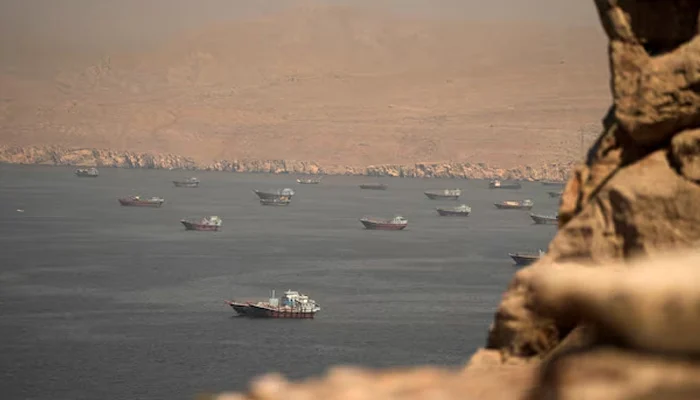
Vessels are seen at the Strait of Hormuz from Musandam, Oman, on June 18, 2026, as captured by Reuters.
On Monday, President Donald Trump announced that the U.S. plans to impose a 20% charge on cargo passing through the Strait of Hormuz after a ceasefire with Iran disintegrated amidst ongoing tensions over Iran’s attempts to maintain control of this critical waterway.
Iran had previously shut down the 21-mile-wide strait, which serves as the main conduit for 20% of global oil exports and other essential commodities, including fertilizers, when the U.S. and Israel launched attacks on February 28, resulting in a severe energy crisis worldwide.
The significance of this issue lies in differences between Trump’s and Iran’s positions, and how these stances impact global stability:
Has the U.S. Changed Its Approach on Charging Tolls in Hormuz?
In late June, Secretary of State Marco Rubio asserted during talks with Gulf nations that “no country has the right to charge for the use of international waterways” and emphasized that shipping costs would not be subject to fees in any agreements.
However, Trump had previously floated the idea of collecting tolls if negotiations with Iran failed.
In a social media statement on June 20, he wrote, “There will be NO TOLLS in the Hormuz Strait for 60 days during the Cease Fire Period, and there will be NO TOLLS after that unless imposed by the United States, in compensation for services as the Guardian Angel to Middle East nations, covering past, present, and future costs.”
Now that the ceasefire has collapsed, he appears to be reverting to his earlier stance.
On Monday, he tweeted, “The USA will be, from now on, known as ‘THE GUARDIAN OF THE HORMUZ STRAIT,’ and as such, shall be reimbursed at a rate of 20% on all cargo shipped.”
Trump has not clarified how such tolls would be enforced or by what legal authority passage could be demanded under these charges.
How does Trump’s proposed toll differ from Iran’s planned fees?
Iran regards maintaining control over the Strait—shared with Oman—as its strategic shield and a secure guarantee against future attacks. It considers this control its strongest negotiating point with the outside world.
Iran believes that last month’s interim deal implied it would facilitate safe passage without fees for 60 days, as the language suggested.
Meanwhile, the U.S. sees it as an obligation for Iran to ensure vessels can pass safely without restriction, not to impose force-backed restrictions or fees.
During the war, Iran established the Persian Gulf Strait Authority, claiming that all vessels must coordinate with it and transit near Iranian shores. It has targeted ships attempting to pass along the Omani coast without permission.
Iran has indicated it might eventually charge transit fees but has yet to specify the amounts.
What was the situation before the conflict, and is charging for passing through the strait legally permissible?
The Strait encompasses territorial waters of Iran and Oman, divided by a maritime boundary along its center.
As per the United Nations Convention on the Law of the Sea (UNCLOS)—which governs international maritime law—coastal states cannot demand payment simply for the privilege of passing through straits.
They may, however, levy limited fees for certain services like piloting, towing, or port facilities, provided these charges are not discriminatory.
Neither Iran nor the U.S. has ratified UNCLOS, but it’s widely accepted as the standard for maritime conduct; the Strait of Hormuz is considered internationally recognized.
In 1968, Iran and Oman agreed on a traffic scheme with the International Maritime Organization (IMO), stipulating that major vessels should use designated sea lanes along the strait’s center. War-related mine-laying has rendered some passages unsafe, complicating transit safety further.
Would other nations accept tolls or fees for crossing Hormuz?
According to shipping officials, no recent instance of a country unilaterally demanding transit fees through a strait has occurred in modern history.
Oman has engaged in talks with Iran on this issue, issuing guidance last month allowing vessels to traverse the Strait without fees through its waters.
Countries in the Gulf region, heavily reliant on the Strait for energy exports, are particularly wary of such fees.
Major buyers of Gulf energy and fertilizers might also be concerned, notably because Trump’s proposal for a 20% surcharge on cargo could significantly elevate global oil prices.