Tag: strait

  • Sources: Proposed Hormuz Deal Could Grant Iran Control of Incoming Traffic

    Sources: Proposed Hormuz Deal Could Grant Iran Control of Incoming Traffic

    Vessels can be seen navigating the Strait of Hormuz from Musandam, Oman, on August 3, 2026. — Reuters

    – Gaining control over this strait would be a significant concession to Iran.
    – President Trump claims discussions with Iran are progressing smoothly.
    – Regional sources caution against assuming a deal is close at hand.

    A senior Iranian source and two regional officials informed Reuters on Wednesday that a proposed agreement between Iran and Oman would grant Tehran authority over ships entering the Gulf via the Strait of Hormuz. This marks one of the most substantial concessions made to Iran to date.

    Despite what appears to be a move towards accommodating Iranian demands, the sources dismissed claims by Donald Trump that a deal to reopen the strait was imminent, clarifying that key details remain unsettled.

    “The concession has already been made regarding some level of control over Hormuz,” one regional official stated.

    The other regional source indicated that specifics on how “control” would be defined are still under discussion, with Gulf negotiators pushing for regional oversight of ship inspections and insisting that any fees be voluntary.

    The Iranian senior official mentioned that the draft agreement on the table envisions Iran holding control over ships heading into the Gulf through the strait. A major point of contention is the extent of Iran’s authority over vessels traveling in the opposite direction.

    There has been no immediate response from U.S. officials regarding these revelations about the potential agreement.

    U.S. representatives have repeatedly stated they would never accept any arrangement that allows Iran dominance over the world’s crucial energy trade route.

    However, in recent days, Trump and high-ranking officials in his administration have suggested a deal is near, aiming to end the conflict he initiated in February, which polls indicate most Americans oppose.

    Oil prices increased slightly Wednesday following news that Yemen’s Iran-backed Houthi movement claimed responsibility for firing on a Saudi-flagged tanker in the Red Sea, amid ongoing disruptions to global energy supplies caused by attacks in the region.

    Despite the uptick, global crude prices remain near their lowest levels since early July, having sharply declined over the past two days after Trump announced a halt to upcoming attacks on Iran, citing new negotiations that could bring an end to the conflict.

    While direct negotiations between Tehran and Washington have not resumed, Iran has been in talks with Oman, which controls the opposite side of the strait. Iran rejected an earlier Omani proposal last week, deeming it too limited in its influence.

    Trump stated in an interview with Fox News overnight that negotiations were “progressing well” and that significant talks took place Tuesday.

    He added, “The Strait of Hormuz will be open very soon. If they back out again, they’ll face severe consequences.”

    Over the weekend, Trump explained the decision to halt plans for large-scale strikes on Iran by citing ongoing negotiations, a pattern he’s repeated multiple times during the ongoing conflict.

    The Iranian official downplayed the notion of an imminent agreement, noting that Foreign Minister Abbas Araqchi was currently on holiday.

    “Talks are ongoing, but it’s premature to say a deal with Oman is finalized,” they said.

    Another Iranian source warned that “the devil is in the details,” noting that “a single tweet from Trump could cause everything to fall apart.”

    If Iran secures control over access to the strait, it would signify a major shift favoring Tehran, effectively altering the regional power balance. Prior to the war, the strait was open to all ships without fees.

    Trump, who initially proclaimed “Operation Epic Fury” would force Iran into unconditional surrender, is now under pressure to exit a conflict that most U.S. voters oppose by a two-to-one margin.

    Iran is reportedly demanding between 5% and 7% in cargo fees from ships passing through the strait, while Oman is proposing lower fees around 3%. The U.S. opposes any fees.

    A voluntary fee system, at least in name, might serve as a compromise, although threats of Iranian attacks could deter shippers from risking transit without paying.

    Despite months of U.S. military operations—including a two-week bombing campaign in July—Iran maintains control over the strait. U.S. military officials admitted in July that supplies of certain munitions were running low, and Reuters reported Tuesday that the Army had used nearly all its long-range precision missiles.

    Periodic U.S. escalation responses have prompted stronger retaliations from Iran and its proxies, such as the Houthis in Yemen and the petro-chemical chokepoint at the Red Sea.

    On Wednesday, the Houthis announced they had again targeted a Saudi tanker in the Red Sea, enforcing what they describe as a blockade on Saudi oil shipments through the key route bypassing the Strait of Hormuz.

    Additionally, on Tuesday, an attack near Yemen sank an Indian-flagged vessel; all 14 crew members, including 13 Indians, were rescued. Yemeni government factions opposed to the Houthis accused them of orchestrating that attack.
  • Trump’s Push for Hormuz Fees Mirrors Iran’s, But Is It Legal?

    Trump’s Push for Hormuz Fees Mirrors Iran’s, But Is It Legal?

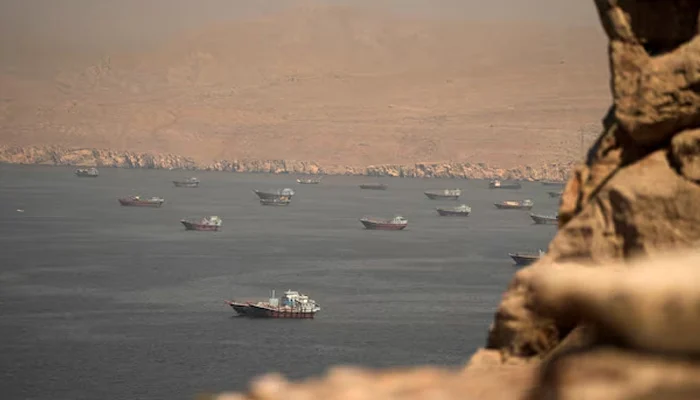
    Vessels are seen at the Strait of Hormuz from Musandam, Oman, on June 18, 2026, as captured by Reuters.

    On Monday, President Donald Trump announced that the U.S. plans to impose a 20% charge on cargo passing through the Strait of Hormuz after a ceasefire with Iran disintegrated amidst ongoing tensions over Iran’s attempts to maintain control of this critical waterway.

    Iran had previously shut down the 21-mile-wide strait, which serves as the main conduit for 20% of global oil exports and other essential commodities, including fertilizers, when the U.S. and Israel launched attacks on February 28, resulting in a severe energy crisis worldwide.

    The significance of this issue lies in differences between Trump’s and Iran’s positions, and how these stances impact global stability:

    Has the U.S. Changed Its Approach on Charging Tolls in Hormuz?
    In late June, Secretary of State Marco Rubio asserted during talks with Gulf nations that “no country has the right to charge for the use of international waterways” and emphasized that shipping costs would not be subject to fees in any agreements.

    However, Trump had previously floated the idea of collecting tolls if negotiations with Iran failed.
    In a social media statement on June 20, he wrote, “There will be NO TOLLS in the Hormuz Strait for 60 days during the Cease Fire Period, and there will be NO TOLLS after that unless imposed by the United States, in compensation for services as the Guardian Angel to Middle East nations, covering past, present, and future costs.”

    Now that the ceasefire has collapsed, he appears to be reverting to his earlier stance.
    On Monday, he tweeted, “The USA will be, from now on, known as ‘THE GUARDIAN OF THE HORMUZ STRAIT,’ and as such, shall be reimbursed at a rate of 20% on all cargo shipped.”

    Trump has not clarified how such tolls would be enforced or by what legal authority passage could be demanded under these charges.

    How does Trump’s proposed toll differ from Iran’s planned fees?
    Iran regards maintaining control over the Strait—shared with Oman—as its strategic shield and a secure guarantee against future attacks. It considers this control its strongest negotiating point with the outside world.

    Iran believes that last month’s interim deal implied it would facilitate safe passage without fees for 60 days, as the language suggested.
    Meanwhile, the U.S. sees it as an obligation for Iran to ensure vessels can pass safely without restriction, not to impose force-backed restrictions or fees.

    During the war, Iran established the Persian Gulf Strait Authority, claiming that all vessels must coordinate with it and transit near Iranian shores. It has targeted ships attempting to pass along the Omani coast without permission.
    Iran has indicated it might eventually charge transit fees but has yet to specify the amounts.

    What was the situation before the conflict, and is charging for passing through the strait legally permissible?
    The Strait encompasses territorial waters of Iran and Oman, divided by a maritime boundary along its center.

    As per the United Nations Convention on the Law of the Sea (UNCLOS)—which governs international maritime law—coastal states cannot demand payment simply for the privilege of passing through straits.
    They may, however, levy limited fees for certain services like piloting, towing, or port facilities, provided these charges are not discriminatory.

    Neither Iran nor the U.S. has ratified UNCLOS, but it’s widely accepted as the standard for maritime conduct; the Strait of Hormuz is considered internationally recognized.

    In 1968, Iran and Oman agreed on a traffic scheme with the International Maritime Organization (IMO), stipulating that major vessels should use designated sea lanes along the strait’s center. War-related mine-laying has rendered some passages unsafe, complicating transit safety further.

    Would other nations accept tolls or fees for crossing Hormuz?
    According to shipping officials, no recent instance of a country unilaterally demanding transit fees through a strait has occurred in modern history.

    Oman has engaged in talks with Iran on this issue, issuing guidance last month allowing vessels to traverse the Strait without fees through its waters.

    Countries in the Gulf region, heavily reliant on the Strait for energy exports, are particularly wary of such fees.
    Major buyers of Gulf energy and fertilizers might also be concerned, notably because Trump’s proposal for a 20% surcharge on cargo could significantly elevate global oil prices.

  • Iran Envoy: Friendly Nations Will Receive ‘Special’ Hormuz Fee Privileges

    Iran Envoy: Friendly Nations Will Receive ‘Special’ Hormuz Fee Privileges

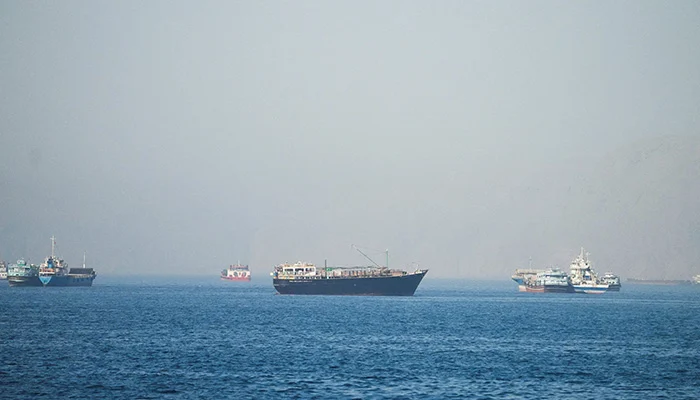
    Vessels are visible at the Strait of Hormuz, as observed from Musandam, Oman, on June 1, 2026. — Reuters

    – Iran’s envoy states that ships passing through Hormuz will be subjected to service fees.
    – Tehran is collaborating with Oman on establishing new arrangements for the Strait.
    – The fees collected are intended to enhance security and oversee vessel passage, according to Fazli.

    Iran’s ambassador to China emphasized on Saturday that new charges will be imposed on ships traveling through the Strait of Hormuz, a move rejected by U.S. officials. He assured that “friendly” nations will receive special treatment.

    The initial agreement between Iran and the U.S. aimed to allow commercial ships to transit the strait without fees for 60 days. The future framework beyond this period remains uncertain.

    Ambassador Abdolreza Rahmani Fazli, speaking at the World Peace Forum in Beijing, said Iran is working in partnership with Oman to develop “new arrangements” for the crucial waterway.

    “As a country that considers the Strait of Hormuz part of its territorial waters, we will indeed implement service fees,” Fazli explained in translated remarks, clarifying these would not be tolls.

    He added that these new arrangements would focus on ensuring safe passage, overseeing vessel movements, and addressing environmental impacts stemming from the high volume of ships.

    Furthermore, Fazli noted that Iran intends to offer special considerations for countries that have shown friendship and support during difficult times.

    The Strait of Hormuz typically facilitates about 20% of global crude oil and liquefied natural gas shipments. However, Iran had largely closed the strait during regional conflicts, causing energy prices to spike.

    Iran resumed allowing passage through Hormuz following an initial agreement with the U.S. aimed at ending regional hostilities, with negotiations ongoing for a permanent resolution.

  • Strategic US-Iran Oil Route at Center of Tensions

    Strategic US-Iran Oil Route at Center of Tensions

    The Strait of Hormuz is a critical maritime corridor for oil transportation, often leveraged by Iran as a geopolitical tool. Tehran has repeatedly threatened to shut it down during crises, though such threats have so far remained empty. In late January, a senior naval commander from Iran’s Revolutionary Guard reiterated the warning, signaling potential closure if attacked, amid U.S. President Donald Trump’s earlier threats of military intervention if Iran didn’t agree to curb its nuclear activities.

    While Iran has occasionally hinted at blockades, it has yet to take definitive action, although it did briefly close part of the strait during recent military exercises citing safety concerns. Here’s what you need to know about this vital waterway.

    Gateway to the Persian Gulf
    The Strait of Hormuz connects the Persian Gulf to the Indian Ocean, situated between Iran and Oman’s Musandam Peninsula. Its narrow width—about 31 miles (50 kilometers)—and shallow depth—no more than 200 feet (60 meters)—make it susceptible to military blockage. The area includes several strategically significant islands, such as Iran’s Hormuz, Qeshm, and Larak. Disputed territories like Greater Tunb, Lesser Tunb, and Abu Mussa, controlled by Iran since 1971, lie in proximity and provide vantage points overlooking the Gulf.

    Major Oil Transit Route
    This strait is among the world’s most crucial energy chokepoints, serving as a corridor for oil produced in the Gulf to reach markets across Asia, Europe, North America, and beyond. According to the U.S. Energy Information Administration, approximately 20% of global oil consumption—around 20 million barrels daily in 2024—flows through this passage. Nearly as much liquefied natural gas (LNG), primarily from Qatar, also transits these waters. Although Saudi Arabia and the UAE have infrastructure to reroute oil shipments, their capacity—about 2.6 million barrels daily—is limited. The EIA emphasizes that large volumes of oil depend on this route, with few alternatives if it gets blocked. Over 80% of the oil and gas passing through the strait is destined for Asian markets, with China importing over 90% of Iran’s oil exports, according to industry sources.

    Military Dynamics
    Iran’s Revolutionary Guard oversees naval operations in the region, frequently criticizing the presence of foreign military forces—including the U.S. Fifth Fleet based in Bahrain and the U.S.’s largest Middle Eastern base in Qatar. Tensions have escalated, especially after 2018, when the U.S. disavowed the Iran nuclear deal and reimposed sanctions, leading to increased confrontations. Historical incidents include attacks on ships during the Iran-Iraq War, mines laid in the strait in the late ‘80s, and the tragic shootdown of Iran Air Flight 655 by USS Vincennes in 1988, which resulted in 290 deaths.

    Recurring Maritime Incidents
    The strait frequently witnesses ship seizures, attacks, and confrontations. Post-2018, these events intensified, with attacks on vessels and the downing of unmanned drones raising fears of broader escalation. Highlights include the 2021 attack on an Israeli-affiliated tanker in the Gulf of Oman that resulted in two deaths, with accusations directed at Iran. In 2024, Iran’s Revolutionary Guards seized a Portuguese-flagged cargo ship, alleging ties to Israel. Early February saw a U.S.-flagged tanker challenged by Iranian gunboats but allowed to proceed. Tensions continue to shape this strategic passage, underscoring its importance and volatility.