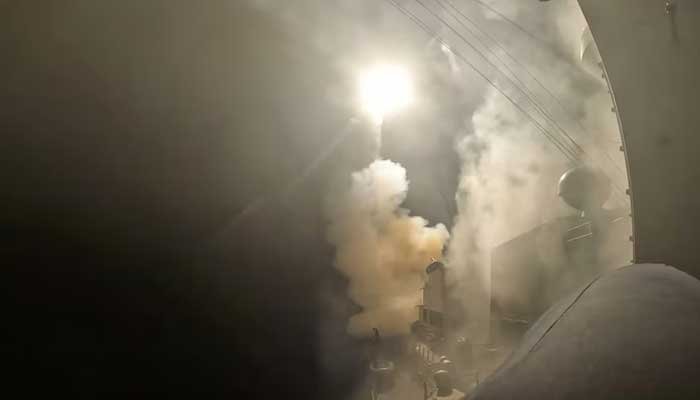
- U.S. targets IRGC facilities “in response to Iranian strikes on shipping”.
- Iran responds by attacking U.S. sites in Jordan, Bahrain, and Iraq.
- Hostilities escalate again after weeks of relative calm.
WASHINGTON/CAIRO: Tensions between the U.S. and Iran have reignited, marking the most significant escalation in recent weeks. Washington has threatened additional severe strikes, while Iran claimed an attack that resulted in five civilian deaths and dozens wounded at a wedding.
Washington’s Central Command reported completing a series of strikes Tuesday against Iranian Revolutionary Guard Corps sites, targeting air defenses, radar installations, maritime assets, mine-laying equipment, and communication infrastructure.
Iranian state media claimed several bombardments across the country, especially near the Strait of Hormuz, where Iran has recently warning oil tankers navigating the waterway without permissions.
Iran alleged it retaliated by attacking U.S. assets in Jordan and Iraq, with reports suggesting Bahrain was also targeted. While Iran’s IRGC claimed it killed many U.S. personnel in Jordan, initial assessments from two U.S. officials indicated there were no casualties.
Jordan’s military reported intercepting 10 of 13 ballistic missiles entering its airspace, with three falling in remote areas. Bahrain’s defenses shot down and destroyed Iranian drones.
The IRGC claimed its ground forces launched combined missile and drone assaults on U.S. bases in Erbil, northern Iraq, reportedly killing several U.S. personnel—though neither Iraq nor the U.S. has confirmed these claims.
This exchange marks the first serious combat since July, ending a period of quiet with both sides holding fire but showing limited interest in peace talks. Iran’s economy, already strained by conflict, has suffered further setbacks, and its conventional military capabilities have diminished.
Meanwhile, in the U.S., President Donald Trump faces rising fuel prices ahead of the November congressional elections. Reports indicate that the U.S. military has depleted much of its precision long-range missile stockpile, raising concerns about readiness for future conflicts.
The renewed fighting prompted vigorous statements from both sides.
“I prefer our current position—almost total control of the Strait of Hormuz, while Iran’s economy is collapsing,” Trump said. “They’re just playing out the inevitable. When will the Iranian people rise up?”
Iran issued warnings of heavier responses against the U.S. and its allies.
“We caution that continued American aggression in the region will face heavier, broader, and devastating retaliation. Any country supporting the U.S. military’s hostile actions must accept severe consequences,” the Iranian joint military command stated.
Civilian Casualties at Wedding
One of the most notable civilian tolls occurred near Sirik, a coastal area along the Strait of Hormuz, where five people were killed and approximately 50 wounded at a wedding, according to Iran’s Red Crescent. The Mehr news agency reported a 4-year-old child among the fatalities, while IRNA news cited a figure of 68 wounded.
U.S. officials have not yet commented on this incident.
“This brutality is part of a pattern of atrocities,” Iran’s foreign ministry spokesperson declared, referencing past events like the deadly school explosion in Minab that killed 160 students on the first day of the conflict.
The Pentagon has not released an official assessment of the Minab event, but sources suggest it may have been caused by outdated targeting information used by the U.S.
Iran’s government pledged to respond strongly to these alleged crimes.
“Countries and international bodies that remain silent or seek to justify these acts must understand that remaining silent is not neutrality,” Iran said. “Today’s silence will not shield them from future consequences.”