

Select Language:
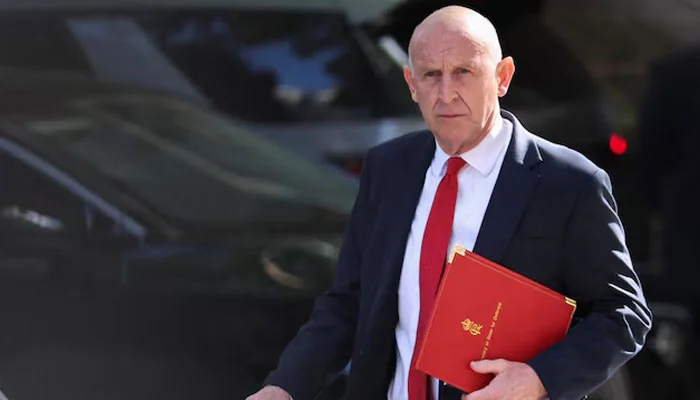
British Defense Secretary John Healey walks along Downing Street to attend a cabinet meeting the day before the State Opening of Parliament in London, May 12, 2026—Reuters/File.
– Healey resigns over delayed and contested Defense Investment Plan (DIP).
– Resignation follows Streeting’s departure earlier in May.
– Military officials push for increased defense funding.
Healey stepped down Thursday amid disagreements over military spending, accusing Prime Minister Keir Starmer of failing to allocate sufficient funds to safeguard the nation during a period of rising threats. His surprise departure included a pointed public letter, intensifying pressure on Starmer, who is facing potential leadership challenges and highlighting the government’s dilemma on how to boost defense budgets without additional revenue.
For months, the UK’s defense and finance departments have been in negotiations over how to meet escalating demands for military expenditure, delaying the release of Britain’s Defense Investment Plan (DIP), initially slated for last year.
Defense leaders emphasize the necessity of the plan to address growing security challenges, such as frequent Russian incursions into British waters. Meanwhile, the government struggles with debt reduction efforts amidst the highest tax rates seen in decades.
Healey’s outspoken resignation adds to a series of political shakeups. Starmer has already faced the resignation of Wes Streeting from the health ministry in May, with another politician, Andy Burnham, seeking to re-enter frontline politics and possibly challenge the leadership.
“Inadequate resource commitments from the Treasury threaten our ability to defend the nation during this dangerous time,” Healey wrote in his letter to Starmer.
The UK’s defense sector has voiced frustration over the DIP’s delay, which hampers their capacity to plan long-term investments. The situation is compounded by the U.S. moving away from European security commitments and recent conflicts involving Israel and Iran exposing deficiencies in Britain’s naval preparedness, with ships unable to swiftly respond to regional crises.
The DIP aims to outline funding allocations for military equipment and operations to prepare the armed forces for active combat. Starmer indicated that the plan would be released before the NATO summit starting July 7.
Healey criticized the current financial package, stating, “The DIP funding you provided — which I only saw fully this Monday — falls well short of what’s needed for national security in this perilous period.” He warned that inadequate funding forces decisions that could compromise military readiness and personnel safety, ultimately making the country less secure.
 ChatGPT
 Perplexity
 Gemini AI
 Grok AI


