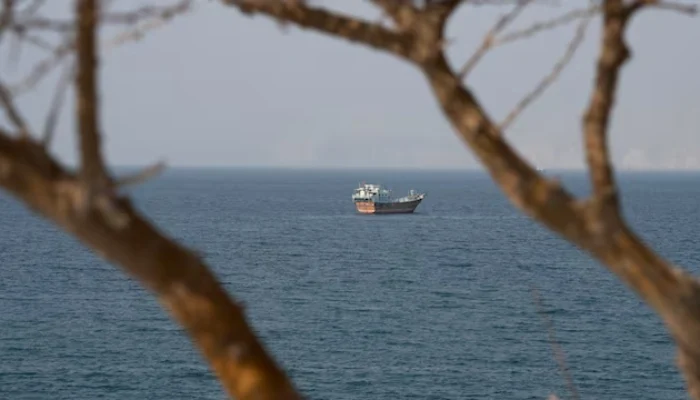
A ship navigates near the Strait of Hormuz, seen from Musandam, Oman, on August 17, 2026. — Reuters
– Tehran threatens a precise military strike against the US naval blockade.
– The US dismisses Iran’s claim that an agreement grants Tehran the right to govern Hormuz.
– Trump rules out extending the temporary agreement signed in June.
Iran has issued a warning that it may carry out a military attack to break the US naval blockade if diplomatic efforts to resolve the conflict fail, a senior Iranian official told Reuters on Monday. Meanwhile, Washington has indicated it will not extend the ongoing ceasefire agreement.
Peace negotiations and the resumption of oil tanker traffic through the vital Strait of Hormuz have come to a standstill, with no indication that the parties involved are nearing a resolution of the conflict initiated by US and Israeli strikes on Iran on February 28.
“Iranian entities should prepare for heightened tensions in the Strait of Hormuz and the wider region, as Iran is ready to make tough decisions and take action,” the official stated. The official also warned that Tehran would execute a “timely and precise” military strike if diplomacy fails to deliver results.
Monday was the deadline for Iran and the US to finalize a peace agreement under a memorandum of understanding signed in June, aiming to end hostilities. The agreement, signed on June 17, set a 60-day window for broader negotiations on Iran’s nuclear program and US sanctions.
However, disagreements over control of the Strait of Hormuz—the narrow waterway through which about 20% of global oil and natural gas exports pass—caused the agreement to unravel quickly. Iran asserts that Section 5 of the deal grants it management rights over the Strait, which it shares with Oman, a position rejected by the US. Hostile actions resumed as Iran began firing on vessels it claimed were passing through Hormuz on unauthorized routes, prompting Trump to declare the pact “over” on July 7.
Iran has warned that the US must implement all the terms of the agreement within weeks, which it says is a condition for future negotiations. Mediators are expected to notify Washington and regional allies of Tehran’s deadline. Additionally, Iran has been in talks with neighboring Oman over managing the Strait, seen as a key component of a broader deal. Progress has been slow, but Iran states they are close to reaching an agreement. Trump responded by threatening, “If Oman obstructs us, we’ll bomb them.”
The conflict has resulted in thousands of deaths — primarily in Iran and Lebanon — since the US and Israel initiated strikes against Iran in late February. Iran has also targeted US military bases and infrastructure across Oman, Jordan, Kuwait, Israel, the UAE, and Saudi Arabia.
Trump has warned that Americans should prepare for ongoing high fuel prices because of the war, while also claiming that “after we finish defeating Iran, I’ll soon declare the Strait of Hormuz territory of the United States.” Earlier, he reaffirmed on social media that his primary goal is ensuring Iran never acquires nuclear weapons.
Oil prices have surged since the conflict’s start, with Brent crude reaching $126 per barrel at peak — about 75% higher than pre-war levels — amid concerns over disruptions to Gulf oil supplies and shifting peace prospects. On Monday, prices slightly increased to around $89 per barrel.
Attacks by Iran-backed Houthis in Yemen have intensified fears of a wider regional conflict and its economic consequences. The Houthis recently launched missiles at a Saudi military vessel and four escort ships in the Bab el-Mandeb Strait, a crucial chokepoint connecting the Red Sea and Gulf of Aden, vital for international shipping. No confirmation has yet been provided by Saudi authorities.