

Select Language:
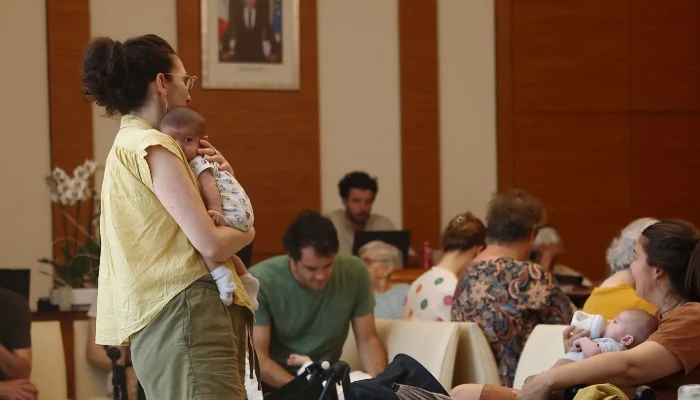
Families with young children gather inside a cooled room open to the public at the 17th district city hall as temperatures soar in Paris, France, on June 25, 2026 — Reuters.
France’s highest court announced on Friday that children born through surrogacy abroad should be officially recognized as the children of their intended parents, despite surrogacy being illegal within France. The country’s ban on surrogacy — where a woman carries and delivers a child for intended parents unable to do so — has left many children born abroad and their families in legal limbo, creating complications for French courts.
The ruling was based on a case involving a married male couple with three children conceived through surrogacy in Canada, who sought legal acknowledgment in France of a Canadian court’s decision that recognized them as the children’s lawful parents. The court stated, “Considering the child’s best interests, France’s prohibition on surrogacy does not, in itself, justify dismissing a foreign judgment that designates the intended parents as the legal parents of a child born via surrogacy in another country.”
This decision marks an important legal milestone in France. The court also referenced a ruling from the European Court of Human Rights, which determined that a national ban cannot prevent the relationship between a child and their intended parents. The court emphasized that denying recognition would leave the child in legal uncertainty, which would be against their best interests.
Additionally, the court highlighted that Canadian authorities confirmed the surrogate mothers had consented to the surrogacy agreements and agreed to transfer their parental rights. The debate over France’s surrogacy ban has intensified, especially after former Prime Minister and potential presidential candidate Gabriel Attal expressed support for legalizing altruistic surrogacy — where surrogates are not compensated — though many allies oppose this move.
Opposition voices, like Minister for Gender Equality Aurore Berge, argue that surrogacy conflicts with women’s dignity and bodily autonomy. The issue remains highly divisive in French politics, with supporters of LGBTQ+ rights clashing with conservatives advocating traditional family models. It also sparks controversy among women’s rights advocates and libertarians advocating for bodily sovereignty.
The discussion continues in Spain, where surrogacy remains illegal, yet numerous children born abroad through the practice seek legal recognition. Meanwhile, Italy recently outlawed its citizens from traveling abroad to pursue surrogacy arrangements.
 ChatGPT
 Perplexity
 Gemini AI
 Grok AI