الوسم: court ruling

  • Judge halts Trump admin from revoking immigrant work permits

    Judge halts Trump admin from revoking immigrant work permits

    A federal judge temporarily blocked President Donald Trump’s administration from removing the work authorization for tens of thousands of immigrants and asylum seekers with Temporary Protected Status (TPS), allowing them to retain their ability to work in the U.S. pending further review. Judge Nathaniel Gorton of the U.S. District Court in Boston issued the halt after siding with a coalition of immigrant rights organizations and labor unions that filed a lawsuit to prevent U.S. Citizenship and Immigration Services (USCIS) from enforcing recent policies linked to new immigration restrictions passed by Congress last year.

    This preliminary injunction will remain until the judge rules whether to extend it into a longer-term suspension, expected by August 5. USCIS has not yet issued a comment on the order.

    The policies in question, part of a 2025 tax and spending law enacted by a Republican-controlled Congress, introduced fees for asylum applications and limited work authorization for individuals with TPS—a designation that permits nationals from countries impacted by war, natural disasters, or other crises to reside and work in the U.S. when returning home is unsafe.

    Under the Trump administration’s tough immigration stance, efforts have been made to end TPS protections for over a dozen countries. Last month, the Supreme Court approved efforts targeting thousands of Haitians and Syrians to lose their TPS status.

    The lawsuit, brought by the legal nonprofit Democracy Forward, argued that USCIS unlawfully implemented these changes without proper notice or a chance for public comment, violating the Administrative Procedure Act. The suit specifically highlights the potential loss of work rights for thousands of TPS holders from El Salvador, Sudan, and Ukraine, starting as soon as Wednesday.

    The plaintiffs claim that these policies unlawfully shorten the work authorization period by retroactively applying new restrictions to the above countries, without proper legal authority. Democracy Forward’s CEO Skye Perryman stated the ruling ensures that numerous families won’t suffer immediate loss of income while courts later examine the legality of the administration’s actions.

    While TPS had previously been extended for nationals from those three nations, current protections run through September 9 for El Salvador and October 19 for Sudan and Ukraine. The lawsuit alleges that USCIS’s new policies were promulgated without proper public notification and failed to follow legal procedures, rendering them invalid.

    For now, the judge declined to halt the collection of fees for TPS applications but ordered USCIS not to revoke existing work permits or penalize individuals who fail to pay the fee.

    This case, based in Boston—a hub for legal challenges against Trump’s immigration policies—was heard by a judge appointed by Republican President George H. W. Bush.
  • France’s Highest Court Recognizes Foreign Surrogacy Children

    France’s Highest Court Recognizes Foreign Surrogacy Children

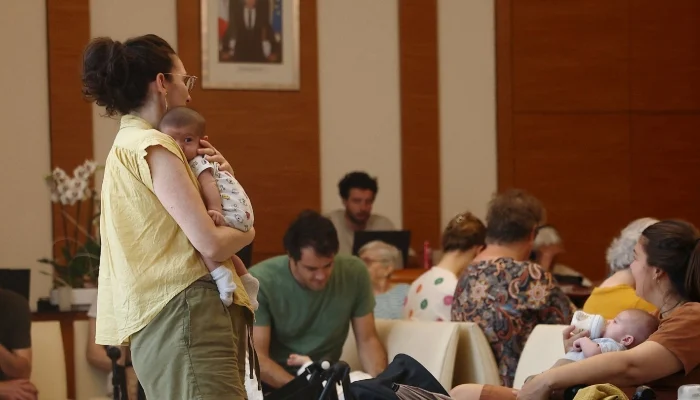
    Families with young children gather inside a cooled room open to the public at the 17th district city hall as temperatures soar in Paris, France, on June 25, 2026 — Reuters.

    France’s highest court announced on Friday that children born through surrogacy abroad should be officially recognized as the children of their intended parents, despite surrogacy being illegal within France. The country’s ban on surrogacy — where a woman carries and delivers a child for intended parents unable to do so — has left many children born abroad and their families in legal limbo, creating complications for French courts.

    The ruling was based on a case involving a married male couple with three children conceived through surrogacy in Canada, who sought legal acknowledgment in France of a Canadian court’s decision that recognized them as the children’s lawful parents. The court stated, “Considering the child’s best interests, France’s prohibition on surrogacy does not, in itself, justify dismissing a foreign judgment that designates the intended parents as the legal parents of a child born via surrogacy in another country.”

    This decision marks an important legal milestone in France. The court also referenced a ruling from the European Court of Human Rights, which determined that a national ban cannot prevent the relationship between a child and their intended parents. The court emphasized that denying recognition would leave the child in legal uncertainty, which would be against their best interests.

    Additionally, the court highlighted that Canadian authorities confirmed the surrogate mothers had consented to the surrogacy agreements and agreed to transfer their parental rights. The debate over France’s surrogacy ban has intensified, especially after former Prime Minister and potential presidential candidate Gabriel Attal expressed support for legalizing altruistic surrogacy — where surrogates are not compensated — though many allies oppose this move.

    Opposition voices, like Minister for Gender Equality Aurore Berge, argue that surrogacy conflicts with women’s dignity and bodily autonomy. The issue remains highly divisive in French politics, with supporters of LGBTQ+ rights clashing with conservatives advocating traditional family models. It also sparks controversy among women’s rights advocates and libertarians advocating for bodily sovereignty.

    The discussion continues in Spain, where surrogacy remains illegal, yet numerous children born abroad through the practice seek legal recognition. Meanwhile, Italy recently outlawed its citizens from traveling abroad to pursue surrogacy arrangements.

  • US Judge Rules Trump’s Name to Be Removed from Kennedy Center

    US Judge Rules Trump’s Name to Be Removed from Kennedy Center

    President Donald Trump announced his administration would transfer control of the Kennedy Center to Congress after a judge ordered the removal of Trump’s name from the Washington venue and blocked his plan to shut it down for renovations.

    On social media, Trump said he directed the U.S. Commerce Department to coordinate with Congress to facilitate a full transfer of the institution, making lawmakers responsible for its operation, upkeep, and management. It’s unclear how this directive might be implemented. Established by Congress in 1958, the Kennedy Center is managed by a trustee board, which Trump has influenced during his second term.

    This comes after a judge ruled last Friday that the center, which Trump tried to rename the “Trump Kennedy Center,” cannot be renamed without Congressional approval. U.S. District Judge Christopher Cooper in Washington ordered the removal of all signage bearing Trump’s name and the elimination of references to a “Trump Kennedy Center” from official documents within two weeks.

    Cooper emphasized that the Kennedy Center’s founding statute clearly states it must bear President Kennedy’s name, and no other official name or memorial can be assigned without Congress’s approval. The ruling also halts Trump’s proposed two-year shutdown for extensive renovations, though the judge acknowledged that critical repairs to the aging facility could still proceed. Cooper clarified that his decision does not dictate how the Center should be managed or its future plans.

    In a post on Truth Social, Trump claimed that the upcoming renovations starting next month would be impossible without a closure and criticized Cooper’s ruling to keep the Center open, calling it “dangerous.” He stated, “I cannot be involved in a situation where public safety is allowed to be compromised openly.”

    The lawsuit was filed by Ohio Democrat and Kennedy Center trustee Joyce Beatty, who stated after the ruling that the Center is a national institution belonging to the American people, not to Trump.

    Trump’s efforts to renovate the Kennedy Center are part of a broader strategy to reshape Washington’s iconic landscape. His plans also include constructing a 250-foot arch and building a 90,000-square-foot ballroom on the site of the demolished East Wing of the White House. These initiatives are also facing legal challenges, with a federal appeals court permitting the construction to move forward amid a lawsuit seeking to prevent it.

    Beatty criticized the renaming effort, calling it a “flagrant violation of the rule of law” and asserting it undermines constitutional principles. Cooper noted that the Kennedy Center’s board could still decide to close the facility if they independently determine it’s necessary after weighing all options.

    The Kennedy Center has been a memorial to President John F. Kennedy since it opened in 1971.

  • Indian Court Declares Bhojshala Mosque a Hindu Temple

    Indian Court Declares Bhojshala Mosque a Hindu Temple

    A court ruling has terminated a 20-year-old worship agreement at the Bhojshala-Kamal Maula mosque complex in Madhya Pradesh, India, allowing daily Hindu prayers to resume. The Madhya Pradesh High Court’s Indore bench declared the site a Hindu temple dedicated to goddess Vagdevi (Saraswati), based on a 2024 Archaeological Survey of India (ASI) report indicating the structure was built using fragments of older temples, with the mosque constructed centuries later.

    Following the decision, the ASI issued a directive on May 16 permitting Hindu devotees unrestricted access for daily worship, replacing prior arrangements that limited Hindu worship to Tuesdays and Muslim Friday prayers. Advocate Vishnu Shankar Jain, representing Hindu petitioners, emphasized that Hindus can now visit and worship at the site freely.

    The site remains a protected monument under India’s 1958 law, with worship timings set by the superintending archaeologist in consultation with local authorities. The court’s ruling notes that the complex was built using remnants from earlier temples, reinforcing its status as a Hindu religious site. The Muslim community was offered an alternative location for building a mosque, but Dhar city Qazi Waqar Sadiq stated that Muslim petitioners plan to appeal to the Supreme Court and have expressed opposition to relocating.

    This site has long been a flashpoint, with Hindu groups claiming it is a Saraswati temple, while Muslims insist it is the Kamal Maula mosque. The decision effectively restricts Muslim access for prayer, placing the mosque off-limits. Legal, historical, and political voices from the Muslim community have criticized the ruling, warning it jeopardizes protections for Muslim religious sites in India. Lawyer Ashhar Warsi labeled it a “misjudgment” and a violation of established law, while politician Asaduddin Owaisi warned that the verdict poses a “serious threat” to Muslim worship rights and suggested it could set a precedent for similar claims, echoing concerns about the aftermath of the Babri Masjid verdict.

    Historian Audrey Truschke commented that this trend of targeting Islamic places of worship reflects deep-seated Islamophobia rooted in Hindu nationalism. The dispute is part of a broader movement to challenge medieval mosques and Islamic-era monuments across India, with claims that many were built over Hindu temples, a narrative that has gained momentum since Prime Minister Narendra Modi took office in 2014.

  • Brazil Court Detains Bolsonaro Over Flight Risk Concerns

    Brazil Court Detains Bolsonaro Over Flight Risk Concerns

    Brazil’s ex-president Jair Bolsonaro was moved from house arrest into police custody on Saturday to prevent him from escaping while he appeals a conviction related to a failed coup attempt, according to the Supreme Court. The right-wing leader was sentenced to 27 years in prison for plotting to prevent Luiz Inacio Lula da Silva from taking office after the 2022 elections.

    Supreme Court judge Alexandre de Moraes, who is overseeing Bolsonaro’s trial, stated that his arrest was a preventative step because he is considered a “high flight risk,” and not a formal part of his sentence enforcement.

    Bolsonaro, who served as Brazil’s leader from 2019 to 2022, had been placed under house arrest in August. He was confined to a luxury condo in Brasília and monitored electronically. Moraes explained that a planned demonstration outside Bolsonaro’s residence, organized by his son Flavio Bolsonaro, could incite unrest and possibly facilitate his escape.

    Moraes also noted that there was a failed attempt to remove Bolsonaro’s ankle monitor just after midnight Saturday, indicating plans to escape amid the confusion of the rally. The judge pointed out the close proximity of Bolsonaro’s home to the U.S. embassy and mentioned that Bolsonaro had previously considered fleeing to the Argentine embassy to seek political asylum.

    Bolsonaro’s allies include former U.S. President Donald Trump, who labeled the trial a “witch hunt” and retaliated with tariffs and sanctions against Brazil.

    He was taken to a federal police facility in Brasília, where inmates undergo medical checks before transfer to prison. Bolsonaro was convicted in September for leading a criminal organization aiming to maintain authoritarian control, which included alleged plots to assassinate Lula, Vice President Geraldo Alckmin, and judge Moraes.

    His incarceration is nearing a deadline, as an appeal last week was denied. His lawyers have announced plans to file additional appeals by Monday and requested that Bolsonaro serve his sentence under house arrest, citing health concerns and risks to his safety. They argued his health, already compromised by a stabbing in 2018 and multiple surgeries, deteriorates further with each hospital visit—Bolsonaro has been hospitalized three times since his house arrest, suffering from conditions such as gastritis, severe sleep apnea requiring a CPAP, and persistent hiccups that cause shortness of breath and fainting.

    In a comparison, Bolsonaro’s lawyers referenced that former President Fernando Collor de Mello was allowed to serve his nearly nine-year corruption sentence at home due to health issues.

    As the possibility of imprisonment approaches, Bolsonaro’s family has expressed concern over his health publicly. His son Flavio called supporters to rally for the country, while Bolsonaro’s wife, Michelle, wrote on Instagram, “I trust in God’s justice. Human justice, as we have seen, no longer holds. But I know the Lord will provide a way out.”

    A court hearing on Bolsonaro’s custody is scheduled to happen via video on Sunday, and Moraes ordered a doctor to be present with Bolsonaro at all times.

  • Supreme Court Allows Trump to Block $4B Food Aid Funding Temporarily

    Supreme Court Allows Trump to Block $4B Food Aid Funding Temporarily

    Volunteers at the Mt. Carmel Veterans Service Center are organizing food for over 100 cars lined up at the center’s distribution site, still managing the backlog weeks into the ongoing U.S. government shutdown in Colorado Springs, Colorado, on November 7, 2025. — Reuters

    The U.S. Supreme Court has temporarily permitted the Trump administration to withhold approximately $4 billion, which is essential to fully fund a food assistance program serving 42 million low-income Americans this month, amid the ongoing federal shutdown.

    This order, called an administrative stay, extends time for a lower court to consider the government’s formal plea to fund only part of the Supplemental Nutrition Assistance Program (SNAP), also known as food stamps, for November. The administration was under a Friday deadline set by a judge to ensure full funding for the program.

    Justice Ketanji Brown Jackson, who issued the stay, has set it to expire two days after the Boston-based 1st U.S. Circuit Court of Appeals rules on the government’s request to halt a judge’s order requiring the USDA to distribute the full amount of SNAP benefits for this month, which typically costs between $8.5 billion and $9 billion.

    Jackson anticipates the lower court will act swiftly. The decision by U.S. District Judge John McConnell in Providence, Rhode Island, came after the government announced it would provide an emergency fund of $4.65 billion to partially cover November’s SNAP benefits.

    Jackson, the liberal justice reviewing emergency appeals from several states including Rhode Island, expects the 1st Circuit to resolve the government’s request promptly. U.S. Attorney General Pam Bondi shared on X (formerly Twitter) that the Supreme Court’s decision paused a ruling she viewed as “judicial activism at its worst.”

    Lawyers for the Department of Justice argued that upholding McConnell’s decision could lead to further chaos during the shutdown by forcing “a run on the bank” through judicial fiat. Originally, the administration planned to completely suspend SNAP benefits in November due to funding shortfalls caused by the shutdown.

    However, McConnell ordered USDA last week to use emergency SNAP funds to cover part of this month’s costs. In Thursday’s ruling, he directed the USDA to cover the balance from a separate federal program supporting child nutrition, which has a $23.35 billion budget sourced from tariffs.

    McConnell, appointed by President Barack Obama, criticized the Trump administration for withholding SNAP benefits “for political reasons.” This ruling favored a coalition of cities, unions, and nonprofits represented by the liberal legal group Democracy Forward, prompting the administration to ask the 1st Circuit to stay the order on Friday.

    Legal challengers argued that the government’s actions risk harming nearly one in eight Americans dependent on SNAP. They urged the court to deny the government’s motion to delay providing essential food support.

    On Friday, the 1st Circuit refused the Trump administration’s request to temporarily block McConnell’s ruling but has yet to decide on the administration’s broader appeal. The three-judge panel, appointed by Democratic presidents, assured it would handle the matter “as quickly as possible.”

    Democracy Forward’s Skye Perryman told MSNBC that courts have clearly affirmed the government’s legal obligation to fund SNAP benefits and must do so. Meanwhile, even as the appeal process unfolded, the USDA informed states it was working to comply with the judge’s order — a move that caused some confusion.

    States like New York, New Jersey, and Massachusetts announced they would issue full SNAP benefits for November. Massachusetts Governor Maura Healey criticized the situation, saying President Trump’s actions forced Americans into hardship.

    For the first time in the program’s six-decade history, SNAP benefits were not paid at the start of the month. Many recipients have relied more heavily on food banks or faced tough choices, such as skipping medications, to make ends meet.

    SNAP benefits are monthly payments to eligible individuals earning less than 130% of the federal poverty line. For the 2026 fiscal year, maximum monthly benefits are $298 for a single-person household and $546 for a two-person household.

  • Thai Court Removes PM Paetongtarn Shinawatra Over Ethics Breach

    Thai Court Removes PM Paetongtarn Shinawatra Over Ethics Breach

    Thailand’s Constitutional Court has dismissed Prime Minister Paetongtarn Shinawatra from office due to an ethics violation after just one year in power, marking another setback for the Shinawatra political dynasty and potentially leading to increased political instability.

    Paetongtarn, Thailand’s youngest prime minister, becomes the sixth leader associated with or supported by the wealthy Shinawatra family to be ousted by the military or judiciary during a turbulent 20-year struggle for control among Thailand’s elite factions.

    The court’s ruling cited a leaked phone call from June in which Paetongtarn appeared to show deference to Cambodia’s former leader, Hun Sen, during a period of heightened tension with Cambodia that later escalated into a five-day border fight. The verdict states her actions compromised ethics, damaged national reputation, and eroded public trust.

    This decision opens the path for parliamentary elections to select a new prime minister, though the process may be drawn out. With Paetongtarn’s Pheu Thai party losing leverage, it faces challenges maintaining a fragile coalition with a narrow majority.

    In a 6-3 vote, the court found that Paetongtarn prioritized her personal interests over national interests, undermining diplomatic relations and public confidence. The court remarked that her behavior, seemingly aligned with Cambodia, suggested she was willing to act according to external influences.

    The ruling ends the political career of Paetongtarn, the daughter of influential tycoon Thaksin Shinawatra, who rose rapidly in political prominence after her predecessor Srettha Thavisin was dismissed a year ago. Paetongtarn, 39, has apologized for the leaked call, claiming her actions aimed to prevent conflict.

    She is the fifth Thai prime minister to be ousted by the Constitutional Court in the past 17 years, highlighting the court’s central role amid ongoing power struggles between Shinawatra-supported governments and conservative, royalist military factions.

    Attention now turns to who will replace her, with Thaksin likely to be deeply involved as various parties negotiate to keep Pheu Thai leading the coalition. Deputy Prime Minister Phumtham Wechayachai and the current cabinet will govern on a temporary basis until a new prime minister is elected, with no specific timeline set.

    Candidates eligible for the position include five individuals, one from Pheu Thai—77-year-old Chaikasem Nitisiri, a former attorney general with limited executive experience—alongside retired former Prime Minister Prayuth Chan-ocha, who led a military coup in 2014, and Anutin Charnvirakul, who previously withdrew his party from the coalition over the phone call incident.

    This political upheaval exacerbates Thailand’s challenges amid a sluggish economy, projected to grow just 2.3% this year, and ongoing frustrations over stalled reforms. A Pheu Thai-led government would likely hold only a slim majority and face frequent opposition calls for early elections.

    According to political analyst Stithorn Thananithichot of Chulalongkorn University, assembling a new government could be a protracted and complex process, with Pheu Thai at a disadvantage due to limited bargaining power among other parties.

  • Trump Administration Promises to Rehire 25,000 Laid-Off Workers

    Trump Administration Promises to Rehire 25,000 Laid-Off Workers

    Content Revised for American English:


    Protests Erupt Over Trump Administration’s Dismissal of Federal Workers

    Protesters gather near the offices of federal lawmakers during a demonstration against a federal workforce reduction campaign led by billionaire Elon Musk, a key advisor to President Donald Trump, on Capitol Hill in Washington, DC, on February 25, 2025. — Reuters


    WASHINGTON: In a significant turn of events, the Trump administration has acknowledged that nearly 25,000 recently hired federal employees were terminated and is now focused on their reinstatement. This acknowledgment comes after a court determined that these mass layoffs were likely illegal.

    Court documents revealed that federal agencies are actively working to reinstate all affected workers following a ruling from a judge suggesting that their dismissals were probably unlawful. Filed late Monday in the federal court based in Baltimore, Maryland, the documents contained statements from officials from 18 agencies, confirming that the workers reinstated from probationary status are currently placed on administrative leave, at least temporarily.

    The mass layoffs, part of Trump’s broader initiative to streamline the federal workforce, have received considerable media attention. However, these court filings mark the administration’s first comprehensive disclosure regarding the terminations.

    Most agencies reported dismissing several hundred workers, with the Treasury Department laying off approximately 7,600, the Department of Agriculture about 5,700, and the Department of Health and Human Services over 3,200, as detailed in the filings.

    On March 13, U.S. District Judge James Bredar ruled that the mass dismissals of probationary workers, which began last month, were unlawful and mandated their reinstatement while further legal discussions continue. Although the ruling does not prevent agencies from terminating employees in the future, it criticized how the large-scale layoffs were executed, indicating that agencies should have adhered to appropriate procedures during such significant workforce reductions.

    Typically, probationary workers have served less than a year in their current roles, though some may have been long-term federal employees.

    In a brief notice released on Tuesday, Judge Bredar remarked that agencies have shown "meaningful progress toward compliance" with his prior ruling. He instructed them to provide an update on their reinstatement efforts by Monday afternoon and expressed his expectations for "substantial compliance."

    This ruling follows a lawsuit initiated by 19 states led by Democrats, along with Washington, D.C. They contended that the mass terminations would lead to a spike in unemployment claims and a greater demand for state-provided social services.

    The Maryland Attorney General’s office, which is spearheading the lawsuit, indicated that it is currently evaluating the court’s filings.

    Furthermore, the Trump administration has appealed Bredar’s ruling while requesting the Richmond, Virginia-based appeals court to suspend the order until the legal process unfolds.

    Several former probationary workers from the Departments of Agriculture, Health and Human Services, the Internal Revenue Service, and the General Services Administration told Reuters that they received notifications about their reinstatement with full pay, although they are currently on administrative leave.

    One reinstated worker from the General Services Administration stated he still expects to be let go eventually, but acknowledged that receiving pay and benefits for now provides some relief. "My family has health insurance, and this gives me a little time to figure out what’s next," he noted.

    Federal Court Decision in San Francisco

    Just hours before Judge Bredar’s March 13 ruling, a federal judge in San Francisco ordered the reinstatement of probationary workers at six agencies, including the five outlined in Bredar’s ruling as well as the U.S. Department of Defense. The administration is also challenging this decision.

    U.S. District Judge William Alsup criticized the choice to place probationary employees on administrative leave instead of reinstating them to work, asserting that this approach failed to restore government services as intended.

    In response, the U.S. Department of Justice contended that placing these workers on administrative leave is merely the first step toward full reinstatement and clarified that "administrative leave is not being used to bypass the requirement for reinstatement."

    According to the filings submitted in Baltimore, agency officials indicated that they had either already reinstated dismissed employees or were in the process of doing so. They recognized the confusion and disruption caused by the large-scale reinstatement.

    These officials cautioned that if an appellate court overturns Judge Bredar’s ruling, it could authorize agencies to terminate these workers again, leading to several changes in their employment status within a short timeframe.

    "The considerable uncertainty surrounding this situation and the associated administrative burdens hinder supervisors from effectively managing their teams," stated Mark Green, Deputy Assistant Secretary at the U.S. Department of the Interior, in one of the filings. "Work schedules and responsibilities are being intricately linked to hearings and briefings set by the courts."

    Judge Bredar has scheduled a hearing for March 26 to decide whether his ruling should remain effective during the ongoing lawsuit, a process that could extend for months or even longer.


    This rendition maintains the essence of the original information while ensuring it is uniquely phrased and compliant with American English standards.

  • Hitman Developer Ends Ties With Conor McGregor After Court Ruling

    Hitman Developer Ends Ties With Conor McGregor After Court Ruling

    Conor McGregor styled in a luxurious fur coat and sunglasses in Hitman.
    IO Interactive

    IO Interactive, the studio behind Hitman, has terminated its collaboration with mixed martial arts fighter Conor McGregor after a Dublin civil court ruled he was liable for a sexual assault that occurred in 2018.

    Last week, McGregor was ordered to pay approximately 250,000 euros (about $257,000) to the accuser in a civil lawsuit. Prosecutors did not pursue criminal charges in this case, leading McGregor to dismiss the allegations as “full of lies.”

    “In light of the recent court ruling regarding Conor McGregor, IO Interactive has made the decision to cease its collaboration with the athlete, effective immediately,” the studio announced on X. “We take this matter very seriously and cannot ignore its implications.”

    The associated downloadable content (DLC) has been removed from sale, and any related video content has been taken down from YouTube.

    In light of the recent court ruling regarding Conor McGregor, IO Interactive has made the decision to cease its collaboration with the athlete, effective immediately. We take this matter very seriously and cannot ignore its implications. Consequently, we will begin removing all…

    — HITMAN (@Hitman) November 25, 2024

    The former UFC champion has a long history of controversies involving alcohol, driving offenses, and other public incidents that predate his collaboration with IO Interactive on the World of Assassination DLC. He has been arrested in the past, including a notable incident in Florida where he was charged for allegedly assaulting a fan. Although charges were dropped, he also pleaded guilty to assault in 2019 for an altercation at a Dublin pub.

    Hitman 3 evolved into Hitman: World of Assassination in 2023, with IO Interactive introducing DLC featuring various celebrities as elusive targets. In this content, McGregor portrayed a character known as The Disruptor, an affluent MMA fighter who comes into conflict with a tech CEO, leading to Agent 47 being tasked with eliminating him. Participants gained access to exclusive cosmetic items, including the iconic fur coat and a cane, alongside a two-level Arcade contract called The Ostentatious.