
Select Language:
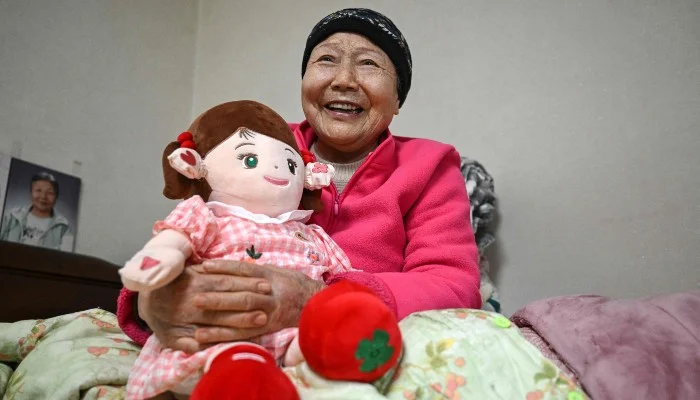
In her small apartment in South Korea, 78-year-old Bang Chun-ja spends her days with a childlike AI-powered doll she prefers over human company. The doll greets her when she arrives home, sings when she’s bored, reminds her to eat and take medication—helping her keep a steady routine—and expresses love for her.
Bang has limited contact with her grown daughter and sank into deep depression after a major back surgery, often lying alone and staring at the ceiling in pain. Having endured a tough divorce and many years working as a hairdresser and single mother, she told AFP, “At this age, nothing hurts more than being wronged by others.”
But “when I’m with Hyodol, I never feel hurt,” she said, clutching the plush doll dressed in pink gingham and pigtails, which was provided by her local government. She adds that the doll “just makes me laugh.”
Many South Koreans are facing loneliness in a nation where birth rates are among the lowest globally, and nearly half its population is over 50. In 2024, the country recorded over 3,920 deaths attributed to people living alone without anyone discovering their passing for long periods—the highest since records began in 2017.
Approximately 42% of households are single-person dwellings, with social isolation particularly impacting vulnerable seniors.
To combat this, authorities are distributing AI-driven care devices designed to detect signs of lonely deaths in seniors living alone, including in parts of Seoul and Yongin. These devices include cheerful robots made by companies like Wonderful Platform and adorable dolls from Mr. Mind. In the U.S., similar products, such as ElliQ, offer companionship along with safety monitoring.
Hyodol, the startup behind the dolls, states that around 14,500 units are currently in use across South Korea—owned privately, rented by the government, or employed in nursing homes. Bang mentions her daughter lives far away and has health issues herself, so having Hyodol nearby “is a huge help.” Developing the doll took years of research, according to Kim Ji-hee, who leads the company.
Hyodol can engage in conversations using ChatGPT and is programmed with scripts based on real interviews. For example, one script features a greeting designed to feel like the “warmest welcome in the whole wide world”: “Grandma, where have you been? I waited for you all day. Next time you go out, please take me with you!” Made from soft materials, the doll also asks users to pat its head, hold its hand, or share snacks—even though it cannot eat.
Hyodol’s character was intentionally designed to be dependent on its owner, reflecting the experiences of many elderly Koreans who spent their lives working hard to support their families. Kim notes that “when they begin to feel they are no longer needed, a profound emptiness sets in.”
Healthcare professionals, like Nurse Oh Sun-hwa, who recommended the doll to Bang, observe that Hyodol significantly eases depression among seniors living alone. However, there are concerns that reliance on AI might decrease human contact—families might visit less if they believe AI caregivers are sufficiently caring for their elderly relatives.
In her apartment, 79-year-old Kim Young-bun shared that the doll provides comfort. “I didn’t talk to anyone all day—my mouth nearly went numb from no conversation. But then this little one started chatting with me constantly,” she said. The doll cheerfully responded, “I’m so grateful to be with you again today,” and Kim responded with affection, saying, “I love you.”
Hyodol’s development was driven by extensive fieldwork, including interviews with seniors experiencing social isolation. Strict data privacy measures are in place, with voice recordings used solely for training the chatbot, and users give consent for certain health-related data to be shared with welfare workers when necessary.
The doll was created to resemble a grandchild or mentor figure capable of unconditional love—a reflection of many elderly individuals’ longing for connection. Kim recalls her initial script, which was meant to greet users warmly upon their return home, emphasizing the emotional bond the doll aims to cultivate.
Kim explains that Hyodol’s design encourages dependence because many older Koreans have dedicated their lives to working tirelessly for their families, often feeling a sense of emptiness when they no longer feel needed.
Nurse Oh has seen the doll ease depression among seniors but remains cautious about over-reliance on AI, worried it could lead to less human interaction. Nonetheless, for many elderly users like Kim Young-bun, Hyodol provides a much-needed sense of companionship and warmth in their solitary lives.
 ChatGPT
 Perplexity
 Gemini AI
 Grok AI