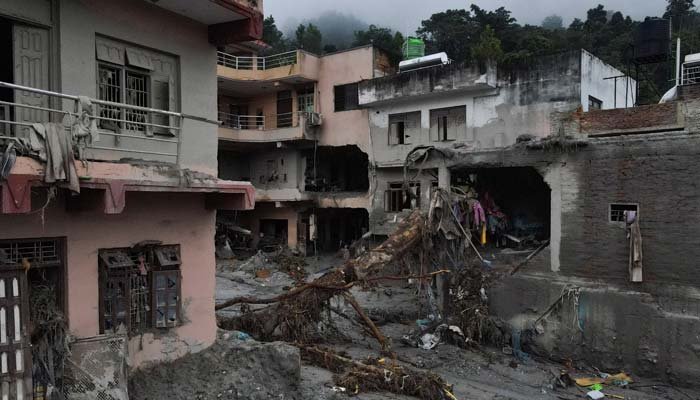
A drone captures an aerial view of a tree that has been uprooted, alongside damaged houses, following the catastrophic flash floods and mudslide in Devighat, Nuwakot District, Nepal, on August 31, 2026. The scene highlights the extensive destruction wrought by the natural disaster. — Reuters
– 933 workers are currently missing at hydropower project sites in the flood-affected areas.
– Dozens of unidentified bodies have been buried in shallow graves amidst the ongoing crisis.
– Nearly 21,000 security personnel have been mobilized to assist Nepal’s rescue efforts.
Nepal’s rescue teams, with support from Chinese and Indian experts, worked through the night to reach hundreds of individuals believed to be trapped inside blocked tunnels of hydropower projects. The floods, which tore through the Himalayan region last week, have left a trail of destruction across valley towns, villages, and even into neighboring China.
The disaster was triggered by a glacier collapse on the Nepal-Tibet border, unleashing an overwhelming flow of ice, rock, mud, and debris that resulted in over 900 deaths, with about 5,000 still unaccounted for. Many bodies, often unrecognized, have been buried hastily in shallow graves as they decomposed in the humid plains after being swept down from the mountains.
Officials in Nepal are prioritizing efforts to unlock the blocked tunnels of approximately six hydropower projects, where workers are believed to be trapped. Rescue teams used earth-moving machinery to remove mud and rocks under the cover of night, with soldiers employing flashlights to search inside the tunnels. An excavated pit was created in a bid to access one of the affected tunnels.
The Nepal Disaster Management Authority reports that 933 individuals are missing at hydropower sites in the flood zone. The Red Cross estimates that more than 90,000 people have been impacted by the disaster, which China attributes to climate change effects.
As of Monday, official counts indicated 903 fatalities and 4,247 people missing in Nepal. On the Chinese side, authorities reported 16 deaths in Gyirong County and 546 individuals missing.
Nepal’s Prime Minister Balendra Shah described the flood as an “unprecedented and devastating natural disaster,” emphasizing the difficulty of fully assessing the scope of the damage. Despite challenging weather conditions, treacherous terrain, and persistent risks, Nepal is committed to continuing rescue operations, with nearly 21,000 security personnel, alongside civilian workers and volunteers, actively involved.
A drone image shows damaged buildings and homes caked in mud along the Likhu River in Devighat, Nuwakot District, following the deadly floods and mudslides on August 30, 2026. The destruction underscores the severity of the event. — Reuters
Chinese President Xi Jinping, currently visiting Kyrgyzstan, has stated that Beijing is making every effort to locate and assist missing persons affected by the disaster, as reported by Xinhua. The Chinese authorities have identified 261 foreign nationals from 23 countries unaccounted for in Tibet near the critical border with Nepal.
China has deployed over 2,100 rescue workers and allocated at least 220 million yuan (roughly $33 million) for relief operations. The country has been air-dropping supplies and deploying life-detection equipment to aid frontline rescue teams.
Despite Nepal’s assertion that it does not require foreign rescue assistance, it has relied on India and China’s expertise for tunnel rescue operations. Rescue activities faced interruptions since Friday due to adverse weather and the potential threat posed by a newly formed lake on the Nepal-China border, potentially causing further flooding as it overflowed into Nepal’s rivers.
Reports from China’s CCTV indicate that another upstream lake, created by a landslide, has largely drained naturally. This landslide occurred 2.8 kilometers downstream of the initial glacier debris site. Authorities are monitoring a large impact crater on the Nepal side, which expanded to 174,000 square meters by Saturday evening and holds around 2.5 million cubic meters of water. A breach here could trigger a chain reaction affecting downstream lakes.
Further landslides along the river pose risks of additional lakes forming, with eight high-risk spots identified for geological disasters. The floods are largely attributed to glacier instability driven by long-term global warming effects, considered a new and significant feature of cryosphere-related disasters on the Tibetan plateau.
Some Nepali officials have expressed concern over China’s limited sharing of glacier and water level data following earlier cooperation meetings, fearing this could hinder future disaster preparedness. China has yet to respond to inquiries about the extent of data sharing.