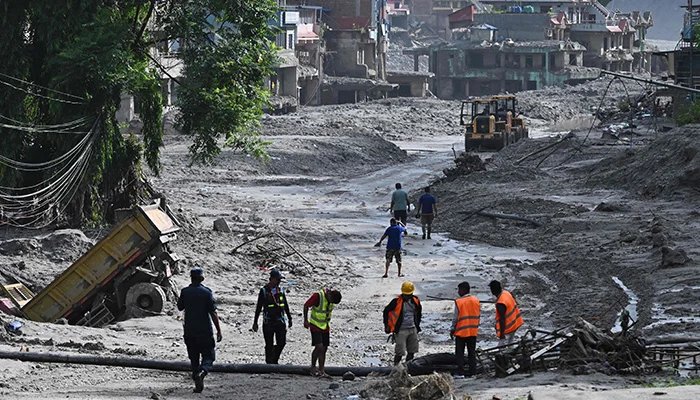
Rescue efforts are ongoing at Trishuli Center in Nepal’s Nuwakot district following devastating flooding along the Nepal-Tibet border on August 30, 2026, caused by severe monsoon rains.
The overall death toll has reached 750, with 3,044 individuals still unaccounted for. The disaster has also been linked to a mudslide in China, which authorities attribute to glacier instability driven by climate change. To aid in relief, Beijing has deployed more than 2,100 emergency personnel.
Nepal’s disaster management agency reported that at least 734 people have died, and the number of missing residents continues to grow. As of the latest update, over 2,426 individuals are listed as missing, including 589 foreigners—an increase from previous figures. Among the missing are 933 workers involved in hydroelectric projects along the river impacted by the floodwaters. Rescue teams have successfully saved over 8,186 people, including 227 foreigners.
In neighboring India, officials recovered seven bodies pulled from rivers originating in Nepal, though these deaths are not yet included in official counts.
In Tibet, China reports that 16 people have lost their lives, and 261 foreign nationals from 23 countries remain missing after a mudslide triggered by a glacier collapse. The highest number of missing foreigners is from Nepal, accounting for 104 individuals. Other unaccounted-for nationals include 49 Indians, 33 Latvians, 18 Americans, and 15 Britons. Chinese authorities confirmed the situation during a press conference, indicating increased risk as water levels in the nearby Trishuli River have risen, prompting residents and rescue workers to relocate to higher ground.
Chinese officials also stated that the glacier collapse was a result of long-term global warming effects, describing this type of disaster as a new and significant cryosphere-related phenomenon in the region. Surveillance footage shows the rapid flow of water and debris engulfing buildings at the Gyirong border crossing, with the mudslide reaching the area in approximately six to seven minutes.
Chinese Foreign Minister Wang Yi spoke with his Nepalese counterpart on Saturday, calling this the most severe cross-border disaster in recent years. The Chinese government has mobilized over 2,100 rescue workers and allocated at least 220 million yuan (about $32.7 million) for relief efforts, including emergency funding, supplies, satellite data, and specialized rescue teams. The joint efforts between China and Nepal focus on locating missing persons, improving disaster response, and addressing the impacts of climate change. Experts estimate that more than 90,000 people could have been affected by the disaster.