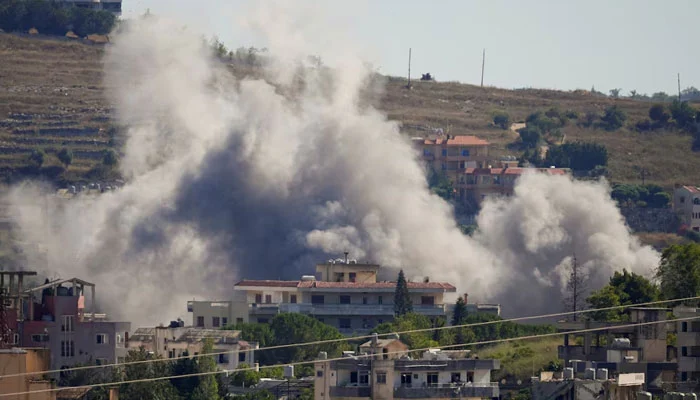
A ceasefire agreement has been reached between Israel and Hezbollah in Lebanon after escalating hostilities threatened to derail broader peace negotiations over Iran. The recent clashes cast doubt on the progress toward a lasting Middle East peace deal. U.S.-Iran negotiations scheduled for Switzerland on Friday were postponed due to renewed fighting, adding uncertainty to the vital discussions about reopening the Strait of Hormuz to international shipping.
President Donald Trump later told NBC News that he had spoken with Israel and encouraged them to accept a ceasefire. He was quoted saying, “Sometimes you just have to calm down and think ahead,” though he didn’t specify whether he had directly contacted Israeli Prime Minister Benjamin Netanyahu.
An American official confirmed that the ceasefire took effect around 4 p.m. Lebanon time (1 p.m. GMT), following exchanges of fire. Negotiators from the U.S. and Qatar, with assistance from Iran, had finalized the agreement. Both Hezbollah and an Israeli official verified the ceasefire to Reuters. The Israeli official noted that as long as Hezbollah refrains from attacking, Israel will not consider it a time of war. Israel intends to maintain its forces in southern Lebanon, where it controls a strip along Israel’s northern border.
Lebanese sources reported that Israel conducted around twelve airstrikes during the initial hour of the ceasefire, with no strikes recorded after 5 p.m. Local tensions remain high, and the conflict could influence upcoming negotiations, particularly since ending the fighting in Lebanon is a prerequisite for a broader U.S.-Iran accord.
Unresolved issues persist despite recent agreements. The memorandum signed by the leaders of Iran and the U.S. grants a 60-day window to reach a comprehensive deal regarding Iran’s nuclear program or to extend the current interim agreements. While negotiations were set to begin in Switzerland’s mountain resort of Buergenstock, Vice President JD Vance canceled his participation, and the talks have been delayed.
Switzerland’s foreign ministry stated that preparations are ongoing and remain willing to facilitate the discussions. Hassan Fadlallah, a Hezbollah lawmaker, indicated that Iran’s stance depends on a comprehensive ceasefire, while Lebanon’s government is advised against direct negotiations with Israel while attacks continue.
The interim deal calls for the U.S., Iran, and their allies to immediately and permanently end military actions on all fronts, including Lebanon. Israel, however, is excluded from this agreement and states it is not a party to the negotiations.
Iran’s Foreign Minister Abbas Araqchi, in a call with Pakistan’s deputy prime minister, warned that the U.S. would bear responsibility for any violations of the deal, including the cessation of hostilities in Lebanon.
The conflict’s origins trace back to March 2, when Hezbollah fired at Israel, prompting Israeli military responses and an incursion into southern Lebanon. Since then, Lebanese authorities report 18 deaths and 33 injuries from recent heavy airstrikes in eleven southern towns. The Israeli military announced four soldiers were killed in an incident in Lebanon but provided no further details. Israel claims its strikes targeted Hezbollah operatives and infrastructure in response to violations by the group.
Lebanese President Joseph Aoun condemned the Israeli attacks but expressed hope that the escalation would not obstruct efforts to establish a comprehensive ceasefire. The ongoing conflict between the U.S. and Israel against Iran, which started with airstrikes on February 28, has resulted in over 7,000 deaths, mainly in Iran and Lebanon, and increased global energy prices, fueling inflation worldwide.
Oil prices have eased since the interim deal was signed, as tankers move through the Strait of Hormuz again — a key choke point that Iran previously blockaded. The Iran-backed body managing the strait announced it would waive fees for its use during the 60-day negotiation period.
The recent agreement also envisions economic relief for Iran, including the unfreezing of billions of dollars in assets and immediate U.S. waivers for its oil exports. Negotiators have 60 days to settle the status of Iran’s nuclear program unless an extension is agreed upon, and to establish a $300 billion reconstruction fund for Iran along with other financial incentives.
Trump reiterated his support for the deal amid criticism from some in Washington, including Republican members of Congress concerned that he may have conceded too much—especially as the U.S. approaches midterm elections in November.