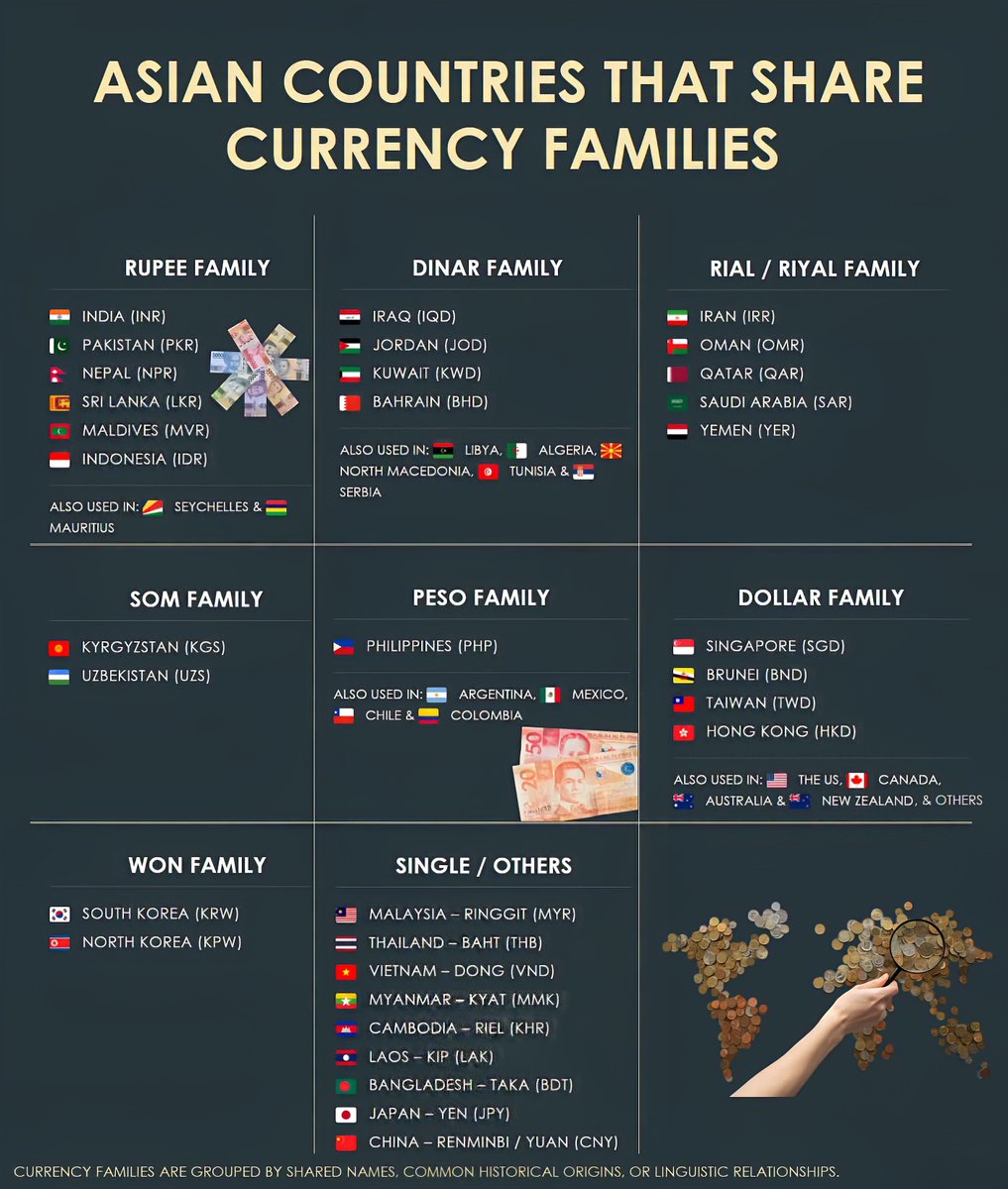
Asian Currencies Classified by Family Types in 2025
Rupee Family Dominates South Asia
The Indian Rupee (INR) continues to serve as the most prominent currency in South Asia, shared by neighboring countries like Pakistan (PKR), Nepal (NPR), and Sri Lanka (LKR). The Maldives (MVR) and Indonesia (IDR) also fall under this currency family, although their currencies have developed separately over the years. The shared nomenclature reflects historical ties rooted in Indian cultural influence, though the currencies’ values differ significantly today.
Dinar Economies in the Middle East
The Dinar is a currency beloved in the Middle East, representing some of the wealthiest economies in the region. Countries such as Iraq (IQD), Jordan (JOD), Kuwait (KWD), and Bahrain (BHD) all share the Dinar family. These nations have leveraged their oil resources to build strong financial reputations, and the Dinar remains a symbol of economic stability in their markets despite fluctuating oil prices. Notably, each country issues its version of the Dinar, and their values are not directly interchangeable.
Rial and Riyal: A Shared Family Across the Gulf
The Rial and Riyal are currencies common across several Gulf Cooperation Council (GCC) countries. Iran (IRR) uses the Rial, whereas Oman (OMR), Qatar (QAR), Saudi Arabia (SAR), and Yemen (YER) utilize the Riyal or Rial variants. These currencies bear similar linguistic roots, with ‘Rial’ or ‘Riyal’ deriving from historical coinage terminology. The Gulf countries’ economies are heavily dependent on oil exports, influencing the stability and valuation of their currencies.
Som: Central Asia’s Stable Currency
Kyrgyzstan (KGS) and Uzbekistan (UZS) share the Som family, serving as India’s neighbors in Central Asia. Although their currencies have experienced significant devaluation over the past decades, efforts to stabilize and modernize the Som continue, aiming to boost regional trade and economic cooperation. Their shared currency family highlights regional ties and historical connections through trade routes like the Silk Road.
Philippine Peso: A Unique Currency in Southeast Asia
The Philippine Peso (PHP) stands as the flagship currency of the Philippines in Southeast Asia. Unlike many neighboring nations, the Peso belongs to its own designated family, reflecting a unique linguistic and historical development distinct from regional trends. The Philippine economy has been evolving, with the Peso gaining strength amid strong remittance flows from overseas Filipino workers.
Dollar Family: The Global Standard
The Dollar family encompasses currencies from Singapore (SGD), Brunei (BND), Taiwan (TWD), and Hong Kong (HKD). These currencies, while sharing a monetary naming convention, exhibit varying degrees of stability and international recognition. The US dollar remains the global benchmark, and these East Asian and Southeast Asian nations have closely linked their monetary policies with dollar pegs to stabilize their economies.
Won Family: Two Koreas, One Currency Lineage
South Korea (KRW) and North Korea (KPW) utilize the Won, with South Korea’s Won being among the most traded currencies globally. The North Korean Won remains tightly controlled by the government. Despite sharing a name, the two currencies are vastly different in value, reflecting the political and economic divide on the Korean Peninsula.
Unique Currencies and Small Families
Several countries, like Malaysia (Ringgit), Thailand (Baht), Vietnam (Dong), Myanmar (Kyat), Cambodia (Riel), and Laos (Kip), each maintain their independent currencies, representing diverse economic landscapes. Japan’s Yen (JPY) and China’s Renminbi or Yuan (CNY) are vital global currencies, though they stand outside the traditional ‘families’ as distinct monetary systems with unique histories.
Note: While these currency groups share names or historical origins, their values are not interchangeable. The currencies’ relationships are rooted more in cultural or linguistic histories rather than economic parity or standardization.
[Image: Currency Family Groupings Displayed on the Map of Asia]