
Select Language:
All Countries Beginning with the Letter “I” Form a Straight Line: A Fascinating Geographical Quirk
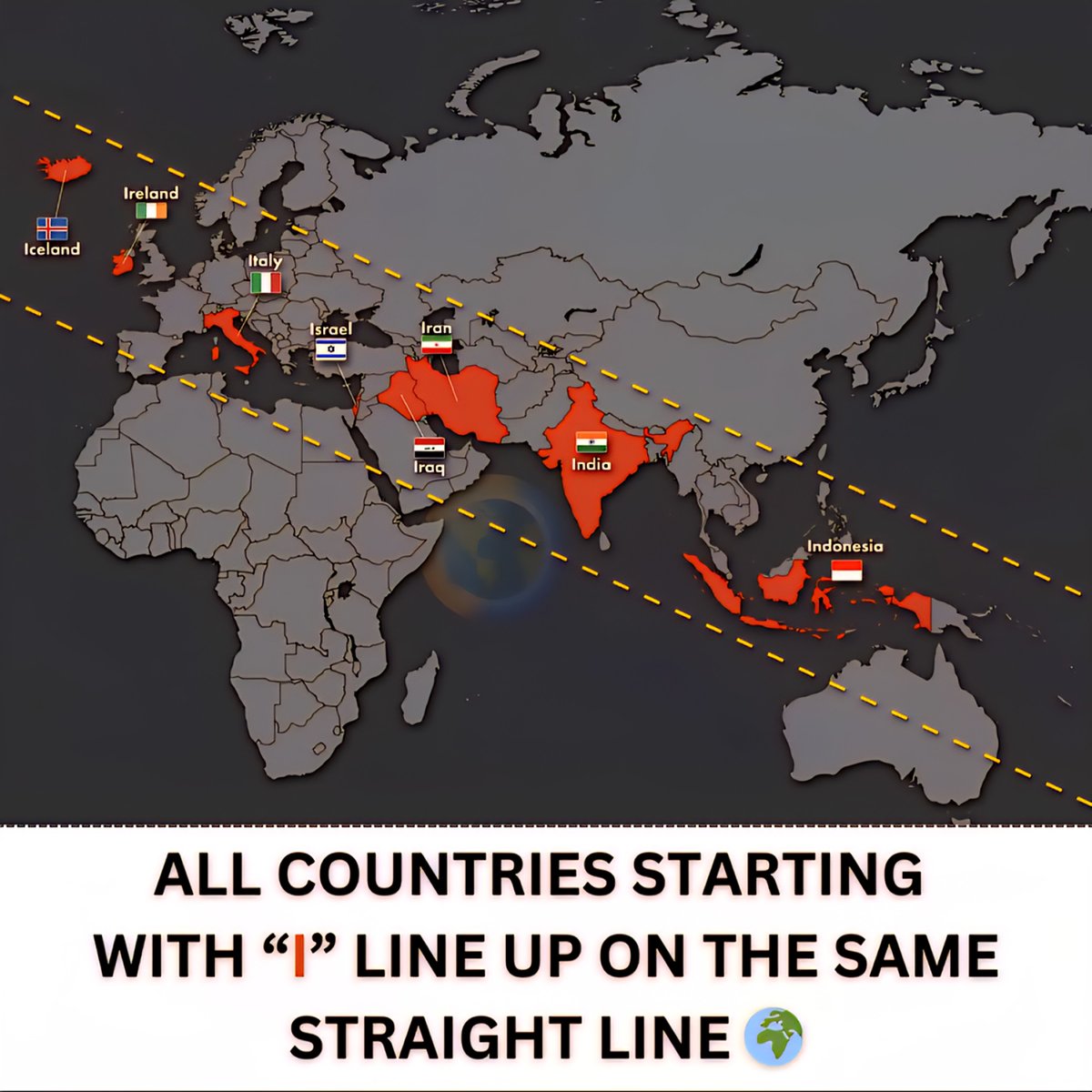
1. The Unique Geographical Pattern of “I” Countries
One of the most intriguing global geographical facts in 2025 is the alignment of all countries starting with the letter “I” in a straight line across the map. These nations — Iceland, India, Indonesia, Iran, Iraq, and Israel — form an almost perfect corridor stretching across multiple continents, from the icy northern reaches of Iceland to the Middle Eastern nations of Iran and Iraq, and down to the diverse islands of Indonesia.
This fascinating pattern sheds light on how diverse yet interconnected these nations are, spanning various climates, cultures, and histories, all surprisingly aligned along a linear north-south path.
2. Iceland: The Northernmost Point in the Line
Positioned at the top of this imaginary line, Iceland is notable for its volcanic landscapes and glaciers. Its location at the edge of the Arctic Circle makes it a nation of stark contrasts—light and darkness, fire and ice. Iceland sets the tone at the northern end of this geographical straight line and is home to rugged natural wonders like geysers, waterfalls, and volcanoes.
3. India and Indonesia: The Massive Subcontinental and Island Nations
Moving southward, India adds a rich tapestry of culture, history, and bustling cities to this line. As the seventh-largest country in the world, India’s influence spans politics, technology, and culture, making it a significant continental player.
Further down, Indonesia’s sprawling archipelago, with thousands of islands, completes this segment of the line. It is the world’s largest island country, oscillating between the Pacific and Indian Oceans. Its position at the line’s southern end emphasizes the incredible diversity of the region — from tropical rainforests to volcanic mountains.
4. Iran and Iraq: The Central Middle Eastern Countries
Further along, Iran and Iraq are key regional players in the Middle East, sharing a rich historical legacy as cradles of ancient civilization. These nations’ positions along this straight line illustrate their geographical proximity and historical connectivity. Iran’s mountainous terrain contrasts with Iraq’s vast desert plains, yet both are integral to regional geopolitics.
5. Israel: The Southern Anchor of the Line
At the southeastern tip of this straight line lies Israel. With its historical and religious significance, Israel occupies a critical position in the Middle East. Despite its small size, it commands global attention, especially due to ongoing regional dynamics.
6. The Significance of the Straight Line Alignment
This geographical quirk isn’t just a visual coincidence; it’s an illustration of how diverse global regions align along a singular north-south axis. It highlights the natural clustering of a mix of island nations, peninsular countries, and continental giants along the same latitude band.
This line also reflects on regional similarities in climate zones, time zones, and even certain cultural overlaps, which can influence trade, migration, and geopolitical relationships.
7. What This Pattern Means for Global Geopolitics
Understanding this line’s significance opens up insights into regional cooperation and challenges. For instance, environmental policies need to tackle issues from icecap melting in Iceland to tropical deforestation in Indonesia and desertification in Iraq and Iran. Moreover, this alignment could serve as a basis for cross-regional initiatives on climate change, security, and technological development.
8. Why Such Geographical Patterns Matter
Geography often shapes politics, culture, and history. Recognizing patterns like the line of “I” countries underscores how natural features and latitude influence human development and relationships. Knowing such facts can inspire future research and policy planning, especially as nations grapple with global challenges in 2025.
In sum, the intriguing straight-line alignment of all countries starting with the letter “I” is a testament to the fascinating quirks of our planet’s geography. It not only sparks curiosity but also fosters a deeper understanding of how diverse nations can be interconnected through natural patterns, despite their differences.
 ChatGPT
 Perplexity
 Gemini AI
 Grok AI