

Select Language:
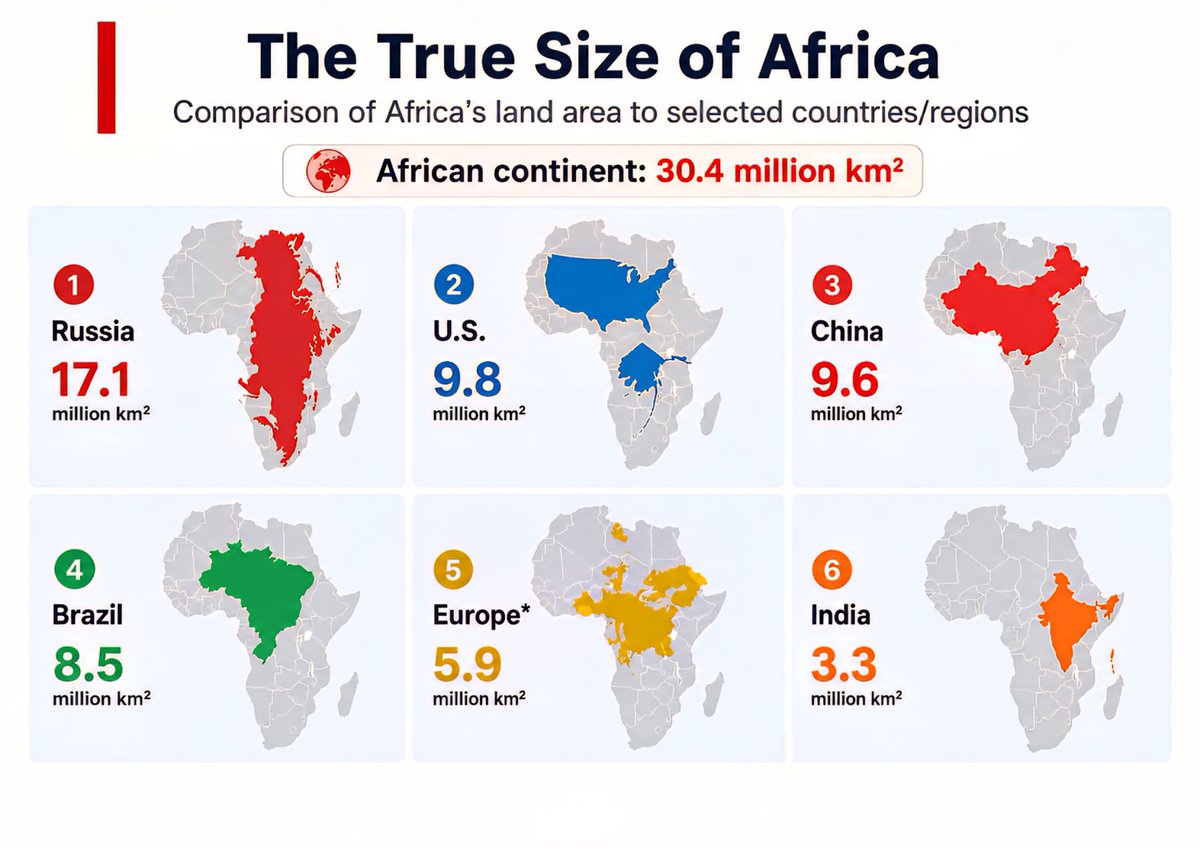
1. Africa’s Land Mass Is Truly Vast—A Size Comparison
Many people don’t realize just how massive Africa is until they see it compared to some of the world’s largest countries and regions. Covering an expansive 30.4 million square kilometers, Africa is a continent of incredible scale and diversity. To put this in perspective, check out how Africa stacks up against some of the most prominent countries and regions in the world.
2. Russia: The Largest Country in the World Is Less Than Half of Africa
Russia, by far the largest country globally, spans approximately 17.1 million square kilometers. Despite its vast territory, it still makes up just over half the size of Africa. This comparison sheds light on Africa’s extraordinary size, as it could host nearly twice Russia in terms of landmass. Russia’s sprawling landscape includes diverse terrains from tundras to mountains, yet Africa’s terrain encompasses landscapes from deserts to lush rainforests, making the continent incredibly diverse geographically.
3. United States and China: Major Global Powers, but Smaller Than Africa
The United States measures around 9.8 million square kilometers, and China covers roughly 9.6 million square kilometers. Both countries are among the largest in the world but combined, they’re still less than two-thirds the size of Africa. This underscores Africa’s unparalleled scale, keeping it ahead of other large nations in terms of land area. While these countries are economic powerhouses with extensive populations, their land mass pales in comparison to Africa’s vast expanse.
4. Brazil and Europe: Slightly Smaller But Equally Impressive
Brazil, the largest country in South America, spans about 8.5 million square kilometers—a hefty size, but still only a third of Africa. Europe’s total land area is approximately 5.9 million square kilometers, which is significant in itself but still only a fraction of Africa’s size. These comparisons highlight how Africa’s reach extends well beyond most individual countries and regions.
5. India: A Major Subcontinent with a Big Footprint
India, often considered a subcontinent due to its size and diversity, covers roughly 3.3 million square kilometers. Even India, with its dense population and rich cultural history, is just a tiny fraction of Africa’s expansive landmass. The continent’s terrain holds everything from deserts like Sahara to expansive rainforests and savannas.
6. The Significance of Africa’s Size and Diversity
While many may underestimate Africa’s physical extent, it’s clear from these comparisons that the continent is a colossal landmass. Its size has historically affected its climate zones, biodiversity, and cultural diversity. From the snowy peaks of Mount Kilimanjaro to the vast Niger River delta and the expansive Serengeti plains, Africa’s diverse landscapes cover an incredible range, all within its enormous boundaries.
7. Visualizing Africa’s Size—Understanding Its Global Role
Understanding Africa’s true size is essential in grasping its global significance. The continent’s sheer size affects everything from economic development potential to environmental conservation. Its strategic geographic position as a bridge between continents also makes it vital in global trade and politics.
8. Wrapping Up
Africa’s size is among the most striking features, symbolizing both the richness of its diverse ecosystems and the vast potential of its nations. As the continent continues to grow in influence on the world stage, recognizing its geographic scale offers a deeper appreciation for its importance and complexity.
Image Source: Twitter
 ChatGPT
 Perplexity
 Gemini AI
 Grok AI