Imagine a robot capable of not only visual perception but also sensing touch sensations. Researchers have developed a revolutionary material that shifts color when pressed, enabling robots to detect touch in a more straightforward and intelligent way.
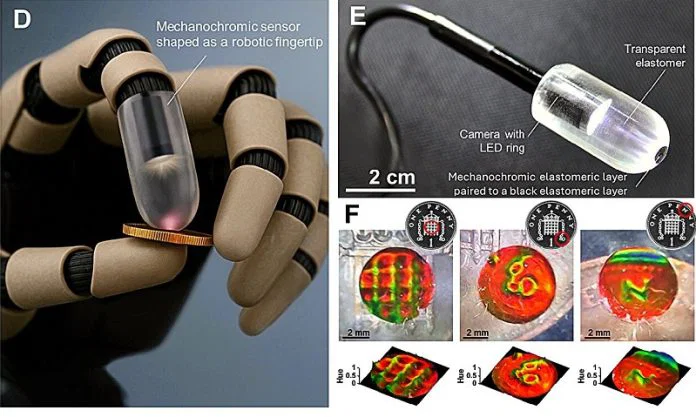
Scientists at Queen Mary University of London have engineered a new tactile sensor that transforms applied pressure into vibrant, changing color patterns.
Published in Science Advances, this research could enhance robotic applications in manufacturing, healthcare, and even artificial limbs.
Touch is more complex than it appears. Every time you flip a light switch or grasp a cup, thousands of tiny sensory receptors in your skin transmit information to your brain. Your hand alone contains over 10,000 touch receptors, allowing you to feel pressure, texture, and movement with incredible precision. Replicating this level of sensitive touch in robots has been a significant challenge for engineers.
Most existing robotic touch sensors rely on numerous miniature electronic sensors, which tend to be costly, intricate, and slow. These systems require complex data processing, delaying the robot’s response to touch.
This new approach takes an entirely different path. Instead of filling sensors with electronics, the sensing capability is embedded directly into the material itself. When the surface is pressed, it alters color in specific areas depending on the amount of pressure.
A simple, affordable USB camera observes these color changes and quickly generates detailed maps of the touch location and intensity. Because the tactile information is stored visually in the pattern of colors, the computer doesn’t need to perform extensive calculations to interpret the data. This results in faster, more detailed responses.
Lead researcher Giacomo Sasso explained that the team was especially thrilled that the material could even detect the fine ridges of fingerprints. According to the scientists, no current technology provides such high-resolution detail while remaining simple and cost-effective.
This innovative sensor could have numerous practical applications. In factories, robots could assemble small, delicate electronic components with gentle, precise force. In medicine, robotic surgical systems might detect subtle differences between healthy and diseased tissues by sensing minute variations in pressure.
Additionally, this technology could significantly improve prosthetic limbs, offering users a much richer sense of touch. This enhancement would make everyday tasks like handling fragile objects or using tools safer and easier.
The research involved collaboration between scientists from the UK and Italy, integrating advances in soft robotics, flexible materials, and sensor technology.
While further development is necessary before widespread adoption, this color-changing material points toward exciting future possibilities in robotics. Instead of relying solely on complex calculations, the material visually demonstrates what is being felt, bringing robotic touch closer to the natural abilities of the human hand—faster, simpler, and remarkably intuitive.