الوسم: Touch

  • Tiny Brain Signals Could Restore Touch Sensation

    Tiny Brain Signals Could Restore Touch Sensation

    Losing the sense of touch can significantly impact daily life. Individuals with spinal cord injuries might no longer feel their hands, even though they are still there. Without tactile feedback, simple activities like holding a cup, buttoning a shirt, or handling delicate objects become much more challenging because the brain no longer receives signals about pressure or contact.

    Researchers have dedicated years to finding ways to restore this vital sense. Recent studies indicate that one promising technology may be safe for long-term use. Dr. Michael Smith and colleagues from the University of Pittsburgh and the University of Chicago have shared positive results from over a decade of research on a specialized brain-computer interface.

    Their findings, published in Science Translational Medicine, focus on intracortical microstimulation—tiny electrical pulses delivered directly into the brain regions responsible for touch. Brain-computer interfaces (BCIs) are devices that create a direct link between the brain and external machinery, drawing global attention for their potential to help individuals who have lost movement, speech, hearing, or vision.

    Some BCIs enable paralysis patients to control computers or robotic limbs purely via thought, while others aim to restore sensory perceptions by precisely stimulating brain areas. A major concern has always been safety—how well electrodes stay functional over years, whether stimulation causes adverse effects, and if the brain continues to respond normally over time.

    To explore these questions, the team studied five individuals living with spinal injuries. Over a combined total of 27 years, these participants received approximately 168 million electrical pulses through implanted electrodes. According to the researchers, this represents the longest human safety study of intracortical microstimulation to date.

    This research builds on earlier breakthroughs. In 2012, the Pittsburgh team enabled a paralyzed person to operate a robotic arm using implanted brain signals. Later, they added artificial touch via sensory cortex stimulation, allowing participants to feel sensations while manipulating the robotic limb. The University of Chicago expanded on this work with their own participants.

    The new findings reveal that the stimulation remained highly stable over time. When electrical pulses were delivered to the part of the brain representing the hand, participants uniformly experienced sensations in their hands, rather than other body parts. These sensations remained consistently localized even after many years.

    The study also looked for adverse effects. Persistent sensations after stimulation were exceedingly rare, occurring only approximately once every 23,000 sessions. Most sensations faded within seconds, did not cause pain, and did not require medical intervention. While some electrodes gradually became less sensitive, many continued functioning for years. Even after ten years, one participant still had about 60% of the electrodes active.

    These results suggest that long-term brain stimulation could become a viable option for future medical devices beyond research settings. Such systems might eventually allow people with paralysis to control assistive devices and experience touch naturally. Additionally, the safety evidence could accelerate similar approaches for restoring hearing and vision by stimulating other parts of the brain—a crucial step toward wider application.

    Although these findings are promising, further research is essential. The study involved only five participants, so larger trials are necessary to confirm the safety and efficacy of long-term intracortical stimulation. Researchers continue to work on making the artificial touch feel more natural, simplifying device configurations, and enhancing durability over time.

    For those interested in Parkinson’s disease, recent studies suggest that vitamin B may slow cognitive decline, and a Mediterranean diet could reduce Parkinson’s risk. Other research indicates that blueberry supplements might help prevent cognitive deterioration, and plant-based diets could safeguard brain health from air pollution.

    Source: University of Pittsburgh.
  • Scientists develop color-changing robot skin that senses sight and touch

    Scientists develop color-changing robot skin that senses sight and touch

    Imagine a robot capable of not only visual perception but also sensing touch sensations. Researchers have developed a revolutionary material that shifts color when pressed, enabling robots to detect touch in a more straightforward and intelligent way.

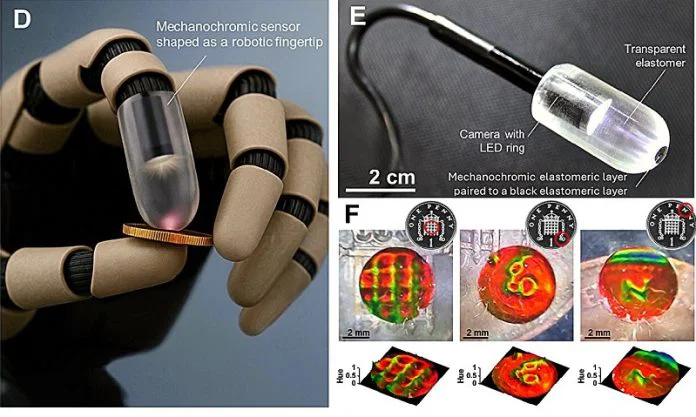
    Scientists at Queen Mary University of London have engineered a new tactile sensor that transforms applied pressure into vibrant, changing color patterns.

    Published in Science Advances, this research could enhance robotic applications in manufacturing, healthcare, and even artificial limbs.

    Touch is more complex than it appears. Every time you flip a light switch or grasp a cup, thousands of tiny sensory receptors in your skin transmit information to your brain. Your hand alone contains over 10,000 touch receptors, allowing you to feel pressure, texture, and movement with incredible precision. Replicating this level of sensitive touch in robots has been a significant challenge for engineers.

    Most existing robotic touch sensors rely on numerous miniature electronic sensors, which tend to be costly, intricate, and slow. These systems require complex data processing, delaying the robot’s response to touch.

    This new approach takes an entirely different path. Instead of filling sensors with electronics, the sensing capability is embedded directly into the material itself. When the surface is pressed, it alters color in specific areas depending on the amount of pressure.

    A simple, affordable USB camera observes these color changes and quickly generates detailed maps of the touch location and intensity. Because the tactile information is stored visually in the pattern of colors, the computer doesn’t need to perform extensive calculations to interpret the data. This results in faster, more detailed responses.

    Lead researcher Giacomo Sasso explained that the team was especially thrilled that the material could even detect the fine ridges of fingerprints. According to the scientists, no current technology provides such high-resolution detail while remaining simple and cost-effective.

    This innovative sensor could have numerous practical applications. In factories, robots could assemble small, delicate electronic components with gentle, precise force. In medicine, robotic surgical systems might detect subtle differences between healthy and diseased tissues by sensing minute variations in pressure.

    Additionally, this technology could significantly improve prosthetic limbs, offering users a much richer sense of touch. This enhancement would make everyday tasks like handling fragile objects or using tools safer and easier.

    The research involved collaboration between scientists from the UK and Italy, integrating advances in soft robotics, flexible materials, and sensor technology.

    While further development is necessary before widespread adoption, this color-changing material points toward exciting future possibilities in robotics. Instead of relying solely on complex calculations, the material visually demonstrates what is being felt, bringing robotic touch closer to the natural abilities of the human hand—faster, simpler, and remarkably intuitive.

  • How To Achieve the Putrid Touch and Solve Skevald in Crimson Desert

    How To Achieve the Putrid Touch and Solve Skevald in Crimson Desert

    When exploring Crimson Desert, you’ll find a wide variety of items, weapons, and consumables to gather. From simple decorations for your home to powerful swords that significantly increase your strength, it’s always worth taking detours from the main path to discover hidden treasures.

    One notable item is the Putrid Touch Abyss Gear, which is a strong modifier for players who prefer fighting with their fists. Obtaining this gear isn’t easy, as it’s not just lying around. Here’s how to get the Putrid Touch and defeat Skevald, the Carrion King.

    Start the Sovereign Wastes quest by heading northeast to the large city south of Tashkalp on your map. Once there, go to the southern part of the city near the big arena champion statue. Look for a bounty notice pinned to a pole near the stockade where prisoners are held. Read the notice to learn that a group of hyenas led by Skevald, the Carrion King, is causing trouble for the locals. This begins the Sovereign Wastes quest, which involves tracking down and defeating Skevald.

    To find Skevald, follow the trail of dead, partially eaten animals marked on your map. Use your lantern to reveal a yellow line showing the direction the pack of hyenas has taken. Continue following this trail with your lantern until you see a large group of hyenas accompanying Skevald.

    Entering the fight head-on will trigger all the hyenas and Skevald to attack you simultaneously, making the battle much more difficult. Instead, shoot a few of the hyenas from a safe distance with an arrow. This should initiate a fight with only a small group of hyenas, which is easier to handle. Clear out these enemies, then repeat the process to lure more hyenas away from Skevald. Be careful to keep the fights away from Skevald himself so you don’t draw his attention prematurely.

    Once most of the hyenas are defeated, focus on Skevald. Start by eliminating the regular hyenas, as their dash attack can stun you if repeated multiple times. Use area-of-effect moves to take out the surrounding hyenas before concentrating on Skevald. When Skevald is alone, keep your distance and use fire attacks if available, since he seems to be vulnerable to fire. Applying fire by imbueing your Turning Slash with flame using the Volcanic Eruption Abyss Gear will cause Skevald to writhe on the ground, making him an easy target.

    Skevald’s attack moves include slashing with his claws, lunging to bite, releasing poisonous clouds, and a loud screech that stuns. He can also lunge and bite repeatedly while on the ground, which can deal heavy damage. Watch for him rearing up on his hind legs—this signals he’s about to perform an AoE screech attack. Moving away at this moment will help you avoid taking damage. Stay out of the poison clouds he leaves behind and be mindful of your health, bringing plenty of food to heal during the fight.

    As your damage to Skevald reduces his health, he will vanish in a cloud of poison. Don’t worry—this isn’t a bug. After he disappears, use your lantern again and follow the yellow trail to find him once more. His second phase doesn’t involve new attacks, but his behavior becomes more aggressive, especially with frontal claw swings. Staying close to him allows you to dodge his attacks more easily and attack safely.

    When you defeat Skevald, you receive the Putrid Touch Abyss Gear, which you can equip to your armor. It applies the same poison effect Skevald uses whenever you perform a Lariat attack. Be sure to return to town and speak with the guard, as you’ll also earn a cool hyena-themed helmet for your efforts.

  • How to Complete Meridian Touch and Solve Secrets in Where Winds Meet

    How to Complete Meridian Touch and Solve Secrets in Where Winds Meet

    Unlocking the Meridian Touch skill in Where Winds Meet is an important step for players looking to improve their combat and healing abilities. This powerful technique allows you to immobilize enemies and solve various puzzles on the map.

    Once you learn it, your character can use Meridian Touch both during fights and outside of combat to influence the environment, help allies, or hinder foes. It’s especially useful in battles to drain an enemy’s Qi gauge. The game also rewards you just for learning this skill. Here’s how to complete the side quest to unlock Meridian Touch.

    How To Unlock Meridian Touch

    The Meridian Touch side quest begins when you travel to the Stonewash Strand boundary stone. As soon as you arrive, look for stone figures nearby. Once you see them, you’re in the right spot. Further into the area, across a small body of water, you’ll find a man standing very still — almost like a statue.

    This is Yan Qiren, who will serve as the quest giver. When you get close enough, an interaction prompt will appear. Speaking with him starts a conversation about Qiren’s son.

    After the chat, Yan Qiren agrees to teach you the secret art of Meridian Touch. Follow the prompts to focus on him, then choose from three options: Immobilized, Overjoyed, and Itchy.

    The Touch Options

    Once you select ‘Immobilized’, Yan Qiren will be freed from his condition. He then realizes you are not his son after all. Meridian Touch is an acupoint technique that you can apply to enemies or people with health issues, such as Yan Qiren. It can also be used for puzzles or other tasks while exploring.

    Practice the Skill

    To practice Meridian Touch, you can revisit Yan Qiren each day. He will be in a different still position every time you return. Repeat the interaction and select ‘Immobilized’ to continue practicing.

  • Disarm Your ADT Security System With Yale Assure Lock 2 Touch

    Disarm Your ADT Security System With Yale Assure Lock 2 Touch

    ADT is known for providing some of the most trusted security systems available. Additionally, it has made significant strides in the smart home sector with a diverse range of Google Home devices. The newest collaboration introduces the Yale Assure Lock 2 Touch Z-Wave 800 Series. This innovative smart lock uniquely features fingerprint control through Z-Wave technology, enabling users to disarm their entire security system using just their fingerprint.

    Designed specifically to work seamlessly with the ADT+ base station, the Yale Assure Lock 2 Touch simplifies security management. Users can control their security system directly from the lock, eliminating the need to enter codes on a keypad. The advanced fingerprint scanner allows for both arming and disarming the system, as well as locking and unlocking the front door. As the only smart lock on the market with this feature, it presents an exciting option for ADT+ members.

    While compatibility with the ADT+ security system is certainly appealing, the smart lock boasts several additional features:

    – Custom code creation for guests and visitors
    – Auto Lock and Unlock functionality
    – Remote access via the ADT+ app
    – Traditional key access
    – A six-month battery lifespan

    The Yale Assure Lock 2 Touch has been engineered with an enhanced communication range, ensuring it can interact effectively with devices positioned far from the front entrance. We are fond of all products in the Assure Lock 2 lineup, and this latest addition appears to be a notable enhancement. Our initial review of the Yale Assure Lock 2 praised it as “smarter than your average smart lock,” and it seems that this collaboration with ADT further validates that claim.

    The Yale Assure Lock 2 Touch Z-Wave 800 Series is priced at $280.