الوسم: sensors

  • Self-Healing Waterproof Electronic Skin Enhances Dive and Robotics Safety

    Self-Healing Waterproof Electronic Skin Enhances Dive and Robotics Safety

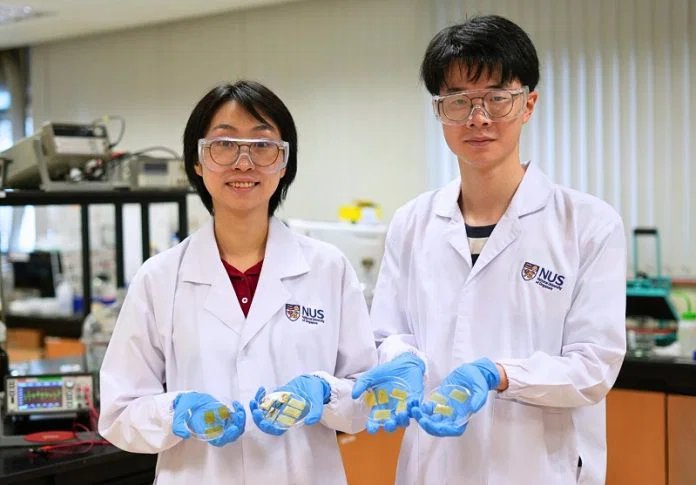
    Scientists at the National University of Singapore (NUS) have created a new type of electronic skin capable of sensing touch, detecting damage, and healing itself underwater. This breakthrough could significantly enhance the durability and reliability of underwater robots, diving gear, and wearable tech operating in difficult environments.

    Led by Assistant Professor Tan Yu Jun from the NUS College of Design and Engineering, the research was documented in the journal Advanced Materials.

    Handling electronics in underwater settings presents unique challenges. Sensors used by divers and robotic submersibles are vulnerable to damage from sharp rocks, shells, and other hazards. When these sensors suffer damage, they typically cease functioning and need repairs, often requiring removal to land-based facilities. Additionally, they usually depend on batteries or external power sources, which can be limiting underwater.

    The innovative system, dubbed the self-healing magnetoelectric sensory system (SMES), addresses multiple issues simultaneously. It can sense touch and nearby objects without external power and recognize when it’s been damaged, initiating automatic repairs. Modeled after human skin—which perceives touch, pain, and heals injuries—this electronic skin reacts when punctured or cut. It consists of a flexible, rubber-like material embedded with tiny liquid-metal conductors. Damage causes a rapid change in electrical resistance, signaling issues instantly.

    This material has a self-healing ability. Small damages, like needle punctures, can recover their original electrical properties in seconds without external assistance. Larger cuts take longer to mend; however, pressing the damaged surfaces together starts the healing process, and given enough time, the device restores its strength and sensing capabilities. The system performs especially well underwater, where many self-healing materials fail; tests demonstrated near-complete recovery of performance even after underwater healing.

    An impressive feature of the sensor is that it powers itself. It works through electromagnetic induction—the same principle behind electric generators. A small magnet inside moves past a coil of liquid-metal wire during touch or approach, generating a tiny electrical signal. This allows the sensor to detect pressure and nearby objects without batteries.

    The system is both fast and durable. It responds to touch in approximately 41 milliseconds and can be used over 10,000 times without loss of function. Even after 10 days submerged— including in simulated seawater—the sensing performance remained intact.

    To showcase its practical applications, the researchers developed a smart diving glove equipped with this electronic skin. Different hand gestures produced distinct electrical signals transmitted wirelessly to a smartphone, enabling commands like “Going up,” “Going down,” “Holding,” and “Help.” The glove also had warning lights to alert the user if it sustained serious damage.

    Additionally, a robotic hand fitted with the sensors was tested underwater. The robot successfully grasped objects and detected punctures from sharp shells, recovering from the damage during operation.

    The team envisions this technology being integrated into underwater robots, prosthetic limbs, wearable electronics, and other soft robots capable of sensing damage and self-repair. Such advancements promise to make these devices safer, more durable, and better suited for complex, challenging environments.
  • Scientists develop color-changing robot skin that senses sight and touch

    Scientists develop color-changing robot skin that senses sight and touch

    Imagine a robot capable of not only visual perception but also sensing touch sensations. Researchers have developed a revolutionary material that shifts color when pressed, enabling robots to detect touch in a more straightforward and intelligent way.

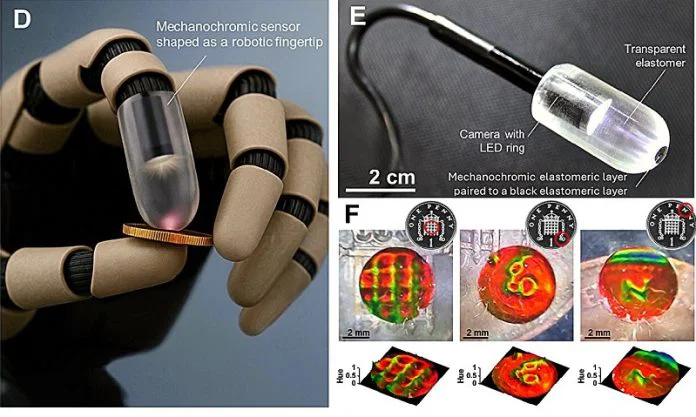
    Scientists at Queen Mary University of London have engineered a new tactile sensor that transforms applied pressure into vibrant, changing color patterns.

    Published in Science Advances, this research could enhance robotic applications in manufacturing, healthcare, and even artificial limbs.

    Touch is more complex than it appears. Every time you flip a light switch or grasp a cup, thousands of tiny sensory receptors in your skin transmit information to your brain. Your hand alone contains over 10,000 touch receptors, allowing you to feel pressure, texture, and movement with incredible precision. Replicating this level of sensitive touch in robots has been a significant challenge for engineers.

    Most existing robotic touch sensors rely on numerous miniature electronic sensors, which tend to be costly, intricate, and slow. These systems require complex data processing, delaying the robot’s response to touch.

    This new approach takes an entirely different path. Instead of filling sensors with electronics, the sensing capability is embedded directly into the material itself. When the surface is pressed, it alters color in specific areas depending on the amount of pressure.

    A simple, affordable USB camera observes these color changes and quickly generates detailed maps of the touch location and intensity. Because the tactile information is stored visually in the pattern of colors, the computer doesn’t need to perform extensive calculations to interpret the data. This results in faster, more detailed responses.

    Lead researcher Giacomo Sasso explained that the team was especially thrilled that the material could even detect the fine ridges of fingerprints. According to the scientists, no current technology provides such high-resolution detail while remaining simple and cost-effective.

    This innovative sensor could have numerous practical applications. In factories, robots could assemble small, delicate electronic components with gentle, precise force. In medicine, robotic surgical systems might detect subtle differences between healthy and diseased tissues by sensing minute variations in pressure.

    Additionally, this technology could significantly improve prosthetic limbs, offering users a much richer sense of touch. This enhancement would make everyday tasks like handling fragile objects or using tools safer and easier.

    The research involved collaboration between scientists from the UK and Italy, integrating advances in soft robotics, flexible materials, and sensor technology.

    While further development is necessary before widespread adoption, this color-changing material points toward exciting future possibilities in robotics. Instead of relying solely on complex calculations, the material visually demonstrates what is being felt, bringing robotic touch closer to the natural abilities of the human hand—faster, simpler, and remarkably intuitive.

  • Top Locations for Completing Sensors in Arc Raiders

    Top Locations for Completing Sensors in Arc Raiders

    If you want to finish the Expedition Project in Arc Raiders before the December deadline, you’ll need to gather at least 20 Sensors to complete the third step. Luckily, Sensors are easier to find compared to some other materials if you know where to look and what to recycle.

    Here’s what you need to know about finding Sensors and what items you can recycle to make them if you’re in a hurry. Remember, you need 20 Sensors, so start saving them early!

    Where To Find Sensors

    Sensors are classified as Security and Technological materials. You’re most likely to find them in places marked with a chevron or microchip icon. Not all these locations are equal, so check out these top spots for farming Sensors:

    • Pilgrim’s Peak in The Blue Gate
    • Control Tower in Dam Battlegrounds
    • Basement of the Arrival Building and Launch Tower in Spaceport

    Pilgrim’s Peak in The Blue Gate is my favorite spot to hunt Sensors. The basement has many breachable server towers, which almost always contain Sensors as loot. Located in the northeast corner of The Blue Gate, this area is more isolated and safer to loot compared to other locations. If you need Sensors quickly, this is the best place to start.

    The Launch Tower at Spaceport is a close second. It’s located in the center of the map. The tower’s two rooms have several servers and machines you can loot, which are likely to drop Sensors, especially during Night Raids when this location becomes especially profitable.

    In Spaceport, the basement of the Arrival Building also contains many servers. This spot is good if you’re looking for Sensors, but since it’s only one room, it’s best to go there solo so you can check all the servers yourself without sharing.

    Finally, the Control Tower in Dam Battlegrounds has a lot of potential for Sensors but is last on the list because it’s a hot spot for player-versus-player combat. If PvP doesn’t bother you, this location offers multiple spots on the second floor that are great for looting Sensors. It’s also connected to areas with many electronic containers, like Research and Administration, which are full of loot.

    How To Buy and Recycle for Sensors

    You can purchase Sensors from Celeste if you have enough Seeds. They cost 10 Seeds each, and you can buy up to 5 per day. This is a good way to quickly accumulate Sensors if your runs aren’t yielding enough.

    To make Sensors from recycled items, you can dismantle the following:

    • Broken Handheld Radio
    • Radio
    • Radio Relay
    • Remote Control
    • Spectrometer
    • Spectrum Analysis
    • Thermostat

    Always recycle items instead of scavenging them during raids whenever possible. Recycling net you Sensors and make good use of junk you find along the way. Since all the listed items are currently useless for other purposes, recycling is the best option for obtaining Sensors efficiently.

    Note that Sensors cannot be crafted directly, but buying, recycling, and looting will easily allow you to gather the 20 Sensors needed for the project with little trouble.