الوسم: prosthetics

  • Scientists develop color-changing robot skin that senses sight and touch

    Scientists develop color-changing robot skin that senses sight and touch

    Imagine a robot capable of not only visual perception but also sensing touch sensations. Researchers have developed a revolutionary material that shifts color when pressed, enabling robots to detect touch in a more straightforward and intelligent way.

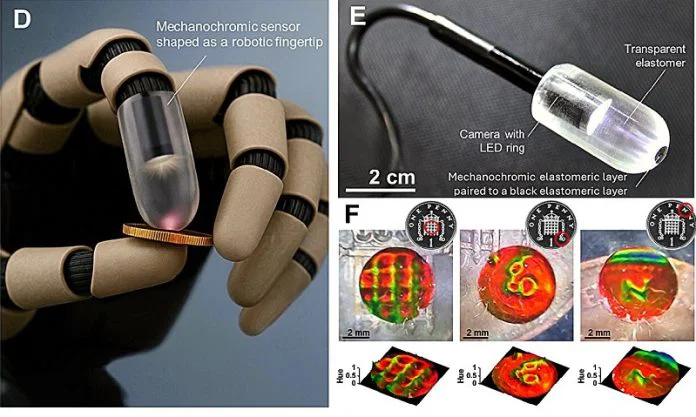
    Scientists at Queen Mary University of London have engineered a new tactile sensor that transforms applied pressure into vibrant, changing color patterns.

    Published in Science Advances, this research could enhance robotic applications in manufacturing, healthcare, and even artificial limbs.

    Touch is more complex than it appears. Every time you flip a light switch or grasp a cup, thousands of tiny sensory receptors in your skin transmit information to your brain. Your hand alone contains over 10,000 touch receptors, allowing you to feel pressure, texture, and movement with incredible precision. Replicating this level of sensitive touch in robots has been a significant challenge for engineers.

    Most existing robotic touch sensors rely on numerous miniature electronic sensors, which tend to be costly, intricate, and slow. These systems require complex data processing, delaying the robot’s response to touch.

    This new approach takes an entirely different path. Instead of filling sensors with electronics, the sensing capability is embedded directly into the material itself. When the surface is pressed, it alters color in specific areas depending on the amount of pressure.

    A simple, affordable USB camera observes these color changes and quickly generates detailed maps of the touch location and intensity. Because the tactile information is stored visually in the pattern of colors, the computer doesn’t need to perform extensive calculations to interpret the data. This results in faster, more detailed responses.

    Lead researcher Giacomo Sasso explained that the team was especially thrilled that the material could even detect the fine ridges of fingerprints. According to the scientists, no current technology provides such high-resolution detail while remaining simple and cost-effective.

    This innovative sensor could have numerous practical applications. In factories, robots could assemble small, delicate electronic components with gentle, precise force. In medicine, robotic surgical systems might detect subtle differences between healthy and diseased tissues by sensing minute variations in pressure.

    Additionally, this technology could significantly improve prosthetic limbs, offering users a much richer sense of touch. This enhancement would make everyday tasks like handling fragile objects or using tools safer and easier.

    The research involved collaboration between scientists from the UK and Italy, integrating advances in soft robotics, flexible materials, and sensor technology.

    While further development is necessary before widespread adoption, this color-changing material points toward exciting future possibilities in robotics. Instead of relying solely on complex calculations, the material visually demonstrates what is being felt, bringing robotic touch closer to the natural abilities of the human hand—faster, simpler, and remarkably intuitive.

  • Simple Color Cues Accelerate Prosthetic Limb Control

    Simple Color Cues Accelerate Prosthetic Limb Control

    Using a robotic arm or prosthetic hand might seem simple, but it actually requires very precise control. Even basic tasks, like picking up an egg, need the right amount of force. Applying too little pressure causes the egg to slip, while too much pressure shatters it.

    For individuals using prosthetic devices or recovering from a stroke, achieving this fine motor control can be especially challenging. One major reason is that they often receive less sensory feedback than when using natural limbs. They may not fully perceive the amount of force they’re applying or how their movements are changing in real time.

    Researchers have been working on solutions for years. Some approaches involve vibrations, sounds, or visual cues to substitute for lost sensations. While these methods can be helpful, they typically require additional equipment and still fall short of replicating the feeling of natural touch.

    Recently, scientists at the Swiss Federal Institute of Technology Lausanne (EPFL) tested a much simpler idea. Instead of trying to recreate missing sensations, they explored whether providing immediate feedback about success during movement could help the brain learn more effectively.

    They conducted five studies with 106 participants, including 18 with chronic stroke. In these experiments, participants followed a moving target on a screen for seven seconds, controlling a cursor by either squeezing a force sensor or contracting their biceps.

    During the task, the target’s color shifted continuously based on performance: green meant they were doing well, while red indicated poor control. The system adjusted in real time to keep the feedback meaningful, ensuring the challenge remained appropriate. In some control tests, the colors changed randomly, and participants were told to ignore them.

    The results were impressive. Just under 20 training sessions with the color feedback led to immediate improvements in motor control. Even after removing the color cues, participants continued to perform better.

    The system proved especially effective when other forms of feedback were limited. For example, when participants could only see the cursor one-third of the time, the benefits of the color feedback were about three times more significant than when they had full visibility.

    Similar improvements were observed in tasks involving muscle-controlled interfaces. The less realistic touch feedback participants experienced, the more they relied on the color cues.

    Stroke patients also showed progress when visual feedback was restricted, but their gains didn’t last once training stopped. The researchers suggest this could be due to the relatively short training period or the impact of brain injuries on forming motor memories.

    The studies also found that individuals more naturally responsive to rewards tended to benefit more from this approach. This indicates that, in the future, it might be possible to predict which patients will respond best to this type of training.

    The scientists believe this simple method could be integrated into many existing prosthetic, rehabilitation, and human-machine systems. By leveraging the brain’s innate ability to learn from rewards, a straightforward color change could help users regain control of prosthetics more quickly, easily, and at a lower cost.

  • Gaza War Amputees Struggle for Prostheses Due to Israeli Limits

    Gaza War Amputees Struggle for Prostheses Due to Israeli Limits

    Fourteen-year-old Fadel Al-Naji, once an avid soccer player, now mostly stays at home in Gaza City after both his legs were amputated in an Israeli drone strike last September. He sits quietly on a sofa, one empty pant leg hanging loose, the other tucked into his waist, next to his 11-year-old brother Amir, who lost an eye in the same attack.

    His mother, Najwa Al-Naji, shares old videos on her phone of Fadel juggling a ball, describing him as increasingly withdrawn and isolated. She hopes prosthetic limbs can be fitted for him, but supplies are scarce in Gaza, where nearly 5,000 amputees, including many children like Fadel, struggle due to Israeli restrictions on essential materials like plaster of Paris.

    Israeli rules, citing security reasons, limit imports of many construction and medical items, affecting access to prosthetic components. Although plaster of Paris isn’t explicitly listed as a dual-use item, other plastic parts needed for prosthetics are restricted, leaving aid organizations and medical centers with limited supplies and outdated equipment.

    Gaza’s amputee population, already substantial before the conflict, now has a higher per capita rate than Cambodia—long notorious for landmine-related amputations—according to aid group Humanity & Inclusion. In response, medical centers have resorted to reusing old prosthetics from war casualties or crafting makeshift limbs from plastic piping and wood, which carry risks of infection or further injury.

    The promised aid under the October ceasefire and the U.S. Trump administration’s plan to provide full assistance with minimal interference remain unfulfilled. The reopening of the Rafah border crossing to Egypt, crucial for evacuations and supplies, has been inconsistent. Israel continues to restrict items it deems dual-use, including construction materials, while claiming to allow medical supplies to enter Gaza.

    The Israeli military agency COGAT states it facilitates medical equipment imports but blocks materials that could aid Hamas’s military build-up. Meanwhile, organizations like the International Red Cross report that plaster supplies are nearly exhausted, with only minimal stock left for the coming months, leaving prosthetic manufacturing severely limited. Local hospitals have run out of supplies altogether, capable only of maintaining existing prosthetics.

    Since early 2025, Humanity & Inclusion has managed to fit just 118 temporary prostheses in Gaza, with dwindling supplies from their last shipment in December 2024. The lack of proper limbs hampers recovery, prolongs trauma, and increases the risk of additional injuries from ongoing Israeli strikes, which have resulted in over 750 Palestinian deaths since the ceasefire.

    Some amputees are on waiting lists, awaiting surgeries like stump revisions or the fitting of prosthetic limbs. Hazem Foura, a 40-year-old ex-office worker, lost his left leg above the knee in a December 2024 bombing that he says was an Israeli attack on his home. Now unable to work, he pleads, “I’m not asking for luxury items—just a limb so I can regain my humanity.”

    Without access to proper prostheses, amputees face not only physical and emotional setbacks but also heightened vulnerability amidst continuing hostilities. Only a handful of prosthetists remain in Gaza, and for children who need frequent adjustments as they grow, the lack of specialized care compounds their suffering.

    Heba Bashir, a technician with Humanity & Inclusion, explains, “Losing a limb isn’t just about the physical loss; it’s about losing hope and independence. For children, it means losing the future they deserve.”