
Select Language:
Engineers have developed an extraordinary new robot capable of swimming underwater and then flapping its wings to take flight, mimicking some of the most skilled diving birds in nature. This innovative device could pave the way for safer, more cost-effective ocean research in the future.
Constructed by researchers from the Massachusetts Institute of Technology (MIT) and the Swiss Federal Institute of Technology Lausanne (EPFL), the robot’s capabilities were detailed in the journal Science. Its design draws inspiration from birds like puffins, loons, gulls, and petrels—creatures that excel in both flying and diving. These birds effortlessly switch between soaring through the air and diving beneath the water to hunt for fish, then quickly returning to flight.
Scientists aimed to unravel how these birds smoothly transition between such contrasting environments. Air is lightweight, whereas water is approximately 1,000 times denser. Achieving efficient movement in both mediums typically requires very different body mechanics.
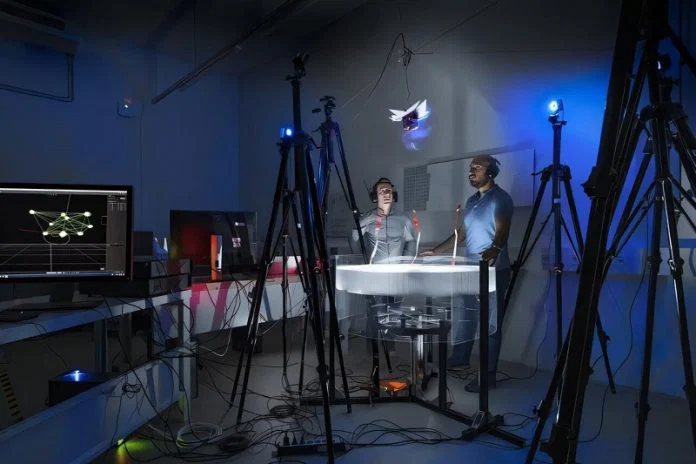
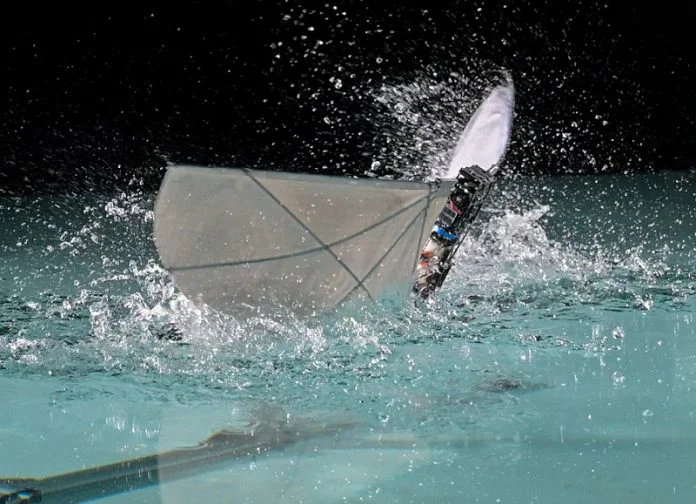
To explore this phenomenon, the team created a lightweight robot, weighing less than 300 grams—roughly the size of a small apple. It features a body, two flexible wings capable of up-and-down flapping, and a movable tail to steer its direction. Powered by a compact, waterproof electric motor and battery, the robot’s wings are coated with a water-repellent material that enables water to rapidly shed after surfacing. Additionally, the wings are interchangeable, allowing researchers to experiment with different sizes to find the most effective design.
The team tested the robot initially in a lab water tank, then in Lake Geneva, Switzerland. During each trial, they submerged the robot about half a meter underwater. They adjusted wing size, flapping speed, and tail angle to observe how well it could swim upward, break the water’s surface, and then continue flying.
After extensive testing, the researchers discovered that medium-sized wings delivered optimal performance. The wings needed a delicate balance of flexibility and stiffness; wings that were too soft failed to generate enough lift in the air, while overly stiff wings didn’t move efficiently underwater.
While flapping at about five times per second, the robot swam nearly one meter each second. Once airborne, it flew at roughly six meters per second, maintaining a similar flapping rhythm. These motions closely mirror those of real diving birds.
A surprising discovery was how the robot exited the water. Many birds, like ducks and puffins, push off the surface with their feet before flying away. The team anticipated similar paddling might be necessary for the robot. However, they found that angling the robot upward at approximately 70 degrees allowed its wings alone to generate enough lift to lift it out of the water, eliminating the need for paddling.
This technology has the potential to revolutionize marine and aerial exploration. Future versions of these robots could fly over oceans, dive to collect water samples or measure environmental conditions, and then return with valuable data. They could also serve in inspecting ports, studying whale populations, monitoring coral reefs, or exploring hazardous regions such as icy waters near glaciers. Their ability to swiftly move through both air and water could enable more frequent and detailed data collection than traditional research vessels.
The team is now working on enhancing the robot by designing wings capable of twisting during flight, similar to real bird wings. They also plan to test its performance in rough seas with strong winds and large waves.
By mimicking the incredible adaptability of diving birds, engineers are making significant strides toward creating robots that can seamlessly explore both the air and the water with just one set of wings.
 ChatGPT
 Perplexity
 Gemini AI
 Grok AI