Tag: underwater

  • Innovative Robot Soars from Water Like a Puffin Without Feet

    Innovative Robot Soars from Water Like a Puffin Without Feet

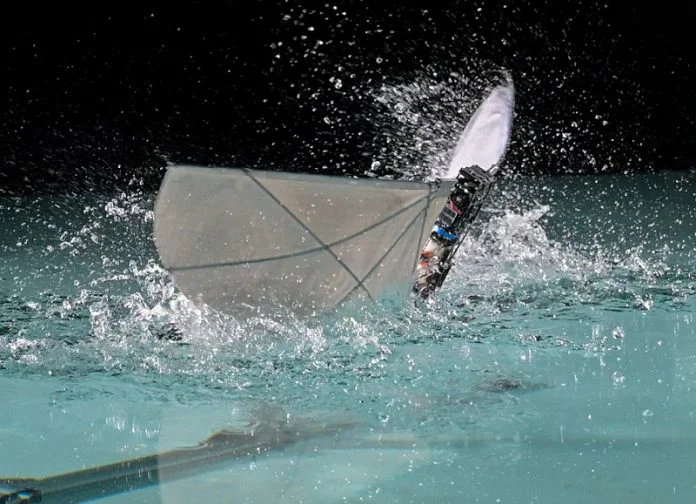
    Engineers have developed an extraordinary new robot capable of swimming underwater and then flapping its wings to take flight, mimicking some of the most skilled diving birds in nature. This innovative device could pave the way for safer, more cost-effective ocean research in the future.

    Constructed by researchers from the Massachusetts Institute of Technology (MIT) and the Swiss Federal Institute of Technology Lausanne (EPFL), the robot’s capabilities were detailed in the journal Science. Its design draws inspiration from birds like puffins, loons, gulls, and petrels—creatures that excel in both flying and diving. These birds effortlessly switch between soaring through the air and diving beneath the water to hunt for fish, then quickly returning to flight.

    Scientists aimed to unravel how these birds smoothly transition between such contrasting environments. Air is lightweight, whereas water is approximately 1,000 times denser. Achieving efficient movement in both mediums typically requires very different body mechanics.

    To explore this phenomenon, the team created a lightweight robot, weighing less than 300 grams—roughly the size of a small apple. It features a body, two flexible wings capable of up-and-down flapping, and a movable tail to steer its direction. Powered by a compact, waterproof electric motor and battery, the robot’s wings are coated with a water-repellent material that enables water to rapidly shed after surfacing. Additionally, the wings are interchangeable, allowing researchers to experiment with different sizes to find the most effective design.

    The team tested the robot initially in a lab water tank, then in Lake Geneva, Switzerland. During each trial, they submerged the robot about half a meter underwater. They adjusted wing size, flapping speed, and tail angle to observe how well it could swim upward, break the water’s surface, and then continue flying.

    After extensive testing, the researchers discovered that medium-sized wings delivered optimal performance. The wings needed a delicate balance of flexibility and stiffness; wings that were too soft failed to generate enough lift in the air, while overly stiff wings didn’t move efficiently underwater.

    While flapping at about five times per second, the robot swam nearly one meter each second. Once airborne, it flew at roughly six meters per second, maintaining a similar flapping rhythm. These motions closely mirror those of real diving birds.

    A surprising discovery was how the robot exited the water. Many birds, like ducks and puffins, push off the surface with their feet before flying away. The team anticipated similar paddling might be necessary for the robot. However, they found that angling the robot upward at approximately 70 degrees allowed its wings alone to generate enough lift to lift it out of the water, eliminating the need for paddling.

    This technology has the potential to revolutionize marine and aerial exploration. Future versions of these robots could fly over oceans, dive to collect water samples or measure environmental conditions, and then return with valuable data. They could also serve in inspecting ports, studying whale populations, monitoring coral reefs, or exploring hazardous regions such as icy waters near glaciers. Their ability to swiftly move through both air and water could enable more frequent and detailed data collection than traditional research vessels.

    The team is now working on enhancing the robot by designing wings capable of twisting during flight, similar to real bird wings. They also plan to test its performance in rough seas with strong winds and large waves.

    By mimicking the incredible adaptability of diving birds, engineers are making significant strides toward creating robots that can seamlessly explore both the air and the water with just one set of wings.

  • Maldives Suspends Luxury Vessel License Following Diver Deaths

    Maldives Suspends Luxury Vessel License Following Diver Deaths

    The Maldives has temporarily revoked the operating license of a luxury vessel following the tragic loss of five Italian tourists in the country’s most severe diving accident to date. Rescue operations have been ongoing for a third day to locate three individuals who did not return after a dive scheduled on Thursday. One of the victims’ bodies was recovered that same day.

    According to the University of Genoa, the victims included a marine biology professor, her daughter, and two young researchers. Government spokesperson Mohamed Hussain Shareef stated that an investigation has been initiated to determine why the group descended beyond the permitted depth of 30 meters (98 feet). One diver’s body was discovered in a cave at a depth of 60 meters (196 feet), but efforts to find the remaining three members of the group were unsuccessful on Friday.

    The Maldives’ Ministry of Tourism and Civil Aviation announced the indefinite suspension of the liveaboard vessel MV Duke of York’s license as the investigation continues. The vessel, a 36-meter luxury boat capable of accommodating up to 25 guests, is currently under scrutiny.

    Italy’s foreign ministry confirmed the deaths of all five of its nationals in the incident. The Maldives, a chain of 1,192 small coral islands scattered approximately 800 kilometers (about 500 miles) along the equator in the Indian Ocean, is renowned for its upscale resorts and dive sites that attract travelers from around the world. Although diving and water sports accidents are relatively uncommon in this South Asian nation, there have been a few fatal incidents reported in recent years.

  • How to Complete the Wakemaker in Subnautica 2

    How to Complete the Wakemaker in Subnautica 2

    The Wakemaker is an easy-to-find early game tool in Subnautica 2, mainly useful for exploration. It features built-in flashlights and provides a small speed boost to help you navigate Proteus’ oceans more smoothly. All three fragments needed to craft this device are located near your lifepod, making it accessible without requiring advanced tools or venturing into dangerous areas early on. However, you’ll need some silver to build it, so check out guides on where to find silver if you’re having trouble—it’s a common resource in the game.

    ### Where To Find All Three Wakemaker Fragments

    You can gather all three fragments within the first 10 minutes of starting a new game.

    #### First Wakemaker Fragment
    Start by facing approximately 15 degrees north/northeast from your lifepod. Follow the wire that runs along the seafloor. Head down into the cave just to the right of a wrecked structure, following the nearby jet stream to reach the caves below. Inside, locate a research station where the first fragment is stored inside a large container. Swim up to it and scan to collect the first part. Afterward, exit through the north cave entrance and proceed.

    #### Second Wakemaker Fragment
    Next, go to the large blooming plant that allows you to eat local flora and fauna—this is where you’ll find the second fragment. Just to the right of this station, you’ll see another research platform. Inside a box on the platform, you’ll find the second fragment.

    #### Third Wakemaker Fragment
    For the third fragment, return to the blooming plant and face roughly northwest—about 240 degrees—toward a large coral structure. Beneath this coral, the caves are rich with early game silver. Once near the structure, do a 360 spin and look into the cave entrance opposite the coral. Inside, behind desks and tables, there’s another box containing the third fragment.

    ### How To Craft A Wakemaker
    To craft a Wakemaker, you need to build a base with a functioning Fabricator. Once established, gather the following resources: grease, silver, a wiring kit, and a basic battery. Using the Fabricator, combine these materials to create the device.

  • How to Obtain the Habitat Builder in Subnautica 2: Solving & Completing

    How to Obtain the Habitat Builder in Subnautica 2: Solving & Completing

    Living underwater in Subnautica 2 isn’t very fun unless you have a base of your own. To do that, you need to find fragments for the Habitat Builder. This tool is essential for starting to build your dream underwater base, with tunnels, hatches, and grow beds.

    In Subnautica 2, you get tools by finding their fragments scattered around the environment and scanning them. Doing this unlocks the crafting recipe at your Fabricator, allowing you to build the tools. Below is a list of all the Habitat Builder fragments we’ve located so far, including the two easiest to find.

    All Habitat Builder Fragment Locations

    Welcome Center

    This is the easiest fragment to find, as it’s located right next to the entrance of the Welcome Center—your first large landmark south of your lifepod. Inside this area, you’ll also unlock your first passive skills, like a dash move and a way to preserve oxygen while standing still.

    Underneath the Welcome Center

    Another Habitat Builder fragment can be found beneath the Welcome Center. You’ll find it in the room with the main terminal, just drop where the oxygen suit is, and you’ll see it stored inside a small container.

    How to Craft a Habitat Builder

    To craft a Habitat Builder, you need to use your Fabricator at the lifepod. The materials required are quartz, copper, and a basic battery. Quartz is located inside large coral domes, while copper can be found in caves and under rocky openings.

    You can also find a basic battery at some research stations scattered around or craft one yourself using acid. Once you craft the Habitat Builder, you’ll unlock blueprints for simple structures like a corridor and hatch. Use these blueprints to establish your first base on Proteus and install a new Fabricator for more advanced crafting options.

  • How To Snorkel In InZoi: Complete Your Adventure and Solve the Mystery

    How To Snorkel In InZoi: Complete Your Adventure and Solve the Mystery

    Snorkeling in InZoi: The Island Getaway is one of the most relaxing ways to explore the game. The ocean is full of different marine creatures and surprises, but you won’t find them just by walking along the beach.

    Getting the right gear makes a big difference between an easy, enjoyable swim and one that quickly drains your energy. This guide will cover everything you need to start your underwater adventures so you can enjoy the sights and maybe even find some cool loot for your Zoi.

    ### How to Get Snorkel Equipment

    Snorkeling begins with getting the proper equipment. Head to the snorkeling stand at the beach; a good spot is near the middle of Barat Beach, on the right side of the Cahaya map.

    At the stand, you can rent a snorkeling set. You have options like the beginner set, diver set, or ocean pro set. If you’re new to the game, we suggest starting with the beginner set. Once you buy it, it will automatically appear in your inventory, ready to use.

    ### How to Snorkel

    Snorkeling involves swimming far out into the ocean to reach the Deep Sea area. You just need to walk past the beach into the water—no boat needed.

    Once you’re in the Deep Sea, select your Zoi and equip your snorkeling gear from your inventory. You can choose ‘Practice Snorkeling’ to improve your skills gradually or ‘Start Snorkeling with your equipment’ to fully experience the underwater wildlife. Practicing boosts your skill, while starting with your gear lets you collect sea life and enjoy the scenery. Keep in mind that swimming long distances uses your energy and stamina, so work on building these skills before trying for longer snorkel excursions.

    Be cautious of sharks and jellyfish, as both can seriously harm or even kill your Zoi.

    ### How to Sell Snorkel Items

    While exploring, you might collect various sea creatures, such as sea urchins, which go directly into your inventory without extra steps. To sell what you find, visit the Coin Exchange Kiosk in the Sri Lestari Resort, located just to the left of the info desk. You can sell your sea life there for coins.

    Coins earned can be exchanged for special resort-themed items at the same kiosk. Improving your swimming and snorkeling skills allows you to spend more time exploring the ocean and gathering items for your Zoi.