

Select Language:
Drones have become essential tools for photography, inspections, and package deliveries. They’re highly agile and capable of hovering in place, but their main drawback is their high energy consumption. The spinning propellers require continuous power, which limits their flight time.
In contrast, airplanes have an advantage: their fixed wings make them highly energy-efficient, allowing them to fly long distances with relatively minimal power. However, they cannot stay stationary in the air.
Now, researchers have developed a flying robot that harnesses the strengths of both systems. Scientists from the Max Planck Institute for Intelligent Systems and the University of Stuttgart introduced a shape-shifting drone named Floaty that can stay aloft without relying on propellers.
Inspired by birds like kestrels, which can seem to hover motionlessly by taking advantage of rising air currents and subtle wing adjustments, Floaty operates in a similar manner. Instead of motors producing lift, it uses rising air. The robot features four movable flaps on its upper side. By rotating these flaps, Floaty manipulates airflow around itself, which changes its air resistance and lets it control its position in the sky.
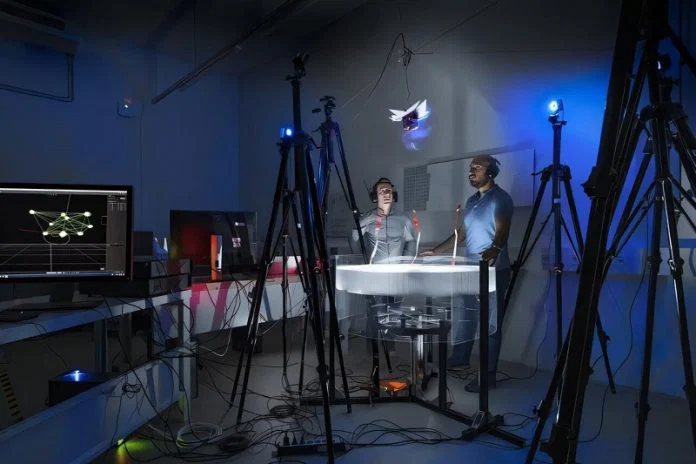
The team tested Floaty in a wind tunnel at speeds up to 10 meters per second, roughly 36 miles per hour. The robot managed to stay balanced even when subjected to side winds, and it could recover from disturbances caused by gusts or physical pushes.
To make this possible, the researchers trained Floaty using data collected from numerous wind tunnel tests. Over time, the robot developed an aerodynamic model to predict how flap movements influence its flight. This enables it to make precise adjustments and hover steadily in the air.
Creating Floaty was challenging initially. Early prototypes with flat designs were unstable and often tipped over sideways instead of correcting themselves. The team solved this by lowering the robot’s center of gravity, which made it less prone to flipping. They also redesigned the flaps with a carefully calculated bend, allowing Floaty to self-stabilize and regain balance during flight.
Scientists believe this technology could have many practical applications. For example, Floaty could inspect smokestacks in factories, where strong upward air currents are common. Similar concepts could help control rockets during reentry into Earth’s atmosphere or improve the efficiency of weather balloons.
Most notably, Floaty demonstrates that flying robots don’t necessarily have to rely on energy-intensive propellers. By learning to ride the wind like birds, future drones could stay airborne much longer while consuming significantly less power.
 ChatGPT
 Perplexity
 Gemini AI
 Grok AI
