الوسم: astrophysics

  • Moon Dust Unveils 100 Million Years of Stellar Explosions


    Chandra image of Cassiopeia A supernova remnant. Credit: NASA/CXC/SAO.

    The lunar surface may hold a surprisingly detailed record of ancient stars that exploded millions of years ago.

    Researchers have devised a new method to interpret this complex history, potentially turning moon dust into an astronomical archive detailing our solar system’s passage through the Milky Way.

    The study, led by Emily Costello from the University of Hawaiʻi at Mānoa, was published in *Physical Review Letters*.

    Massive stars end their lives in spectacular explosions known as supernovae, which release matter into space—including radioactive elements capable of traveling hundreds of light-years.

    Some of this radioactive debris eventually makes its way to Earth and the moon.

    While evidence of ancient supernovae has been previously found in deep-sea sediments on Earth, these layers typically only record events from about the past 10 million years. The moon’s preserved soil could reveal a much longer history.

    Costello suggests that lunar soil, or regolith, might contain evidence dating back 80 to 100 million years or even more.

    Deciphering this record is challenging because the lunar surface is constantly being reshaped.

    Unlike Earth, the moon lacks a thick atmosphere to shield it from space debris. Impacting meteoroids—ranging from tiny particles to sizable asteroids—continually collide with its surface. Over time, these impacts—referred to as “impact gardening”—disrupt and mix lunar material.

    This process means that radioactive substances deposited by supernovae don’t remain in distinct layers but are gradually redistributed through the soil.

    To address this, Costello and her team developed a mathematical model to reconstruct this tangled history. The model factors in multiple simultaneous processes: impacts that expose or bury material, soil compaction, radioactive decay, and modifications caused by space exposure.

    The model estimates when radioactive elements from specific supernova events arrived on the moon and predicts how they moved within the lunar soil over vast timescales.

    Previous studies have shown that supernovae occurring hundreds of light-years away sent radioactive particles toward our solar system about 2.3 million and 7.3 million years ago.

    To validate their model, scientists compared its predictions with actual measurements from lunar soil samples collected during the Apollo missions. The results closely matched observed patterns of radioactive isotope distribution at various depths.

    The model also accurately predicted the presence of iron-60, a radioactive isotope linked to supernova activity, in those lunar samples.

    Building on this, researchers projected how other rare radioactive elements—like plutonium-244, iodine-129, hafnium-182, and curium-247—could have been buried and diffused through the lunar soil over millions of years.

    This research holds particular significance as humanity prepares to explore the Moon further, with NASA’s Artemis program aiming to gather new samples, including deeper cores that might contain ancient material not yet accessible.

    By combining these upcoming samples with the new modeling techniques, scientists could trace supernova activity over tens of millions of years. Such insights might reveal when stars exploded and dispersed material across our solar system, offering clues about the paths of the sun, Earth, and Moon through the galaxy.

    In essence, ordinary moon dust could act as a time capsule, preserving the remains of stars that vanished millions of years ago.

    Source: KSR.
  • Astronomers Detect Magnetic Clues in the Universe’s Brightest Explosions

    Astronomers Detect Magnetic Clues in the Universe’s Brightest Explosions

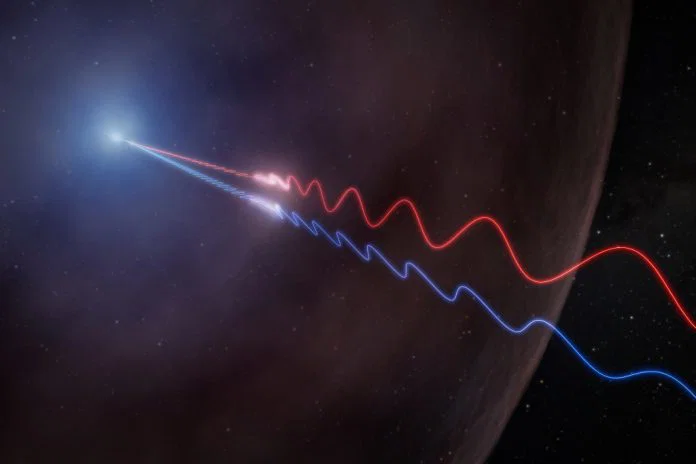
    Astronomers have made a significant breakthrough by detecting a hidden magnetic signal from one of the universe’s most intense explosions. Using the Very Large Array (VLA) radio telescope operated by the U.S. National Science Foundation, researchers observed polarized radio waves from a gamma-ray burst (GRB) for the very first time. They also identified a phenomenon called Faraday rotation within one of these events, providing scientists with a groundbreaking new method to study the powerful magnetic fields surrounding such phenomena.

    Led by scientists from the University of Arizona and the University of Utah, this research sheds new light on the extreme physics behind gamma-ray bursts, or GRBs. These bursts are the universe’s brightest and most energetic explosions, capable of releasing more energy in seconds than the Sun produces over billions of years. Scientists believe they originate when massive stars collapse at the end of their life cycles or during other catastrophic cosmic events, launching narrow, high-speed jets of particles traveling close to the speed of light. These jets often produce radio afterglows that can be visible for months following the initial explosion.

    While gamma-ray bursts have been studied for decades, measuring the magnetic fields around them proved challenging. Such magnetic fields are thought to play a crucial role in the formation and sustenance of the jets, but they have largely remained hidden until now. The burst studied, known as GRB 260310A, was relatively close to Earth compared to other cosmic events. Its radio afterglow was among the brightest observed in recent decades, offering a rare chance for detailed examination.

    When the VLA was pointed at the fading explosion, scientists discovered the radio waves were polarized, meaning the vibrations of the light waves primarily oscillated in a single direction—similar to how polarized sunglasses reduce glare by filtering polarized light reflecting off water. The significance increased when they observed that the polarization changed depending on the radio wavelength. This phenomenon, called Faraday rotation, occurs when polarized light passes through a cloud of charged particles threaded with magnetic fields, twisting the light’s polarization as it travels. This twisting provides valuable clues about the strength and structure of the magnetic fields along its path.

    Measurements indicated magnetic fields thousands of times stronger than what could be explained by the Milky Way or intergalactic space, pointing instead to a densely magnetized cloud of gas surrounding the star before it exploded. The researchers believe this was an HII region—a large bubble of ionized hydrogen created by intense ultraviolet radiation and stellar winds from young, massive stars. The presence of the burst within such an environment supports the idea that many gamma-ray bursts originate when the universe’s most massive stars reach the end of their lives.

    Previous efforts to detect polarization in gamma-ray bursts mostly focused on shorter radio wavelengths and had to be conducted very soon after the explosion before the afterglow faded. The new observations, however, demonstrate that longer radio wavelengths can also provide significant insights, including the first direct detection of Faraday rotation in a gamma-ray burst. Scientists anticipate that future observations using the VLA and other radio telescopes will enable detailed tracking of how magnetic fields around these bursts evolve over time.

    This advancement promises to deepen our understanding of how these colossal explosions generate energetic jets, disperse enormous amounts of energy, and influence some of the universe’s most extreme environments.

    Source: National Radio Astronomy Observatory.

  • Astronomers Discover Hidden Black Hole Amid 10 Million Stars

    Astronomers Discover Hidden Black Hole Amid 10 Million Stars

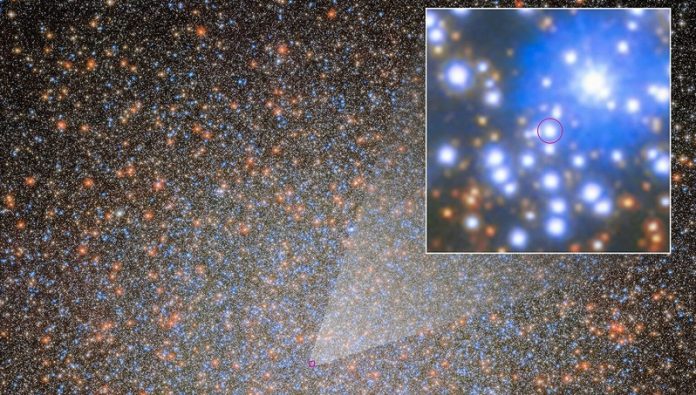
    Astronomers have identified the first stellar-mass black hole concealed within the massive star cluster Omega Centauri, helping to resolve a long-standing mystery among scientists. Situated roughly 18,000 light-years from Earth, Omega Centauri is the largest globular star cluster in the Milky Way, housing approximately 10 million stars tightly packed together.

    For years, scientists believed the cluster should also include thousands of black holes remaining from the remnants of massive stars that ended their lives in supernova explosions. Despite extensive searches, very few of these black holes had been detected—until now.

    Using over two decades of data from NASA’s Hubble Space Telescope combined with recent observations from the James Webb Space Telescope, researchers successfully identified this elusive black hole. Their work has been published in The Astrophysical Journal Letters.

    Previous studies suggested Omega Centauri hosts a large intermediate-mass black hole at its core. Furthermore, computer simulations predicted around 10,000 smaller black holes, each about the mass of a few suns, spread throughout the cluster. However, traditional detection methods—such as monitoring for radio or X-ray signals, or tracking stellar motion deviations caused by unseen companions—failed to reveal these black holes.

    Instead, the team employed astrometry, a method that precisely measures stars’ tiny motions across the sky. Tracking the movement of a specific star over 20 years revealed that it was orbiting an invisible object whose mass was too significant to be anything but a black hole.

    This newfound black hole, named oMEGACat BH-2, weighs approximately 4.5 times the Sun’s mass. While its mass confirms it as a black hole, it is surprisingly lighter than expected for a black hole formed in Omega Centauri’s metal-poor environment.

    The discovery also overturned previous assumptions that the unseen object was a neutron star. By combining Hubble’s observations from 2002 to 2023 with highly precise infrared data from Webb, scientists calculated its mass more accurately. At 4.46 solar masses, it’s simply too heavy to be a neutron star.

    This black hole exists in one of the most unusual binary systems ever observed. Its companion star orbits it approximately once every 94 years, making it the longest-period black hole binary known to date. Such a wide orbit suggests the pair was not born together but likely became companions through gravitational interactions within the crowded star cluster.

    Scientists estimate this pairing will likely break apart within less than a billion years, as close encounters with other stars eventually separate the two. Although a billion years may sound long, it is relatively brief compared to Omega Centauri’s estimated age of about 12 billion years.

    This discovery provides critical insights into how black holes form and behave within dense star environments. It also offers valuable information for understanding how black hole pairs can eventually collide, generating the gravitational waves detected by observatories on Earth.

    Researchers believe this is just the beginning. By continuing to leverage the combined capabilities of Hubble, Webb, and future missions like NASA’s Nancy Grace Roman Space Telescope, astronomers aim to uncover many more hidden black holes within globular clusters, filling in key gaps in our understanding of these mysterious cosmic objects.

  • Scientists find potential habitable super-Earth exoplanet

    Scientists find potential habitable super-Earth exoplanet

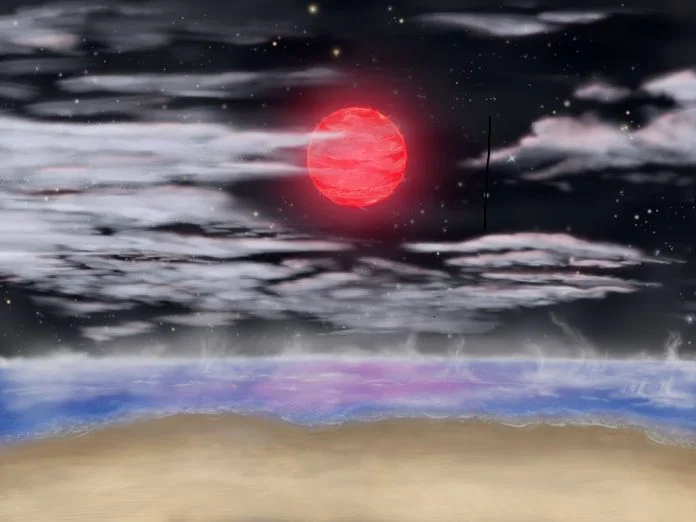
    A nearby planet that might support life appears to be more Earth-like than scientists initially believed. Recent observations indicate that GJ 3378b is smaller and rockier than previous estimates suggested, making it an even more intriguing candidate in the quest to find life beyond Earth.

    Located approximately 25 light-years away in the direction of the constellation Camelopardalis, GJ 3378b remains relatively close in astronomical terms. The planet orbits a small, cool red dwarf star, which makes it a compelling target for study.

    One major reason GJ 3378b has garnered attention is its position within the star’s “habitable zone,” the area around a star where conditions might permit liquid water to exist on a planet’s surface. Since all known life on Earth depends on water, scientists often prioritize planets found within these zones when searching for extraterrestrial life.

    “Our guiding principle is ‘follow the water,’” explained lead researcher Paul Robertson from the University of California, Irvine. The presence of liquid water increases the likelihood that a planet could host life.

    Red dwarf stars are significantly smaller, cooler, and dimmer than our Sun, and they are the most abundant stars in the Milky Way, accounting for about 70% of all stars. Because of their prevalence, astronomers consider them prime locations to hunt for potentially habitable planets.

    Detecting small planets around these faint stars isn’t straightforward. The research team employed the Habitable-zone Planet Finder, a sophisticated instrument attached to the Hobby-Eberly Telescope at the McDonald Observatory in Texas. This instrument is specially designed to detect infrared light, which is the dominant emission from red dwarf stars.

    Instead of observing the planet directly, scientists tracked the star’s subtle wobble caused by the planet’s gravitational pull. By measuring these tiny movements with high precision, they could refine estimates of the planet’s size and orbit.

    The updated findings reveal that GJ 3378b has a mass roughly 2.3 times that of Earth, significantly less than the previously estimated five times Earth’s mass. Smaller “Super Earths” like this are more likely to be rocky worlds, rather than thick, atmosphere-covered planets that are less conducive to life.

    Additionally, the planet completes an orbit around its star every 21 days, a shorter period than previously thought. Despite being closer to its star, the star’s cooler temperature means the planet remains within the habitable zone.

    Scientists remain cautious, though. Its proximity to the star could expose GJ 3378b to intense radiation, potentially stripping away its atmosphere over time—a key ingredient for life. Further observations are needed to determine whether the planet has managed to retain its atmosphere.

    Looking ahead, upcoming giant telescopes such as the Giant Magellan Telescope and the Extremely Large Telescope will offer much more detailed views of nearby exoplanets like GJ 3378b. Researchers hope these powerful observatories will eventually detect biosignatures—chemical indicators that could confirm the presence of life.

    For now, GJ 3378b stands out as one of the most promising nearby worlds in humanity’s ongoing effort to answer one of science’s biggest questions: are we alone in the universe?

  • Gravastars with Big Bang Cores: An Alternative to Black Holes

    Gravastars with Big Bang Cores: An Alternative to Black Holes

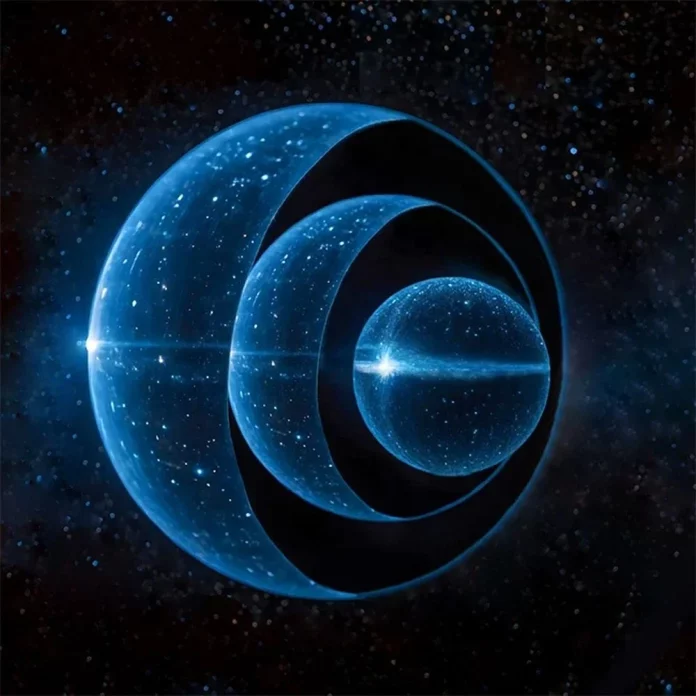
    The issue with stellar-mass black holes is that Einstein’s general relativity doesn’t fully explain their unusual nature. However, theoretical objects called gravastars, which serve as black hole alternatives, do not conflict with Einstein’s equations in the same way. Researchers have now proposed how they might form within the framework of Einstein’s theory. Credit: Daniel Jampolski and Luciano Rezzolla, Goethe University Frankfurt.

    Understanding how stellar-mass black holes form is a fundamental aspect of astrophysics. When a star significantly larger than our Sun exhausts its nuclear fuel, the pressure generated by fusion diminishes. Eventually, this outward force can no longer counterbalance the inward pull of gravity, causing the star to collapse inward, resulting in a point known as a singularity—creating a black hole.

    This classic scenario, however, faces a significant problem. General relativity (GR) accurately describes the process up until the moment a singularity is formed. Post-collapse, questions arise: how can so much mass be concentrated into an infinitely small point? How does spacetime bend infinitely? GR offers no answers at this stage.

    This is where Einstein’s theory begins to break down. It doesn’t mean GR is invalid elsewhere; rather, in this context, it ceases to provide a complete explanation. The quest for a theory of quantum gravity is aimed at addressing these limitations.

    Recent research indicates that Einstein’s equations might still reliably describe the collapse process. Instead of forming a traditional black hole, a collapsing star could produce a different kind of compact object called a gravastar. These objects mimic black holes but avoid some of the problematic aspects of traditional models.

    The research, titled “Formation of gravastars,” is published in Physical Review D. The authors, Daniel Jampolski and Luciano Rezzolla of Goethe University Frankfurt, explore these possibilities.

    Black holes are usually categorized into two main types: standard black holes, which feature an event horizon surrounding a singularity, and so-called “regular black holes,” which are modified versions with no singularity. Instead, they have well-behaved interiors where spacetime curvature remains finite, avoiding some of the issues associated with standard black holes.

    Regular black holes still have an event horizon, but they don’t contain the singularities that challenge GR’s limits. However, their existence introduces the black hole information paradox, which raises questions about the fate of information that crosses the event horizon.

    Enter gravastars—hypothetically horizonless objects that look a lot like black holes in their extreme compactness but do not violate GR. They are ultra-dense stars with outer layers composed of normal matter, while their interiors are filled with dark energy. This dark energy exerts an outward pressure that stabilizes the structure.

    Physicists see gravastars as more consistent solutions since they don’t contain singularities or event horizons, sidestepping some paradoxes. But how do such objects form? The authors note that, although mathematically plausible, the formation mechanisms remain largely speculative. A key challenge is understanding the dynamics that could lead to their creation.

    By solving Einstein’s equations, Jampolski and Rezzolla have proposed a scenario where a mini-universe forms inside a collapsing star, similar to the conditions at the universe’s birth during the Big Bang. In their model, dark energy inside the star keeps the collapse from reaching a singularity, resulting instead in a stable gravastar.

    Surprisingly, Jampolski stumbled upon this solution during his master’s thesis, guided by Rezzolla. The concept is that the universe’s early explosion could occur in a similarly compressed state, giving rise to new structures when matter is extremely dense.

    Rezzolla emphasizes that exploring alternatives to black holes isn’t a sign of skepticism; rather, it’s a way to broaden our understanding. Black holes remain the simplest and most accepted explanation for gravitational collapse, but science benefits from remaining open-minded about other possibilities. History has shown that what seems exotic today can become accepted tomorrow.

    However, the proposed model faces hurdles. It requires precise fine-tuning—such as perfect uniformity and pressureless conditions within the collapsing sphere—conditions unlikely to be perfectly met in reality. Moreover, while the model predicts a static equilibrium, the gravastar’s shell could still be unstable to minor disturbances, like stray photons, which might cause it to collapse into a traditional black hole once again.

    If that happens, the gravastar’s existence becomes fleeting—more an intermediate state during black hole formation than a distinct object. The real observational challenge is distinguishing gravastars from standard black holes, which remains an open question.

    Ultimately, future research must focus on how to detect and tell these objects apart, if they exist at all. Many questions remain unanswered, waiting to be explored.

    Written by Evan Gough for Universe Today.

  • Astronomers find the oldest flickering black hole ever detected

    Astronomers find the oldest flickering black hole ever detected

    A groundbreaking discovery has revealed the earliest flickering quasar, a luminous object powered by a supermassive black hole. This finding is shedding light on how massive black holes formed so rapidly in the universe’s infancy.

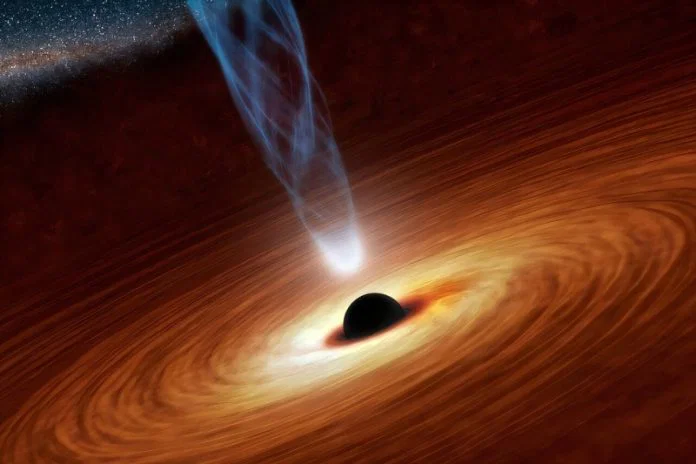
    Nearly every galaxy, including the Milky Way, hosts a supermassive black hole at its core. When these black holes actively draw in gas and dust, the material spirals inward, forming a rotating accretion disk. As the gas heats up, it releases enormous energy, producing some of the universe’s brightest entities known as quasars.

    Researchers from MIT and other institutions identified a quasar that existed just 850 million years after the Big Bang, making it the earliest flickering quasar ever observed. While many quasars from the early universe have been detected before, this is the first showing brightness variations or “flickering” over time.

    This flickering offers valuable insights into the activities near the black hole. Similar to how a candle flame flickers due to air currents, a quasar’s brightness fluctuates when the inflow of gas into the black hole varies. Analyzing these changes allowed scientists to infer the shape of the quasar’s accretion disk — a swirling ring of gas and dust fueling the black hole.

    Surprisingly, the researchers found that this ancient accretion disk was very thin and flat, resembling those around mature black holes observed today. This challenges existing ideas that early black holes should have had thick, unstable, and chaotic disks due to rapid growth.

    This discovery raises intriguing questions about black hole development. Traditionally, it was thought that young black holes in the early universe would have messy, turbulent surroundings. Yet, this early black hole appears to have already settled into a stable structure despite the universe still being very young.

    The findings contribute to the ongoing mystery of how supermassive black holes grew so colossal so quickly after the Big Bang. Some of these black holes were already billions of times the Sun’s mass when the universe was less than a billion years old.

    The team analyzed 14 years of infrared observations from NASA’s NEOWISE mission. Because the quasar’s light has been stretched into infrared wavelengths over cosmic distances, this data allowed scientists to monitor its brightness variations over time. They determined the quasar shines with energy equivalent to about 12 trillion suns and exhibits brightness fluctuations of approximately 20%, equal to about 2 trillion suns.

    By examining the flickering at different wavelengths, scientists mapped the temperature of the material surrounding the black hole, revealing the structure of the accretion disk. Their results indicate that the same feeding mechanisms seen around black holes today were already in place in the universe’s earliest quasars.

    Looking ahead, researchers hope to identify even younger quasars to understand what occurred before these black holes reached such advanced stages. Future discoveries might finally unravel how the first supermassive black holes formed and expanded so swiftly in the universe’s early days.

  • What occurs when a star nears a black hole?

    What occurs when a star nears a black hole?

    Supermassive black holes are some of the most mysterious entities in the universe. They weigh millions to billions of times more than our Sun and are usually found at the centers of large galaxies. The black hole at the core of the Milky Way, Sagittarius A*, has about four million solar masses. Since black holes don’t emit light, astronomers can only detect them indirectly by observing how they influence nearby stars and gas.

    In a recent study published in The Astrophysical Journal Letters, Eric Coughlin, an assistant professor of physics at Syracuse University, along with colleagues, explains what occurs when a star ventures too close to a black hole and gets torn apart. Instead of vanishing instantly, the star is stretched into a long, thin stream of debris by the black hole’s gravity. Over time, this debris wraps around the black hole—a process driven by Einstein’s General Theory of Relativity, as classical Newtonian gravity doesn’t produce this effect. When parts of this debris stream collide, they release a burst of energy, causing some material to spiral inward and be absorbed by the black hole. These events generate intense radiation, briefly outshining the entire galaxy, which can contain roughly a trillion suns in brightness.

    Such events are called tidal disruption events, or TDEs. They provide a rare window into studying supermassive black holes like Sagittarius A* in other galaxies. “Studying TDEs gives us a chance to learn more about these hidden black holes,” Coughlin explains.

    TDEs have long intrigued scientists because each flare is like a unique signature. By analyzing how the brightness rises, peaks, and diminishes, researchers can infer properties such as the black hole’s mass and spin. However, understanding exactly how these flares form has been challenging due to the complexity of accurately simulating the processes involved.

    This is changing thanks to advanced high-resolution simulations. A team led by Lucio Mayer at the University of Zurich, including Coughlin, utilized a technique called smoothed particle hydrodynamics. This method models the star as a collection of particles that interact hydrodynamically, governed by the Navier-Stokes equations—the same principles describing water flow.

    Using tens of billions of particles, the team captured the detailed behavior of the disrupted star’s gas for the first time. Their findings reveal that instead of dispersing chaotically, the debris tends to form a narrow, coherent stream that follows a predictable orbital path around the black hole before ultimately crashing into itself. This confirms a long-standing theoretical prediction. Earlier, lower-resolution simulations often misrepresented the stream’s structure, showing a more chaotic spread and overestimating fluid dissipation.

    By deploying powerful supercomputers and leveraging graphics processing units (GPUs), the team achieved a much clearer view of the debris stream’s shape and behavior. Their models also uncovered the influence of black hole properties—specifically, its mass, spin rate, and the orientation of that spin relative to the debris’ orbital plane. These factors can affect the timing, brightness, and duration of the resulting flare.

    If the black hole is rotating, it causes additional distortions in spacetime, leading to an effect known as “nodal precession”—which can cause the debris stream to shift out of its initial plane. This shifting can delay when the flare begins, as the debris misses self-collision points, possibly causing multiple orbit crossings before a collision actually occurs. Such complexities might explain why observed TDEs vary so much—some flare up quickly and fade fast, others unfold more slowly, and some display behavior that’s hard to classify.

    While the mass of the black hole may account for some of this diversity, the new simulations suggest that the black hole’s spin could play a major role. TDEs turn otherwise invisible black holes into observable phenomena—stars are torn apart, debris collides and emits light, revealing the black hole’s hidden presence. With improved simulations and more advanced telescopes, astronomers are becoming better equipped to interpret these signals with greater clarity.

  • How Dark Matter Might Have Spawned Early Massive Black Holes After the Big Bang

    How Dark Matter Might Have Spawned Early Massive Black Holes After the Big Bang

    Astronomers have long been intrigued by the presence of massive black holes in the early universe. Some of these black holes, discovered less than a billion years after the Big Bang, are as large as a billion times the mass of our Sun. Traditional theories suggest there wasn’t enough time for these giants to form through standard growth processes. However, a recent study offers a potential explanation involving dark matter.

    Led by researchers at the University of California, Riverside, the study proposes that a gradual “decay” of dark matter particles might have created favorable conditions for rapid black hole formation. This research was published in the Journal of Cosmology and Astroparticle Physics.

    Dark matter, which accounts for approximately 85% of all the matter in the universe, remains one of science’s greatest mysteries. It doesn’t emit or reflect light, making it invisible to telescopes. Yet, its gravitational pull influences galaxy formation and the large-scale structure of the cosmos. In this new investigation, scientists examined what could happen if dark matter particles slowly release tiny amounts of energy as they decay over time.

    While each particle would emit an incredibly small amount of energy—far too little to influence everyday devices—this energy might have had a significant impact in the early universe. At that time, galaxies primarily consisted of simple hydrogen gas, which is highly responsive to even minimal energy changes.

    Typically, this hydrogen gas cools and forms stars. The researchers found that if the decay of dark matter adds just enough energy, it can alter the gas chemistry in a way that hinders star formation. Instead, large amounts of gas could directly collapse into black holes—a process known as “direct collapse”—which accelerates the formation of black holes far beyond the normal timeline.

    The discovery of unexpectedly large black holes by the James Webb Space Telescope in the early universe has challenged traditional models. The new research suggests that dark matter decay could have increased the frequency of direct collapse events, helping to explain these observations.

    Using sophisticated computer simulations, the team analyzed how gas would behave under the influence of decaying dark matter. They identified specific ranges of dark matter particle masses that could produce the ideal conditions for direct collapse, adding an important piece to the puzzle of how the first galaxies and black holes emerged.

    This idea also bridges different areas of physics, linking cosmology and particle physics. It demonstrates how tiny effects at the atomic level could have driven the evolution of the universe as a whole.

    Though further research is necessary to confirm this hypothesis, the findings present a compelling new perspective on one of astronomy’s most profound mysteries. If proven correct, it would mean that dark matter not only shaped galaxies through gravity but also directly contributed to the creation of some of the universe’s earliest and most massive objects.

  • Hubble Sees Rogue Black Hole Consuming A Star

    Hubble Sees Rogue Black Hole Consuming A Star

    Black holes are the voracious giants of the universe; incredibly dense entities capable of drawing in everything that comes too close, ultimately leading to its consumption. Recently, astronomers utilizing the Hubble Space Telescope witnessed a black hole actively consuming a star, tearing it apart and emitting a massive burst of radiation.

    This radiation release, known as a tidal disruption event (TDE), enabled the scientists to pinpoint the black hole. The TDE designated AT2024tvd was especially intriguing for a unique reason: while most supermassive black holes reside at the centers of galaxies, this one is a nomadic outlier.

    “Typically, one anticipates locating massive black holes at the core of galaxies, like Sagittarius A* in the Milky Way,” noted lead researcher Yuhan Yao from UC Berkeley. “That’s where tidal disruption events are usually sought. However, this black hole is not at the center; it’s located approximately 2,600 light years away. This marks the first optically identified off-nuclear TDE.”

    In addition to Hubble, researchers employed various instruments, including NASA’s Chandra X-Ray Observatory and the NRAO Very Large Array telescope, to study the TDE depicted above.

    The black hole often starts as a discreet figure in the cosmos, but when a star ventures too close, it succumbs to the black hole’s gravitational pull and becomes extended, or “spaghettified,” into a long shape. This results in a disk-like formation of debris around the black hole, which rapidly spirals in, generating a burst of radiation detectable from Earth — indicating that the black hole defies typical central placement within galaxies.

    Interestingly, this galaxy houses not just one, but two supermassive black holes: one at the core and another wandering nearby. This phenomenon is believed to arise when two smaller galaxies collide and amalgamate, forming a larger galaxy.

    “Massive black holes are generally positioned at the centers of galaxies, but galaxies do merge — this is a fundamental process in their growth. When two galaxies merge, they can host multiple black holes,” said co-author Ryan Chornock, also from UC Berkeley. “What happens next? While we anticipate they will eventually merge, theorists have postulated a population of black holes that roam within galaxies.”

    The researchers speculate that these two supermassive black holes may eventually combine, resulting in a cataclysmic event powerful enough to produce gravitational waves that could be detected from our planet.

    The study will be published in The Astrophysical Journal Letters.

  • James Webb Sees Dying Star Forming Cosmic Hourglass

    James Webb Sees Dying Star Forming Cosmic Hourglass

    This intriguing image might resemble a dividing cell or even a brain, but it’s neither of those. In reality, it’s a space nebula situated 1,500 light-years away, affectionately dubbed the Crystal Ball Nebula, or more formally known as NGC 1514. The captivating form of this celestial object was shaped by the dramatic life cycle of a dying star.

    The James Webb Space Telescope has captured this remarkable image, revealing the nebula’s features in unprecedented detail. Before this, the nebula was observed in 2010 by researcher Mike Ressler of NASA’s Jet Propulsion Laboratory using a NASA telescope called the Wide-field Infrared Survey Explorer (WISE). Recently, Ressler revisited the nebula with the advanced capabilities of Webb’s Mid-Infrared Instrument (MIRI), which unveiled a series of fuzzy rings visible only in infrared wavelengths, alongside some voids nearer to the center of the nebula.

    “Before Webb, we weren’t able to detect most of this material, let alone observe it so clearly,” Ressler remarked. “With MIRI’s data, we can now comprehensively examine the turbulent nature of this nebula.”

    The unusual shape of this nebula is the result of a binary star system at its core. One star in this pair exhausted its fuel, expanded, and expelled layers of gas and dust, eventually leaving behind a hot core known as a white dwarf. This white dwarf emits fast, faint emissions of material called stellar winds, influencing the surrounding material. Researchers believe that this stellar wind, interacting with the other star in the pair, is responsible for the distinctive hourglass shape and the formation of the two bright rings.

    “When this star was at its peak of losing material, the companion could have gotten very, very close,” explained David Jones from the Institute of Astrophysics in the Canary Islands, who has been studying this system. “Such interactions can produce unexpected shapes, leading to these rings instead of a simple spherical structure.”

    Thanks to Webb’s observations, it’s clear that the rings are not solid; they have a fuzzy appearance and vary in thickness. “We believe the rings are primarily composed of very tiny dust particles,” Ressler noted. “When these grains are illuminated by ultraviolet light from the white dwarf, they heat slightly, making them detectable by Webb in mid-infrared wavelengths.”

  • NASA Reveals Innovative LISA Prototype for Gravitational Wave Detection

    NASA Reveals Innovative LISA Prototype for Gravitational Wave Detection

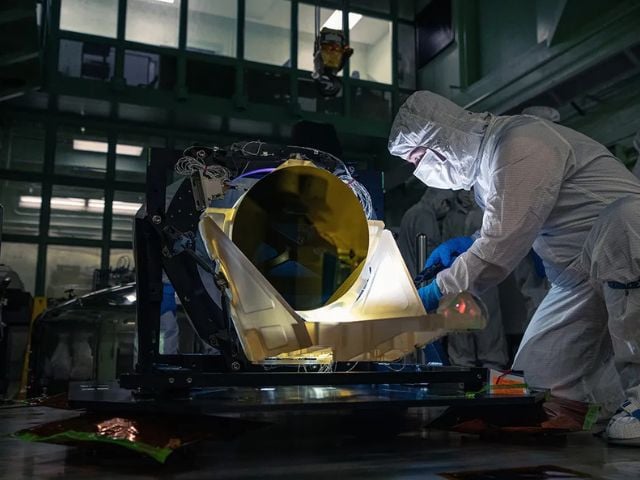
    NASA has introduced an exciting preview of a full-sized prototype for a series of six telescopes that will facilitate the detection of gravitational waves from space in the coming decade. This initiative, called the Laser Interferometer Space Antenna (LISA), represents a partnership with the European Space Agency (ESA).

    Gravitational waves are distortions in the fabric of space-time, triggered by dramatic cosmic events like the merging of black holes. LISA’s mission is to identify these waves by employing lasers to measure minute changes in distance—precisely down to picometers, which are one-trillionth of a meter—between three spacecraft arranged in a triangular setup. Each side of this extensive arrangement will stretch nearly 1.6 million miles (or about 2.5 million kilometers).

    According to Ryan DeRosa, a researcher at NASA’s Goddard Space Flight Center, “Each spacecraft will host twin telescopes that will both send and receive infrared laser beams to monitor their counterparts.” NASA is responsible for providing all six telescopes for the LISA mission.

    The prototype, referred to as the Engineering Development Unit Telescope, will play a crucial role in the development of the flight hardware. It was subjected to a thorough inspection after delivery in a darkened clean room at NASA Goddard in May. The telescope is crafted from a unique amber-colored glass-ceramic that retains its shape across a wide range of temperatures, and its mirror is coated with gold.

    This innovative design not only enhances the reflection of infrared lasers but also minimizes heat loss in the frigid environment of space, allowing the telescope to function effectively at temperatures close to that of a typical room. Produced by L3Harris Technologies in Rochester, New York, the Engineering Development Unit Telescope exemplifies significant advances in material technology.

    Its primary mirror is composed of Zerodur, another amber-hued glass-ceramic renowned for its stability and precision. The LISA mission is expected to launch in the mid-2030s, paving the way for revolutionary discoveries in the field of astrophysics.