
Select Language:
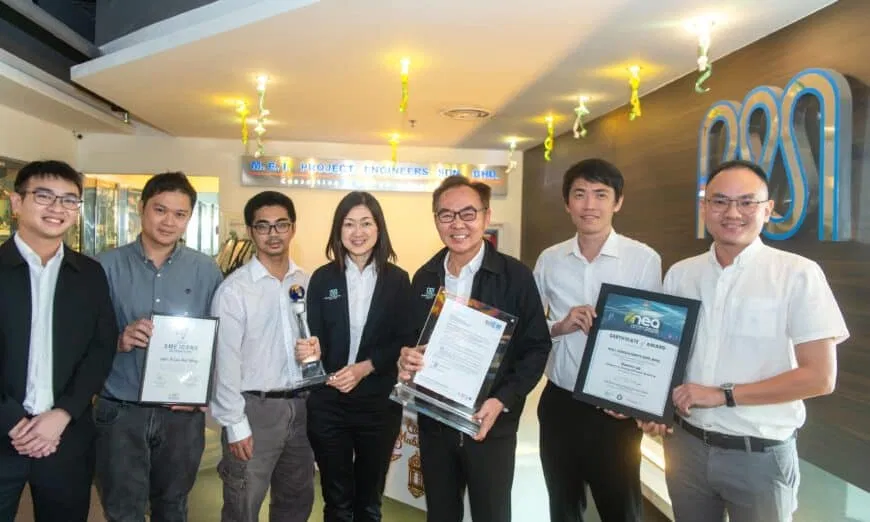
Chinese manufacturers are increasingly viewing Malaysia as a manufacturing hub rather than just a sales market. They are bringing their own design teams and contractors, while relying on local partners to adapt projects to Malaysian regulations and operational conditions, according to Dato’ Seri Lim Kok Khong, managing director of M.E.I. Project Engineers Sdn. Bhd.
As more manufacturing capacity shifts overseas, companies expanding into Malaysia require assistance with navigating local laws, approval processes, supply chain logistics, and cultural practices—roles that local architecture, engineering, and project management firms are becoming more adept at fulfilling, said Lim.
Founded in 1988, M.E.I. has designed and overseen manufacturing projects across Malaysia, including aerospace facilities in Kedah, food production plants in Johor, and semiconductor projects throughout the country’s industrial zones. Chinese companies have become one of the firm’s fastest-growing client groups, driven by increasing outbound investments from China.
In 2023, China was the top source of approved manufacturing investments in Malaysia, and Chinese firms continue to expand their industrial footprint across various Malaysian states. As manufacturing moves abroad, local expertise is playing an increasingly critical role for businesses seeking sustainable operations.
Chinese manufacturers generally arrive with substantial experience in factory design and construction but are less familiar with Malaysia’s specific regulatory requirements, site conditions, approval procedures, local materials, and government agencies. M.E.I.’s job is to bridge this knowledge gap.
Many Chinese design institutes complete about 30 to 60 percent of a project’s initial design before entering Malaysia. M.E.I. then localizes those plans by ensuring compliance with Malaysian regulations, replacing imported materials with locally available options when possible, and designing facilities suitable for operation and maintenance by local teams. In some instances, Chinese designers collaborate directly with M.E.I. engineers within the firm’s offices.
Lim’s understanding of China predates this wave of investment; he worked on architecture and engineering projects in Shanghai during the 1980s, giving him a deeper insight into how Chinese builders and designers operate compared to many local professionals.
This experience influences M.E.I.’s approach to Chinese clients. “We went there to learn from them, too,” Lim said, referring to the Chinese design teams the company has partnered with. Observing their successes and mistakes has helped M.E.I. enhance its project delivery.
Cultural understanding is now a key part of their value proposition. Chinese investors often prioritize relationships and mutual obligations, with cost as a major consideration. In contrast, American clients tend to emphasize detailed documentation and strict compliance, including policies against gifts and mandatory transaction declarations. Korean and Japanese companies usually fall somewhere in between.
A local firm capable of navigating these diverse business cultures and drafting multilingual contracts enforceable under Malaysian law can help foreign investors reduce compliance and operational risks, Lim added.
M.E.I.’s Chinese clients span multiple industries and regions. For example, sensor manufacturer Trensor, which established its first overseas production facility at Penang Technology Park, engaged M.E.I. as its local architect and engineering consultant.
Another client, Rianlon Corporation based in Tianjin, broke ground in January 2026 on a MYR 1.27 billion (USD 306.2 million) R&D and manufacturing complex in Johor—its first major integrated facility outside China.
In many projects, M.E.I. works alongside Chinese design institutes, providing local expertise that incoming project teams might find challenging to replicate quickly. Lim notes that navigating host-country industrial policies can be more complex than actually building the factory. Despite delays, the business relationships remain strong. For instance, a Chinese automaker sponsored a visit by M.E.I. staff to its facilities in China, emphasizing that “spending is an investment.”
Chinese investors have also evolved significantly over the past decade. Early entrants primarily competed on cost and short-term gains, while today’s investors focus more on quality, scale, and long-term commitment.
“They’re here to stay, not just to make quick profits,” Lim said, explaining that many now view Malaysia as a platform for serving global markets, not just the domestic one.
Keeping its role as a trusted local partner requires M.E.I. to adapt alongside market shifts and customer needs. Malaysia’s construction sector has traditionally depended on low-cost migrant labor—initially from China, then Indonesia and the Philippines, and more recently from Nepal and Bangladesh—but this model is becoming less sustainable.
“Malaysia needs to advance from one stage to the next,” Lim said, noting that the industry is no longer simply labor-intensive. The company is investing in building information modeling (BIM) and AI-assisted design technologies, but Lim remains cautious about over-relying on automation.
“AI can make mistakes, too,” he said. “As engineers with experience, we know how to recognize and correct those errors.”
M.E.I. is also expanding its talent pipeline through internship programs with Malaysian universities and Japan’s Toyohashi University of Technology. Lim believes practical hands-on experience is just as important as academic learning, following the principle that “three years of practical experience equals three years of further study.”
For sectors where Malaysia still lacks deep expertise—such as upstream chemicals, oil and gas, and large infrastructure projects like long-span bridges—Lim advocates collaboration with foreign companies, including Chinese firms, rather than direct competition. The key differentiator for a capable local partner is many years of experience navigating Malaysia’s complex regulatory environment, supply chains, and business culture—capabilities that cannot be quickly replicated by new entrants. Firms like M.E.I. are expected to remain vital as Malaysia progresses into its next phase of industrial growth.
 ChatGPT
 Perplexity
 Gemini AI
 Grok AI