
Select Language:
The rapid growth of domestic new energy vehicles has significantly reshaped China’s parallel-import car market. Once, luxury imported vehicles with markups reaching hundreds of thousands of yuan dominated dealer inventories, but now they are facing declining sales.
This decline is especially noticeable at Tianjin Port, which used to be China’s largest hub for parallel imports. In this market model, independent dealers bring in authentic vehicles outside official manufacturer distribution channels, often offering lower prices and models unavailable through authorized dealers. At its peak, over 130,000 units were imported annually, but current estimates for this year’s sales are just over 10,000 vehicles—about 90% lower than peak levels.
The overall trend reflects a broader slowdown in China’s imported car sector. Two Tianjin-based import dealership owners told us that waning demand and international logistics disruptions have drastically cut business volumes. In 2024, the Tianjin Parallel Import Automobile Circulation Association stopped publicly releasing import statistics amid the declining market. Its last data in 2023 listed nearly 45,920 declared parallel-import vehicles and nearly 39,300 units sold.
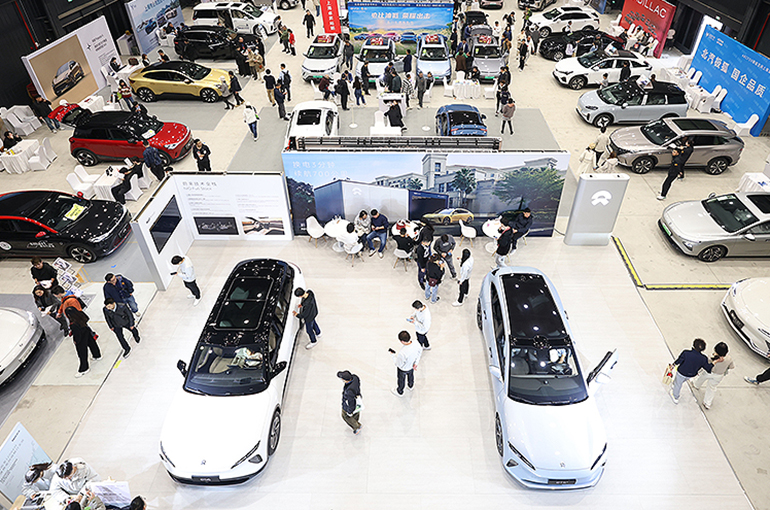
This shift corresponds with the swift adoption of domestically produced NEVs, which have increasingly replaced imported luxury cars as symbols of status among Chinese consumers. Many former import dealers are redirecting their efforts toward exporting vehicles, leveraging overseas networks developed over years in the import business to sell Chinese-made vehicles internationally.
Visiting Tianjin Port recently, we saw that even Senyang International Automobile City—once the largest parallel-import vehicle trading center in the region—struggles to operate normally.
According to industry data, passenger vehicle imports dropped 33% year-over-year to about 27,000 units in April. Luxury brands saw even steeper declines: Audi imports fell by 64%, Volvo by 62%, and Porsche by nearly 46%.
From cash-rich mine owners to empty showrooms
The market landscape has dramatically changed since 2017. Back then, Japanese SUVs like the Toyota Land Cruiser Prado, Toyota Land Cruiser, and Nissan Patrol were among the most desired imported models.
Many buyers came from resource-rich regions such as Shanxi, Shaanxi, and Inner Mongolia. One dealer recalled that customers often arrived with millions of yuan in cash to place orders. These vehicles’ durability and premium image made them particularly popular among mine owners and wealthy entrepreneurs.
A wholesaler recounted that his biggest deal involved importing 3,000 Toyota Land Cruiser Prados from Dubai and reselling them at profit margins across China. Despite a decline starting in 2018, many insiders initially saw it as a temporary cycle. It wasn’t until late 2023 that it became clear the entire industry was in decline, according to Zhang Fangcheng, head of a local dealership.
The wholesaler who had previously sourced Toyota vehicles from Dubai said that dealership closures accelerated, and companies drastically cut their staff. His firm, once employing over 300 people, now operates with just over 30 employees.
The rise of domestic NEVs parallels the decline of imported luxury models
The decline of imported high-end vehicles is linked to the rapid rise of domestic NEVs.
“Before 2023, people around me still asked what a Land Cruiser cost at Tianjin Port. By the end of 2023, they were asking if you had switched to an NEV,” said an industry insider.
Consumer perceptions have shifted too. Another dealer noted, “Driving a Land Cruiser 5.7 used to be a status symbol. Today, driving a domestic NEV worth several hundred thousand yuan feels just as prestigious as driving an imported car priced over a million yuan.”
Zhang mentioned that many friends and industry peers once upgraded to ever more expensive imported vehicles, but most in recent years have opted for domestic NEVs when replacing their cars. He himself bought a domestic NEV SUV in 2023, and many around him followed suit.
Furthermore, a growing number of former parallel-import dealers are now focusing on exporting Chinese-made vehicles to Central Asia, Russia, Africa, the Middle East, and Southeast Asia. The distribution channels and business relationships built over years in the import trade are now supporting the overseas expansion of Chinese automakers.
Zhang’s company has fully transitioned to exporting Chinese vehicles. He hopes to leverage the networks developed over 15 years in import trade to bolster China’s auto industry on the global stage.
For Tianjin Port, this shift signals a new chapter—from being a key indicator of China’s imported luxury vehicle market to serving as a major gateway for exporting Chinese-made vehicles.
Pointing to rows of Chinese-made cars awaiting shipment abroad, Zhang said, “Now it’s their turn to go global.”
 ChatGPT
 Perplexity
 Gemini AI
 Grok AI